Newcastle Plumbing · Plumbing, hot water and gas · Newcastle and the Hunter, NSW
Newcastle Plumbing: 18% of Google Ads clicks became calls or forms
Newcastle Plumbing turned 18% of its Google Ads clicks into calls and web forms in the first six days of ads. That is more than one in six clicks. Ads aimed at searches naming a local town turned clicks into enquiries at 1.8 times the rate of service ads, most web forms were sent in the evening or overnight, and 84% of clicks came from phones.
Services
Google Ads management · Enquiry tracking and reporting · Landing pages on the client's website
Each figure names the window it covers. Use the info button on a tile to see how it was measured.
Headline result
18%
Google Ads clicks that became an enquiry, by phone call or web form
First six days of Google Ads
How it was measured
Enquiries traced to Google Ads (tracked calls and web forms, test entries removed, each person counted once) divided by Google Ads clicks over the same days. Rounded down. The six days start on the first day the ads ran and are complete days only.
1.8×
Enquiry rate from town ads compared with service ads
First six days of Google Ads
How it was measured
Enquiries traced to the town campaign divided by that campaign's clicks, compared with the same for the service campaign over the same days. Rounded down to one decimal.
61%
Web forms sent between 5pm and 7am
First six days of Google Ads
How it was measured
Web-form enquiries from Google Ads sent between 5pm and 7am Sydney time, as a share of all web-form enquiries from Google Ads over the same days. Rounded down.
84%
Google Ads clicks made on a phone
First six days of Google Ads
How it was measured
Google Ads clicks on mobile phones as a share of all Google Ads clicks over the same days, as reported by Google Ads. Rounded down.
10%
Click-through rate: times an ad was shown that ended in a click
First six days of Google Ads
How it was measured
Google Ads clicks divided by ad impressions over the same days. Rounded down.
How we measured +
The window is the first six days of Google Ads: six complete days counted from the first day the ads ran, in Sydney time, which is also the account's time zone. Enquiries are tracked phone calls and web forms traced to Google Ads, with test entries made while the website was being checked removed; a person who got in touch more than once is counted once, at their first contact, and a web form sent without an ad click is left out. Calls are counted as the tracked numbers logged them, which is connected calls only, so very short or unanswered calls do not appear and the enquiry rate errs on the low side. The enquiry rate is enquiries divided by Google Ads clicks over the same days. Clicks, impressions, devices and the hour of each click are as reported by Google Ads; the device of an enquiry is the device of the ad click behind it. The town campaign targets searches naming a suburb or town; regions follow the six regions on the client's website. Whether a search named a place uses the search the customer typed where it was recorded, and the ad's matched search phrase otherwise. Service groups follow the job each ad group was written for. Won-job values are not part of this study, which reports enquiry ratios only. All percentages are rounded down. The figures rest on a small number of enquiries from a new account, so they will move as more weeks come in.
In one minute
The 60-second version
Newcastle Plumbing, from the brief to the result in 5 short slides.
01 The business
A local plumber for Newcastle and the Hunter
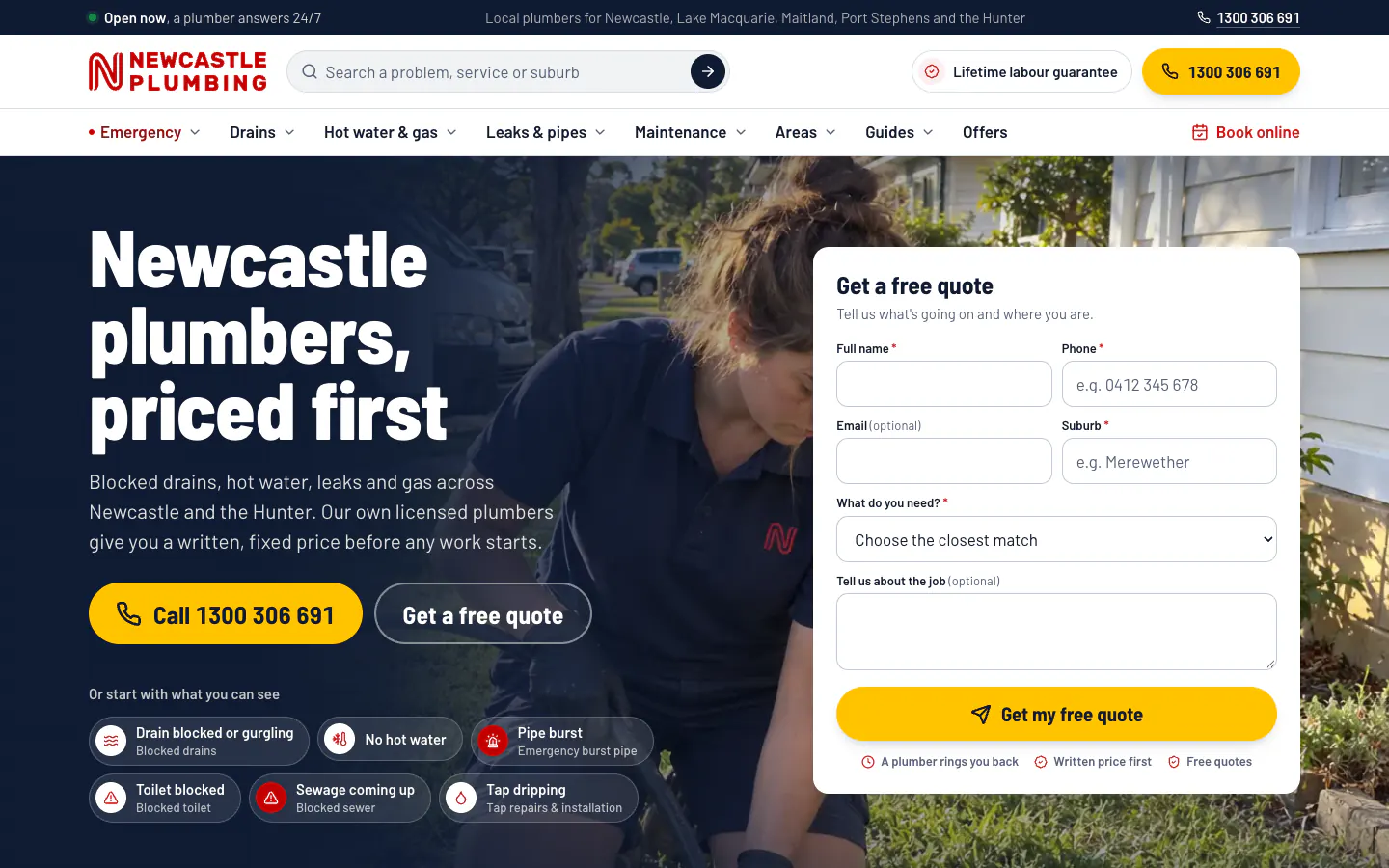
Newcastle Plumbing sends its own licensed plumbers to drains, hot water, leaks and gas jobs across Newcastle, Lake Macquarie, Maitland, Port Stephens, the Hunter Valley and the northern Central Coast.
02 The problem
A new Google Ads account that had to work from week one
The account had no history. It had to bring in calls and forms from the first week, and every enquiry had to trace back to the ad and the page that produced it.
03 What we built
Town ads to town pages, service ads to service pages
One campaign targets searches naming a suburb or town and lands on that place's page. The other targets jobs such as hot water, leaks and relining and lands on the matching service page.
04 What happened
More than one in six clicks became an enquiry
18% of ad clicks became a call or a web form in the first six days, and the rate stayed above one in six as the ads reached more searches. 84% of clicks came from phones.
18%of Google Ads clicks became an enquiry, first six days
05 What we learned
Town names converted best, and forms owned the evening
Town ads turned clicks into enquiries at 1.8 times the rate of service ads. 61% of web forms were sent between 5pm and 7am, while 41% of ad clicks came in those hours.
1.8×enquiry rate from town ads compared with service ads
01 / 05
Insights
What the data showed
What Newcastle Plumbing’s own records showed once the work was live. Open a card for the full finding and how it was measured.
Local01
1.8×
Town ads turned clicks into enquiries at 1.8 times the rate of service ads.
Town ads: clicks that became enquiries28%
Service ads: clicks that became enquiries15%
28% of clicks on town ads became enquiries, against 15% for service ads. The town campaign drew 21% of clicks but 34% of enquiries, and town ads brought in enquiries in all six regions the business covers. Each town ad lands on a page written for that town, which suits someone who wants a local plumber.
How it was measured. Enquiries traced to each campaign divided by that campaign's Google Ads clicks, first six days of Google Ads. Rates rounded down; the comparison is rounded down to one decimal. Region is the region of the suburb or town the ad targeted, as grouped on the client's website. Small numbers, so the gap will move.
Timing02
61%
61% of web forms were sent between 5pm and 7am, outside normal business hours.
Google Ads clicks made between 5pm and 7am41%
Web forms sent between 5pm and 7am61%
Web forms leaned toward the evening: 61% were sent between 5pm and 7am, while 41% of ad clicks came in those hours. People who searched after work tended to send their details through the quote form. The form is the after-hours front door, so a prompt call back the next morning matters as much as a quick answer during the day.
How it was measured. Web-form enquiries from Google Ads sent between 5pm and 7am Sydney time, as a share of all web-form enquiries from Google Ads, compared with the share of Google Ads clicks made in the same hours (as reported by Google Ads in the account time zone), first six days of Google Ads. Rounded down.
Device03
84%
84% of ad clicks and 81% of enquiries came from phones.
Phones84%
Computers12%
Tablets3%
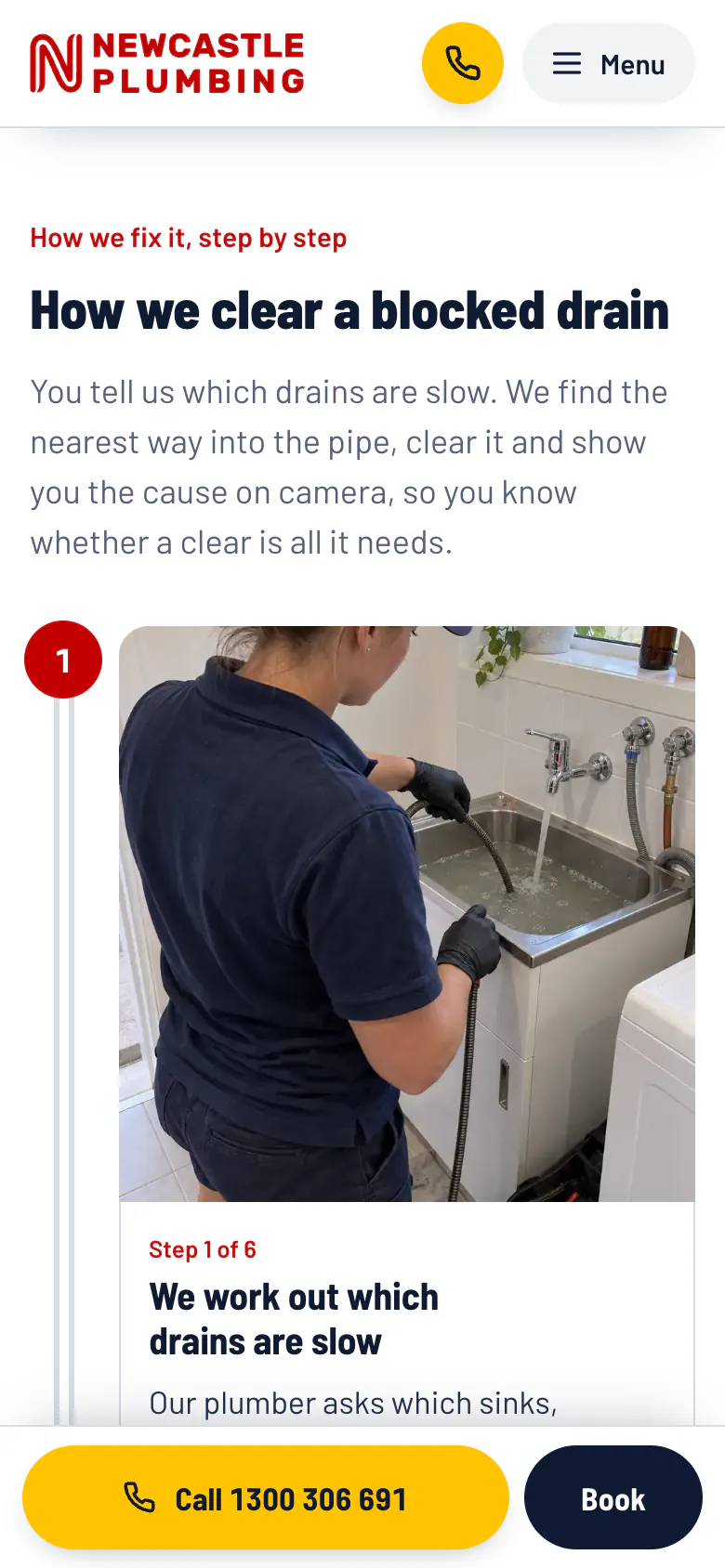
Most people found the ads on a phone and got in touch from it. That is why the website keeps a call button in the header on a phone and a Call and Book bar fixed to the bottom of service pages, so ringing or booking never means scrolling back to the top.
How it was measured. Google Ads clicks by device, first six days of Google Ads, as reported by Google Ads. The enquiry share uses the device of the ad click behind each enquiry. Rounded down, so the shares add to just under 100.
Service04
40%
Hot water and gas brought in 40% of enquiries from the service ads, the largest single group.
Hot water and gas40%
Leaks, shower seals, taps and gutters32%
Kitchen, emergency and general16%
Drains, relining and stormwater12%
Hot water and gas led the service enquiries, with leaks, shower seals, taps and gutters next. The rest spread across drains, stormwater, kitchen plumbing and general searches for a plumber. No single page brought in more than 8% of all enquiries, so the breadth of the service pages is doing real work.
How it was measured. Enquiries from the service campaign grouped by the job the ad group was written for, following the service sections on the client's website, as a share of all service-campaign enquiries, first six days of Google Ads. The page share is enquiries by landing page as a share of all enquiries from Google Ads. Small numbers, so the order can change.
Website development · Newcastle Plumbing
We built their website, too.
Explore the website we designed for Newcastle Plumbing: the pages, the mobile experience and the path to an enquiry.
Explore Newcastle Plumbing’s website, from the first impression to the details.
Use the left and right arrow keys to browse screenshots. Home goes to the first screenshot and End goes to the last.
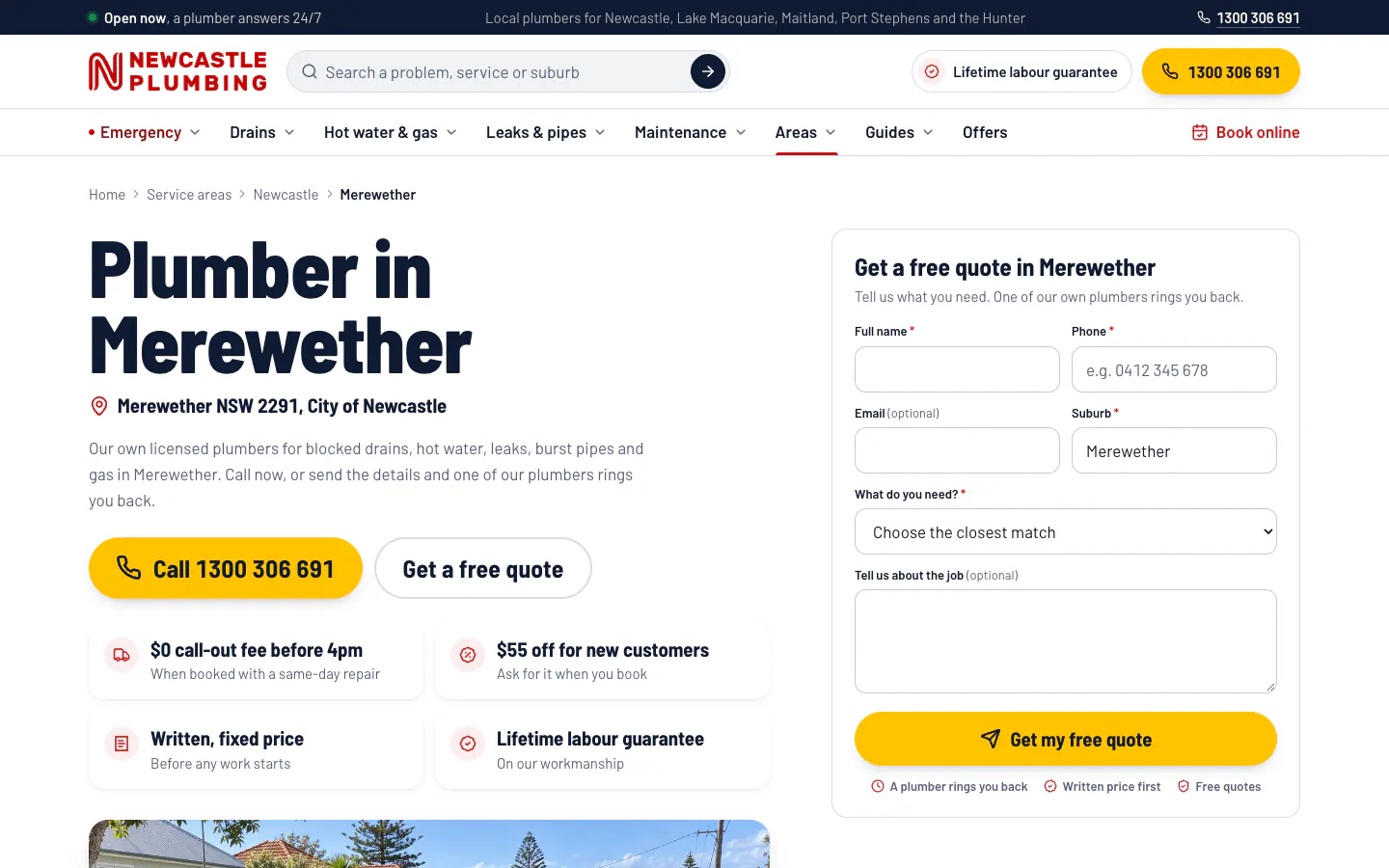
Town page: where a town ad lands, with the call button first and the suburb filled in on the quote form.
01 / 02 · Town page: where a town ad lands, with the call button first and the suburb filled in on the quote form.
The case study
The project, connected.
The brief, the work and what it delivered.
The starting point
Newcastle Plumbing
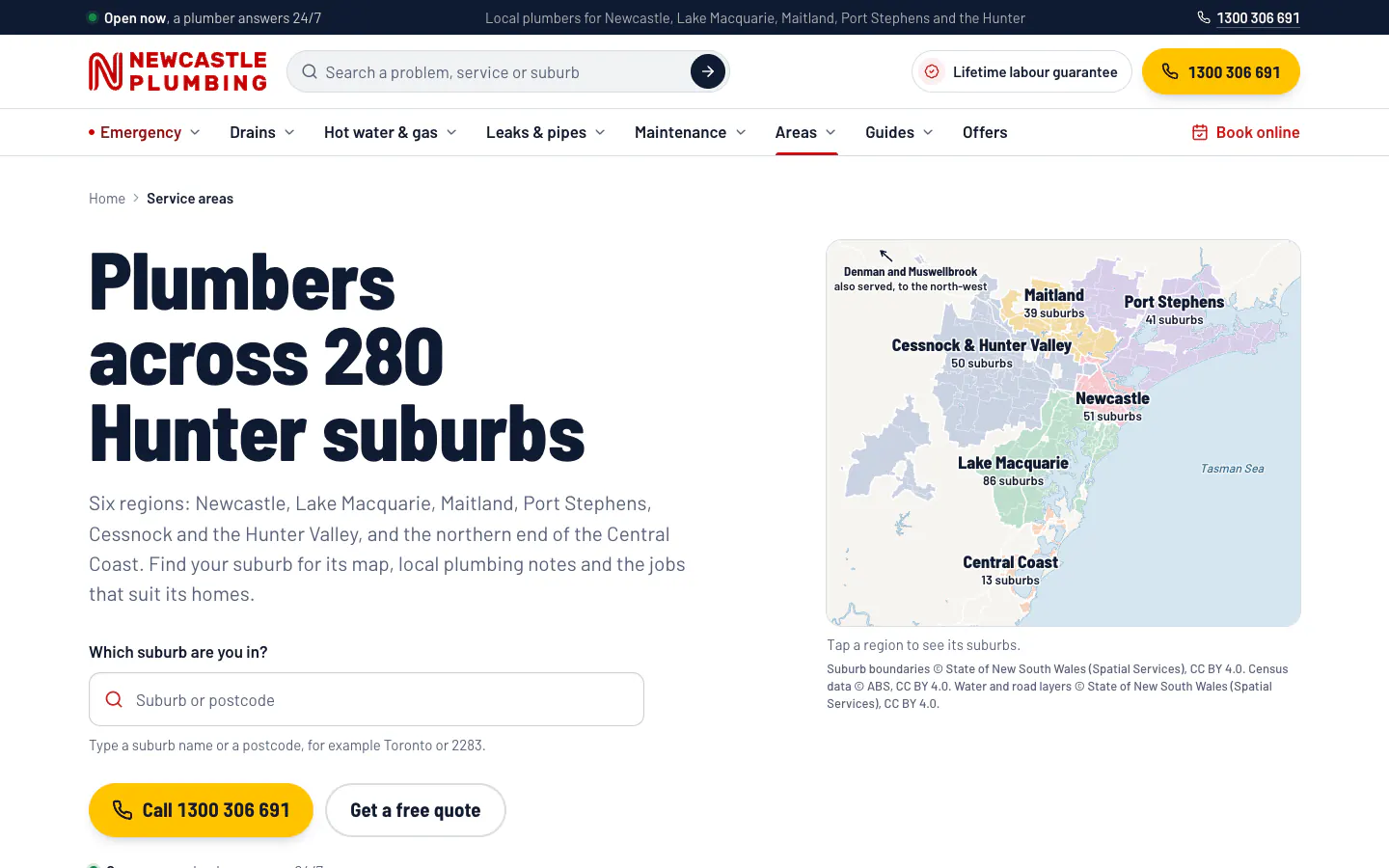
Newcastle Plumbing is a local plumbing business with its own licensed plumbers, covering Newcastle, Lake Macquarie, Maitland, Port Stephens, Cessnock and the Hunter Valley, and the northern Central Coast.
Plumbing, hot water and gas · Newcastle and the Hunter, NSW
SoudCoh services
Google Ads management
Enquiry tracking and reporting
Landing pages on the client's website
What we put in place
The campaign work
A town campaign targeting searches that name a suburb or town the business covers, with every ad sending people to that place's own page.
A service campaign covering jobs from hot water and gas to leaks, shower seals, gutters, drains and kitchen plumbing, with each job's ads sending people to the matching service page.
Tracked calls and web forms traced to the campaign, the ad group and, where recorded, the search behind each enquiry, with test entries removed.
A first-week review of enquiry rates by campaign, device, time of day and service theme.
What the project delivered
The outcome
18% of Google Ads clicks became a call or web form in the first six days of ads, with town ads turning clicks into enquiries at 1.8 times the rate of service ads.
Newcastle Plumbing turned 18% of its Google Ads clicks into calls and web forms in the first six days of ads. That is more than one in six clicks, and the rate held as the ads reached more searches. Ads aimed at searches naming a local town did best, and the way people got in touch changed with the time of day.
The business
Newcastle Plumbing is a local plumbing business with its own licensed plumbers. It takes on blocked drains, hot water, leaks, burst pipes and gas work across Newcastle, Lake Macquarie, Maitland, Port Stephens, Cessnock and the Hunter Valley, and the northern Central Coast. Customers get a written, fixed price before any work starts.
The ads send people to the website we built for the business, which has its own page for each service and each suburb it covers. That build is covered in the Newcastle Plumbing website case study.
What we set out to do
The Google Ads account was new, with no history to lean on. It had to start bringing in calls and forms from the first week, and every enquiry had to be traced back to the ad and the page that produced it. Six days is too early to judge the account on won work, so this first read is about enquiries: how often a click turns into a call or a form, which ads do it best, and when and how people get in touch.
What we built
The account has two campaigns. The town campaign targets searches that name a suburb or town the business covers. It is split by suburb and region, and every ad in it lands on the page for that place, with a call button and a quote form; on a suburb page the suburb is already filled in. The service campaign targets specific jobs, from hot water and gas to leaking taps, shower seals, gutters, pipe relining and stormwater. Each job's ads land on the matching service page, and general searches for a plumber land on a general page such as the home page or the offers page.
Town ads land on the suburb's own page, with the call button first and the suburb already filled in on the quote form.
Every call and form from the ads is traced to the campaign and ad group that produced it and, where it was recorded, the search behind it. Calls come in on tracked numbers on the website. Test entries made while the site was being checked were removed before anything was counted, and a person who got in touch more than once is counted once, at their first contact.
What happened
Over the first six days of Google Ads, 18% of ad clicks became an enquiry, by phone call or web form. About one in ten times an ad was shown, someone clicked it. The enquiry rate stayed above one in six in both the first three days and the next three, as the ads were opened up to more searches.
Enquiries came by both routes, tracked calls and the quote form on the website. Almost half of all enquiries, 47%, came from searches that named a place, whether a suburb, a town or Newcastle itself.
What the first week taught us
Town ads turned clicks into enquiries best
28% of clicks on town ads became enquiries, against 15% for the service ads: 1.8 times the rate. The town campaign drew 21% of clicks but 34% of enquiries. Town ads brought in enquiries in all six regions the business covers: Newcastle, Lake Macquarie, Maitland, Port Stephens, Cessnock and the Hunter Valley, and the Central Coast. A search that names a town is a sign the person wants someone local, and the page they land on is written for that town.
Web forms carried the evening
61% of web forms were sent between 5pm and 7am, while 41% of ad clicks came in those hours. People who searched after work tended to send their details through the quote form. The form is the after-hours front door, so a prompt call back the next morning matters as much as a quick answer during the day.
Phones did most of the work
84% of ad clicks and 81% of enquiries came from phones. That is why the website keeps a call button in the header on a phone and a Call and Book bar fixed to the bottom of service pages, so the next step is always in reach.
Hot water and gas led the service enquiries
Among enquiries from the service ads, hot water and gas made up 40%, the largest single group. Leaks, shower seals, taps and gutters came next. The work was spread widely: enquiries arrived through town pages, service pages and a couple of guides, and no single page brought in more than 8% of them.
These are the first six days of a new account, so the figures rest on a small base and will move. The direction is clear enough to act on: keep the town campaign well funded, make sure web forms get a fast call back, and keep the phone layout simple.
How we measured it
The enquiry rate is enquiries traced to Google Ads divided by Google Ads clicks over the same days. Enquiries are tracked calls and web forms from the ads, with test entries removed and each person counted once, at their first contact. Calls are counted as the tracked numbers logged them, which is connected calls only, so the enquiry rate errs on the low side. Clicks, impressions and devices come from Google Ads. Times are Sydney time. Percentages are rounded down, and the town-to-service comparison is rounded down to one decimal.
The definitions behind the campaign results, from enquiries and conversion rates to advertising spend.
Conversion
An action recorded under the account’s conversion setup, such as a tracked call, form submission, booking or purchase. Platform call/form enquiries are described separately in the study; repeat calls can be separate events, so enquiries are not necessarily unique people.
Cost per job · cost per lead
Advertising spend divided by the relevant recorded enquiry or job count. The study identifies the denominator. Enquiry cost is considered alongside lead quality and job value.
Conversion rate
The share of people who clicked the ad and then did the thing. A high click count with a low conversion rate usually means the ad and the page are promising different things.
Ad spend
Money spent on the advertising platform. The enquiry costs and revenue-to-ad-spend figures here exclude agency fees and the cost of delivering the client’s service.
The measurement window
The period covered by the result, with spend and outcomes drawn from the same reporting window.
A starting point
Starting values appear beside the resulting figure when the account history is available.
Qualified lead
An enquiry that matched the service and the service area, so it was worth someone picking up the phone for. Where a study says qualified, somebody checked.
An anonymised client
A project published without the client’s name. The page identifies its sector and explains the scope of the work.
Put your own numbers to work: work out your own cost per lead, with your own click price and close rate. It takes about a minute and asks for nothing.
— 06 · The rules behind it
How we run accounts
The two numbers behind this result.
Every account we run follows the same written rules, published on the SoudCoh Compound page. This result rests on two of them: deciding what counts as a real enquiry, and starting each account with what the others learned.
We agree which calls, forms, bookings or sales count as a result, and a real test enquiry goes through every tracking path before the campaign goes live.
The number it moves: Waste blocked before the first click
Every change on an account like this one is written to that client's change history, and what it teaches, never the client's numbers, goes into the next account's starting point.
Start with your goals and current setup. We review the opportunity, agree the work and plan the next stage with you.
The call
Thirty to forty-five minutes, free
What you sell, who buys it, and what one customer is worth to you. No deck. You leave with a real number for your situation rather than a range.
Week 0
The audit
We open your account — or your competitors' ground, if you do not have one yet — and write down every leak we can find. That list is yours whether or not you work with us.
Week 1
The build
Everything the account needs before it can spend a dollar: what it will bid on, what it must never pay for, the ad copy, the assets, the landing pages and the tracking. It waits in our approval queue, and a real test enquiry goes through every tracking path before anything is live.
Day one
You press go
Campaigns are created paused, every time, so you can read the whole build first. You activate when you are ready, not when we are.
Days 1–14
The clean
The busiest fortnight your account will ever have. Search terms read daily, waste negated, early winners promoted, ad copy iterated against what is actually being served.
From there
Rhythm
Weekly optimisation, reporting on a fixed cadence whether the news is good or bad, and a proper conversation each quarter about where the next block of budget should go.
Before you ask us anything
Here is what everybody asks first.
FAQ
The questions this raises.
How the results were measured and how the approach could apply to plumbing businesses.
How was the 18% for Newcastle Plumbing worked out?
We took every tracked call and web form traced to Google Ads over the first six days of ads, removed test entries, counted each person once, and divided by the clicks Google Ads recorded over the same days. The result is rounded down to a whole percentage.
Why is there no return on ad spend figure?
Return on ad spend needs the value of won jobs, and six days is too early to judge an account on won work. This study sticks to what can be measured fairly so far: clicks, enquiries and how people got in touch. A return figure makes sense once enough enquiries have been quoted and won.
What is a town ad?
An ad in the town campaign, which targets searches that name a suburb or town the business covers. Each one sends people to that place's own page on the website, with a call button and a quote form. Clicks on these ads became enquiries at 1.8 times the rate of the service ads.
When did the web forms come in?
Mostly outside business hours. 61% of web forms were sent between 5pm and 7am, while 41% of ad clicks came in those hours. People who searched in the evening tended to send their details through the quote form, so a fast call back the next morning is part of the job.
What do the results in this Newcastle Plumbing case study measure?
Campaign results describe the enquiries or job outcomes reported for the client. Each figure identifies what it measures.
Which records support these results?
Result basis: First six days of Google Ads. The labels distinguish advertising conversions, call/form enquiries and won-job revenue. Enquiry events can include repeat calls; booked jobs are reported separately.
Would this work for plumbing businesses like mine?
We assess your service area, competition, margins and customer value, then build a plan around the opportunities in your business. The first call establishes the priorities, budget and tracking for that work.
Why does this study show a result but not a starting point?
Where a comparable earlier result is available, the study shows both values. New accounts report their launch result, with the tracking basis explained alongside it.
— 09 · Read next
More work for plumbing businesses.
Explore the campaigns, websites and customer journeys we have built for more businesses in this industry.
pages in one plumbing website: services, suburbs, regions and guides
Live sitemap count
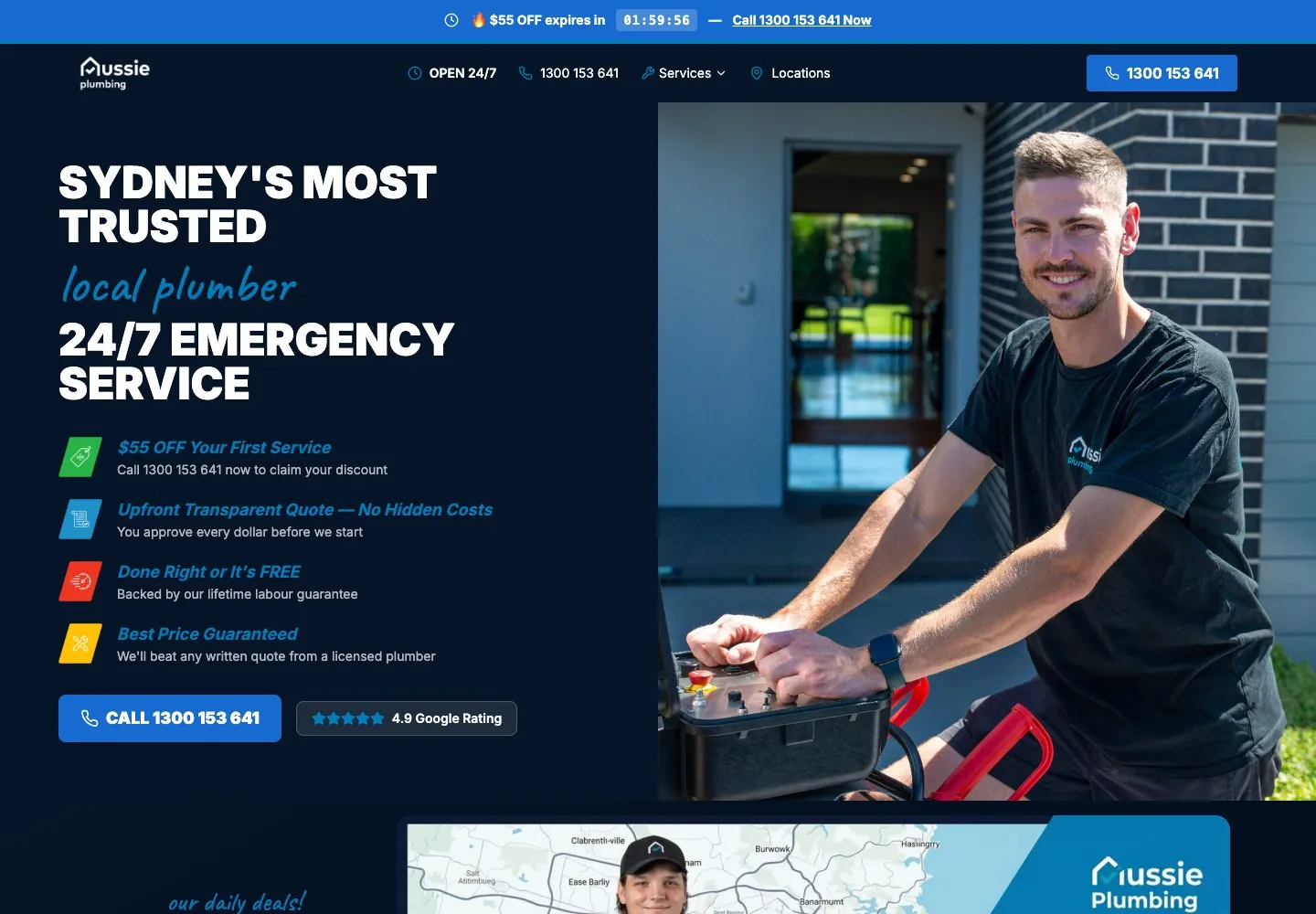
We rebuilt Aussie Plumbing into a 677-page plumbing website for Sydney: 108 service pages, 471 suburb pages in 22 regions, 53 guides and a problem finder.
Aussie Plumbing is the plumbing business of Aussie Home Services, alongside Aussie Drains and Aussie Electrical, with licensed plumbers and gas fitters across Sydney, the Central Coast and the Blue Mountains.
Delivered: 677 pages: 108 services, 7 service group hubs, 471 suburbs, 22 regions and 53 guides. Suburb pages that fill the suburb into the quote form, and service pages that preset the service.
Outcome: Whatever the plumbing job and wherever the property in the service area, there is a page that explains it and a quote form already set up for it.
pages in one plumbing website: services, suburbs, regions and guides
Live sitemap count
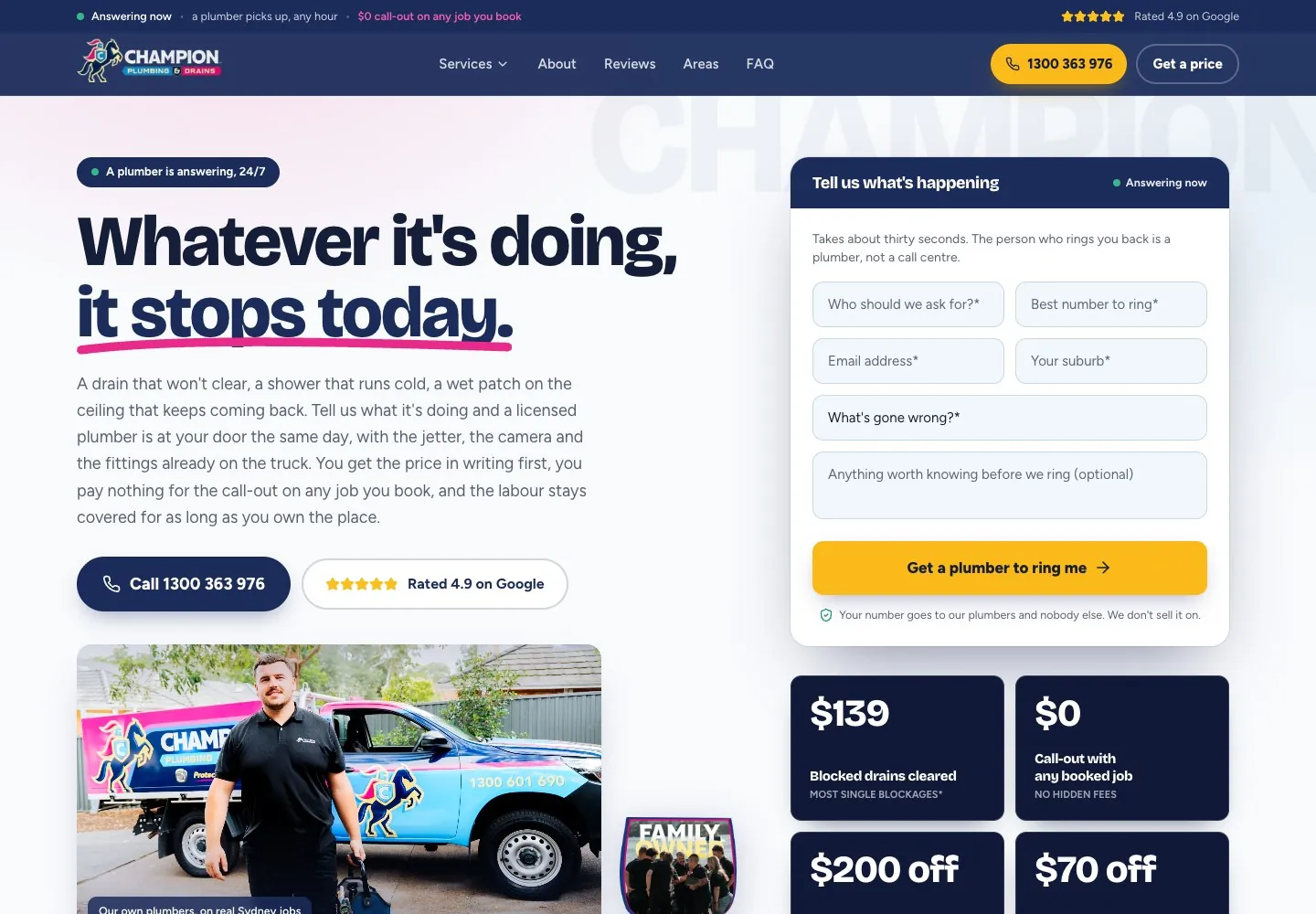
We rebuilt Champion Plumbing's Sydney website into 906 pages: 127 services, 699 suburb pages, 41 guides and a Problems menu sorted by room.
Champion Plumbing & Drains is a family-owned plumbing business serving households across Greater Sydney, NSW.
Delivered: 906 pages: 127 services, 699 suburbs, 19 regions and 41 guides. Five trade mega menus and a Problems menu sorted by room.
Outcome: Whatever the problem and wherever the house, there is a page that explains it, with a call button and a callback form in the same place every time.