
Roofing leads NSW: cost per lead down 20.47% from one period to the next
Cornerstone Roofing · Roofing & roof restoration · New South Wales
The short version · one measured period to the next, 2026
Cornerstone Roofing covers repairs, restorations, repointing, roof painting and storm damage across New South Wales.
We have picked the periods below out of 2026 and stripped the dates off them, deliberately. Taken over the whole account rather than one period, it recorded 276 enquiries and 20 tracked phone calls from 2,373 clicks and 46,410 impressions, at a blended $31.62 each. The best of them ran 31 days and produced 71 enquiries at $25.31, with 15.01% of clicks converting. The most instructive was the one where cost per enquiry climbed to $41.71, then dropped 20.47% to $33.17 in the period straight after. That correction is why this study exists.
The result.
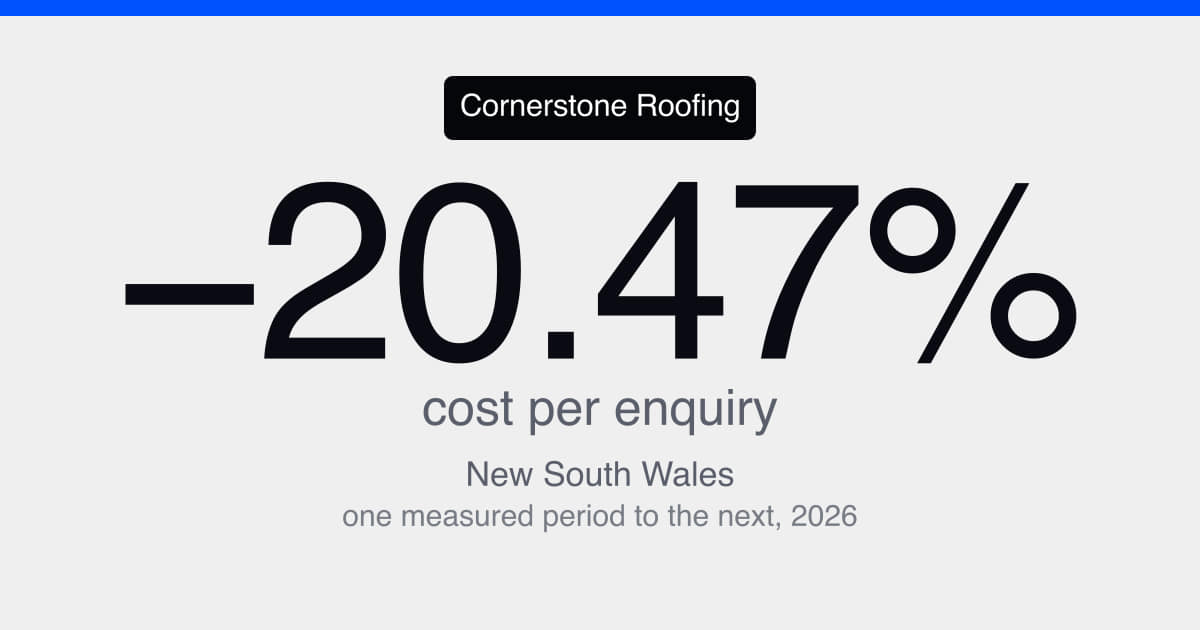
−20.47%
cost per enquiry
one measured period to the next, 2026
$41.71
cost per enquiry, before the correction
a measured period in 2026
$33.17
cost per enquiry, on 52 enquiries
the next measured period, 2026
71
enquiries at $25.31 each
a 31-day period in 2026
276
enquiries in total
across the account's wider run
- Industry
- Roofing & roof restoration
- Discipline
- Roofing
- Ad spend band
- $5K–$10K
- Measured over
- one measured period to the next, 2026
Every figure above was read out of this client's live account and is reproduced exactly as the study publishes it. It is a record of what happened on one account, in one market, at one budget — not a forecast for yours.
What would this look like on your account?
Different market, different budget, different numbers. The first call is where we work out whether the same approach fits yours at all.
The case study
What moved for Cornerstone Roofing.
The short list
- Cost per enquiry fell 20.47% from $41.71 in one period to $33.17 in the next, with volume rising from 43 to 52 enquiries.
- The strongest period was best on both counts: 71 enquiries at $25.31 each, converting 15.01% of clicks.
- One period needed 693 clicks to produce 68 enquiries; the next needed 473 to produce 71. Attention is not the same as work.
- 276 enquiries at a blended $31.62 each, taken over the whole account rather than one period.
- The account was judged period by period, which is the only way to manage a trade whose demand is set by the weather.
Each line above belongs to the period printed with it. None of them is an average across the account, and none of them is a forecast.
TL;DR — Cornerstone Roofing covers repairs, restorations, repointing, roof painting and storm damage across New South Wales. We have picked the periods below out of 2026 and stripped the dates off them, deliberately. Taken over the whole account rather than one period, it recorded 276 enquiries and 20 tracked phone calls from 2,373 clicks and 46,410 impressions, at a blended $31.62 each. The best of them ran 31 days and produced 71 enquiries at $25.31, with 15.01% of clicks converting. The most instructive was the one where cost per enquiry climbed to $41.71, then dropped 20.47% to $33.17 in the period straight after. That correction is why this study exists.
Roofing runs on the weather
A storm crosses New South Wales and the phone runs hot for a week. The month after that, everything goes quiet and the same ads cost twice as much for half the work. Anyone advertising roof repairs, restorations, repointing or cleaning is riding that curve whether they planned for it or not.
Cornerstone covers the lot — repairs, restorations, repointing and re-bedding, roof painting and cleaning, gutters, storm damage. Those jobs sit at wildly different values, and a roofing account left to itself will happily fill up with the cheapest enquiries while the restoration work goes to whoever turned up on the search that actually mattered.
There is a second problem here, and it is about time. A leak is an emergency. A restoration is a considered purchase, where the homeowner collects three quotes and decides over a month or more. Both people type similar words into Google, and the advertising has to be worth paying for in both cases — which is why an account like this has to be judged over months, not over a fortnight of storm traffic.
Cheap leads are the trap, not the win
Attention is affordable in this category. Account-wide, 5.11% of the people served an ad clicked it, 11.63% of those clicks became an enquiry, and the blended cost landed at $31.62. Against the value of a roof job, that sounds like nothing.
Cheap is exactly where roofers come unstuck. When leads cost this little it is easy to buy a lot of the wrong ones and feel busy for a month while the good work goes elsewhere. So the account was rebuilt around the enquiries that turn into quoted jobs rather than the ones that merely turn into clicks.
Dates are withheld on purpose here; what follows is a run of selected periods, sized but not named. Across the wider account the ads served 46,410 impressions, took 2,373 clicks, and produced 276 enquiries — landing on the large majority of trading days. Only periods with 14 or more days of activity are plotted below, because a part-month makes a flattering dot and a dishonest chart. Demand in roofing is seasonal and event-driven, so this account was watched rather than scheduled. That is the only way to stop a quiet stretch from quietly doubling the price of a lead.
The month that went wrong, and the month after it
One period was the difficult one: $41.71 per enquiry on 43 enquiries, with the conversion rate down at 9.71%. The next came back to $33.17 — a fall of 20.47% — on 52 enquiries at a 12.62% conversion rate. Volume up, cost down, one month apart.
Nothing about the trade changed between those two blocks. The drift just got caught while it was still one month old — worth more to you than a flawless line would be.
Read the trend across the plotted periods and it goes $31.24, then $26.27, $25.31, $41.71 and $33.17. Not a straight line down, and we are not going to pretend otherwise. What it shows is a band the account held to, one spike, and a recovery — which for a weather-driven trade is a more honest promise than a smooth graph.
The volume chart hides the best comparison on this page. One period produced 68 enquiries. The one straight after produced 71. Near enough to identical, until you look at what each of them had to buy to get there.
One period needed 693 clicks to produce 68 enquiries. The next needed 473 to produce 71.
Nearly twice the attention in the first, for three fewer enquiries. It converted 9.81% of its clicks from 16,361 impressions; the one after it converted 15.01% from 8,789. Same account, same trade, very different quality of traffic — and that is why a conversion rate sits next to the volume in every line on this page.
The account's opening stretch deserves a mention as well. It recorded the highest conversion rate of any period at 15.38%, on 34 enquiries at $31.24 each across just 18 days. A partial month, and labelled as one.
- $41.71 cost per enquiry on 43 enquiries at a 9.71% conversion rate — a measured period in 2026
- $33.17 cost per enquiry, on 52 enquiries at a 12.62% conversion rate — the next period, a 20.47% reduction
- 71 enquiries at $25.31 each, 15.01% conversion rate, from 473 clicks and 8,789 impressions — a 31-day period in 2026
- 68 enquiries at $26.27 each from 693 clicks and 16,361 impressions, at a 9.81% conversion rate — the period before it
- 34 enquiries at $31.24 each and a 15.38% conversion rate across an 18-day opening stretch
- 276 enquiries and 20 tracked phone calls at a blended $31.62 each — across the account's wider run
What it meant for the business
276 enquiries gives a roofer something the trade rarely has: a quoting schedule that does not depend on the last storm. Crews can be planned, materials ordered with confidence, and a quiet fortnight stops feeling like a crisis. Enquiries arriving on most trading days turns quoting into a routine — a morning of inspections instead of a scramble.
Getting that $41.71 back under control is the practical bit. Restoration is a considered purchase, so a share of enquiries will always take months to convert or never convert at all, and that patience only stays affordable while the cost per enquiry stays sane. A roofer paying too much per lead cannot wait out a six-week decision, and starts discounting to close early.
The 693-click period against the 473-click one should change what you ask your agency for. More impressions is not the goal. The loudest period on the chart was not the best one, and fewer, better-qualified enquiries meant fewer wasted inspections — an inspection in roofing costs you a half day and a ladder.
Twenty tracked phone calls came through on the account. In roofing those are usually the leaks: booked on the call rather than quoted against two competitors.
Key takeaways
- Cost per enquiry fell 20.47% from $41.71 in one period to $33.17 in the next, with volume rising from 43 to 52 enquiries.
- The strongest period was best on both counts: 71 enquiries at $25.31 each, converting 15.01% of clicks.
- One period needed 693 clicks to produce 68 enquiries; the next needed 473 to produce 71. Attention is not the same as work.
- 276 enquiries at a blended $31.62 each, taken over the whole account rather than one period.
- The account was judged period by period, which is the only way to manage a trade whose demand is set by the weather.
Roof restoration leads in NSW: common questions
What does a roofing lead cost in New South Wales?
On this account, between $25.31 in its best period and $41.71 in its worst, blending to $31.62 over the wider account. Roofing leads come cheaper than most trades because the search volume is broad — which makes qualifying them, not buying them, the hard part.
My roofing ads work after a storm and die the rest of the year. Is that fixable?
Partly. Nobody can manufacture weather, and this account's own chart has a period that went the wrong way. What is fixable is how quickly a bad stretch gets spotted and corrected. Here the gap between the two was a single month: $41.71, then $33.17.
Should I judge a roofing campaign on leads or on cost per lead?
On both, in the same sentence, with the period attached. Two consecutive periods produced 68 and 71 enquiries at conversion rates of 9.81% and 15.01%. Volume alone would have told you those two were the same. They were not.
How long does a roof restoration enquiry take to become a job?
Longer than a repair, and that is a property of the purchase rather than the advertising. It is precisely why the cost per enquiry has to stay sensible: you need to be able to afford the slow ones.
Compare notes with us
If your advertising works brilliantly after a storm and poorly the rest of the year, that gap is worth fixing. Talk to us — we will tell you whether we think we can help before you spend anything.
Tags
- Roofing & roof restoration
- New South Wales
- $5K–$10K
That is one account. Yours is a different one.
We read your ads, your search presence and your tracking the same way this one was read, and tell you what we would change first.
What every number on this page actually means.
Marketing words get used loosely, and a loose word can make a small result look like a big one. Here is exactly what we mean by each of them.
- Conversion
- One real action by one real person: a phone call that lasted long enough to be a conversation, a submitted enquiry form, a booking, or a purchase. Not a page view and not a form that merely loaded.
- Cost per job · cost per lead
- The advertising money spent, divided by the number of those actions. It is the only figure that tells you whether the advertising is worth doing, which is why we publish it next to the count.
- Conversion rate
- The share of people who clicked the ad and then did the thing. A high click count with a low conversion rate usually means the ad and the page are promising different things.
- Ad spend
- Money that went to the advertising platform, not to us. Our management fee is separate and is never included in a cost-per-job figure, because mixing them would flatter the number.
- The measurement window
- The dates the figure covers, named every time. Where a study covers a launch, the clock starts the day campaigns went live — not the day the graph started looking good.
- A starting point
- Where a study knows what a figure was before the work began, that number is printed next to the one it became. Where the account had no history to compare against, the result is printed on its own rather than measured from a number nobody recorded.
- Qualified lead
- An enquiry that matched the service and the service area, so it was worth someone picking up the phone for. Where a study says qualified, somebody checked.
- An anonymised client
- Government, council and cultural-institution engagements are published as sector and jurisdiction only. The work and the measured outcome are described in full; the organisation is not named.
One more, because it matters most: nothing on this page is a guarantee. It is a record of what happened on one account, in one market, at one budget.
What this study cannot tell you is what the same figure looks like on your account — so what a lead costs you at your click price, with your own click price and close rate. It takes about a minute and asks for nothing.
This page exists because of two of the six stages.
Compound is how our team works on any account — six stages every change passes through. Two of them are why there is anything honest to publish.
Meter
If it can't be measured, it doesn't get bought.
Before a dollar moves, every action worth money to the business is tracked as itself — calls, forms, bookings, purchases — with values attached. Without that stage there is no honest number to publish afterwards.
Ledger
Every change we make becomes a record you can open.
Every change lands in a dated record as it happens — what was added, what was stopped, what was rewritten and what it cost. Writing this page afterwards was reading a file, not reconstructing a memory.
What actually happens after the first call.
No mystery and no lock-in before you have seen anything. This is the sequence every account on this site went through.
- The call
Thirty to forty-five minutes, free
What you sell, who buys it, and what one customer is worth to you. No deck. You leave with a real number for your situation rather than a range.
- Week 0
The audit
We open your account — or your competitors' ground, if you do not have one yet — and write down every leak we can find. That list is yours whether or not you work with us.
- Week 1
The build
Everything the account needs before it can spend a dollar: what it will bid on, what it must never pay for, the ad copy, the assets, the landing pages and the tracking. A second person checks all of it before anything is live.
- Day one
You press go
Campaigns are created paused, every time, so you can read the whole build first. You activate when you are ready, not when we are.
- Days 1–14
The clean
The busiest fortnight your account will ever have. Search terms read daily, waste negated, early winners promoted, ad copy iterated against what is actually being served.
- From there
Rhythm
Weekly optimisation, reporting on a fixed cadence whether the news is good or bad, and a proper conversation each quarter about where the next block of budget should go.
Before you ask us anything
Here is what everybody asks first.
The questions this raises.
Whether the figures are real, how they were measured and over what length of window, what it costs, and whether any of it would hold for roofing businesses.
The first call is free and there is no deck.
Book a callWhat does a roofing lead cost in New South Wales?
On this account, between $25.31 in its best period and $41.71 in its worst, blending to $31.62 over the wider account. Roofing leads are cheaper than most trades because the search volume is broad — which makes qualifying them, not buying them, the hard part.
My roofing ads work after a storm and die the rest of the year. Is that fixable?
Partly. You cannot manufacture weather, and this account's own chart shows a period that went the wrong way. What is fixable is how fast a bad stretch gets spotted and corrected. Here the gap between the bad period and the recovery was one month: $41.71, then $33.17.
Should I judge a roofing campaign on leads or on cost per lead?
On both, in the same sentence, with the period attached. Two consecutive periods produced 68 and 71 enquiries — almost identical volume — but at very different conversion rates, 9.81% against 15.01%. Volume alone would have told you the two were the same. They were not.
How long does a roof restoration enquiry take to become a job?
Longer than a repair. That is a property of the purchase, not of the advertising. It is precisely why the cost per enquiry has to stay sane: you need to be able to afford the slow ones.
Are the figures in this Cornerstone Roofing case study real?
Yes. Every number on this page was read out of the client's own advertising account and is printed here exactly as the study publishes it, beside the period it covers. The dashboard and ad images are screen-grabs of that account rather than recreations. If one of these figures matters to your decision, ask about it on the first call and we will walk you through where it came from.
How were these numbers measured, and over what window?
The headline figure covers one measured period to the next, 2026, and every other figure on the page is printed beside the period it belongs to. We publish the LENGTH of a measurement window and the year, and withhold the exact dates — when a client advertised, and how their trading calendar looks, is their commercial information rather than ours. A conversion means one real action by one real person: a phone call that lasted long enough to be a conversation, a submitted enquiry form, a booking, or a purchase. Not a page view, and not a form that merely loaded.
How much was being spent to produce this?
The study publishes this account's advertising spend as a band — $5K–$10K — rather than an exact figure, because the precise number is the client's business. Our management fee is separate from that and is never folded into a cost-per-lead figure anywhere on this site; mixing the two would flatter every number on the page.
Would this work for roofing businesses like mine?
We cannot promise you the same numbers, and nobody honestly can. What this page tells you is what was achievable in that market, at that budget, for that service. Your competition, your service area, your margins and what one customer is worth to you all move the answer. On the first call we build the picture from your figures rather than someone else's, and if the honest answer is that this channel is wrong for you right now, we will say so.
More accounts, same discipline.
Studies from the same kind of work, so you can see how the pattern holds across different businesses.

Roofing
Roof repair leads Sydney: 35 enquiries at $116.85
Roof repair and leak leads for Aussie Plumbing in Sydney: 35 enquiries at $116.85 each in a 25-day period in 2026, with cost per enquiry at $111.30 across the final 14 days.
Read case study
Cleaning
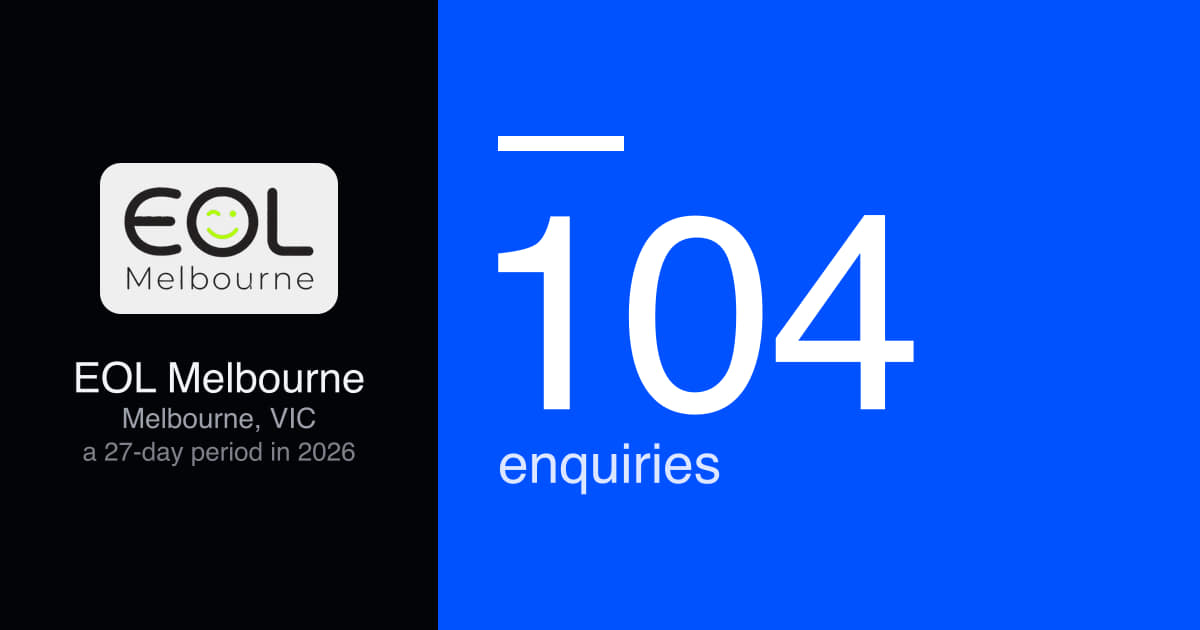
End of lease cleaning Melbourne: 104 leads in a 27-day period
End of lease and bond cleaning leads in Melbourne: 104 enquiries in a 27-day period in 2026 at a 33.12% conversion rate, out of 276 enquiries in total.
Read case study
Property Maintenance
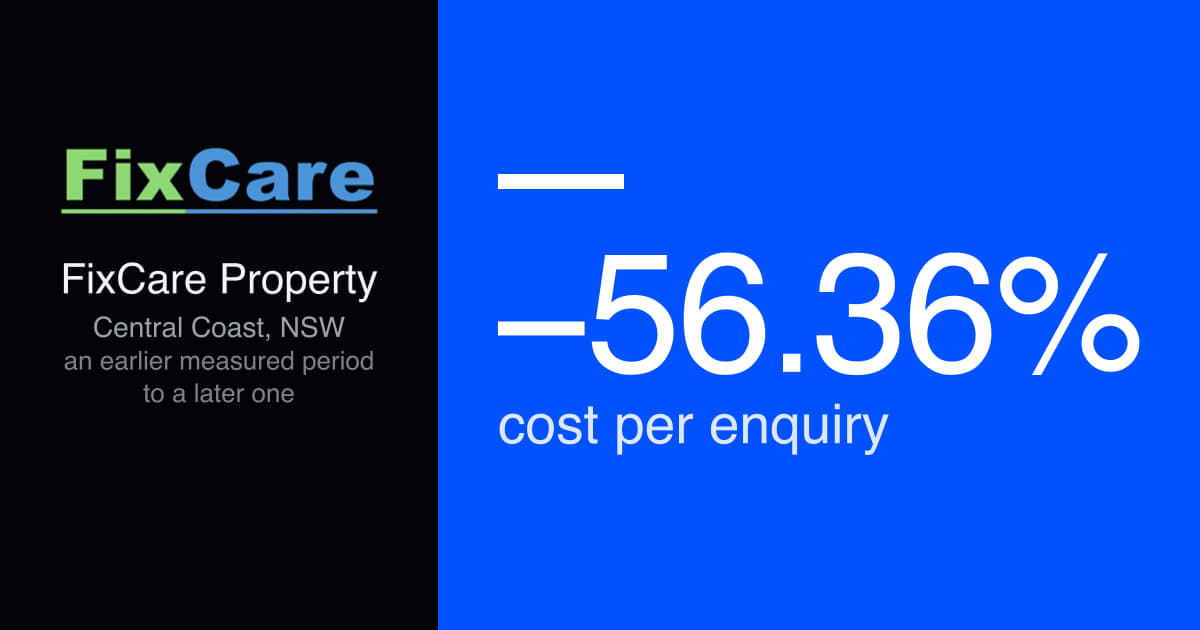
Central Coast property services: cost per lead down 56.36%
Lawn, pool and property maintenance leads on the NSW Central Coast: cost per enquiry down 56.36% from an earlier measured period to a later one.
Read case study
The work that produced this.
Everything above was delivered by one of a handful of things we do. These are the ones this account leant on, written up in full rather than summarised, alongside the page written for roofing businesses generally.
- How roofing accounts are built and budgetedSeasonality, job value and the storm-chasing competition, written up for the trade rather than as a generic services page.
- Before-and-after advertising on FacebookRestoration work sells on the visual difference. This is how that footage gets cut, targeted and turned into booked quotes.
- Filtering out the quote-shoppers before they callA roof job is a considered purchase. Most of the wasted spend in this trade is people ringing for a number they were never going to accept.
The briefing behind the work.
The case study records what happened. These two explain the channel, measurement or operating decision that made the result interpretable in the first place.
The external entity data underneath any local-service acquisition programme. That case is argued in The citation inconsistencies that still move local rankings.
Why the primary and secondary categories must match the work a business actually wants. The other half of it is set out in Google Business Profile categories as a silent rank constraint.
The work behind this one is written up in full under how roofing accounts are built and budgeted, and the six stages every change on this account passed through sets out the sequence in order.
Want results like this?
Thirty minutes on your numbers rather than somebody else's, and a written list of what we would change first. Yours to keep either way.
No pitch deck. No upsell. A real conversation and a written list of leaks.