The pixel is not really a counter. It is how Facebook and Instagram learn what your customers have in common, so they can go and find more of them. Report the wrong thing and the system will faithfully deliver more of it.
The pixel and its audiences stay in your business account · Matching details hashed in the browser before they leave · Consent wired alongside, not after
Client case studies
Social campaigns and the pages after the ad.
Explore WELND’s paid social work and the website journeys behind finance and retail enquiries. The stories show the creative, the landing experience and what we delivered.
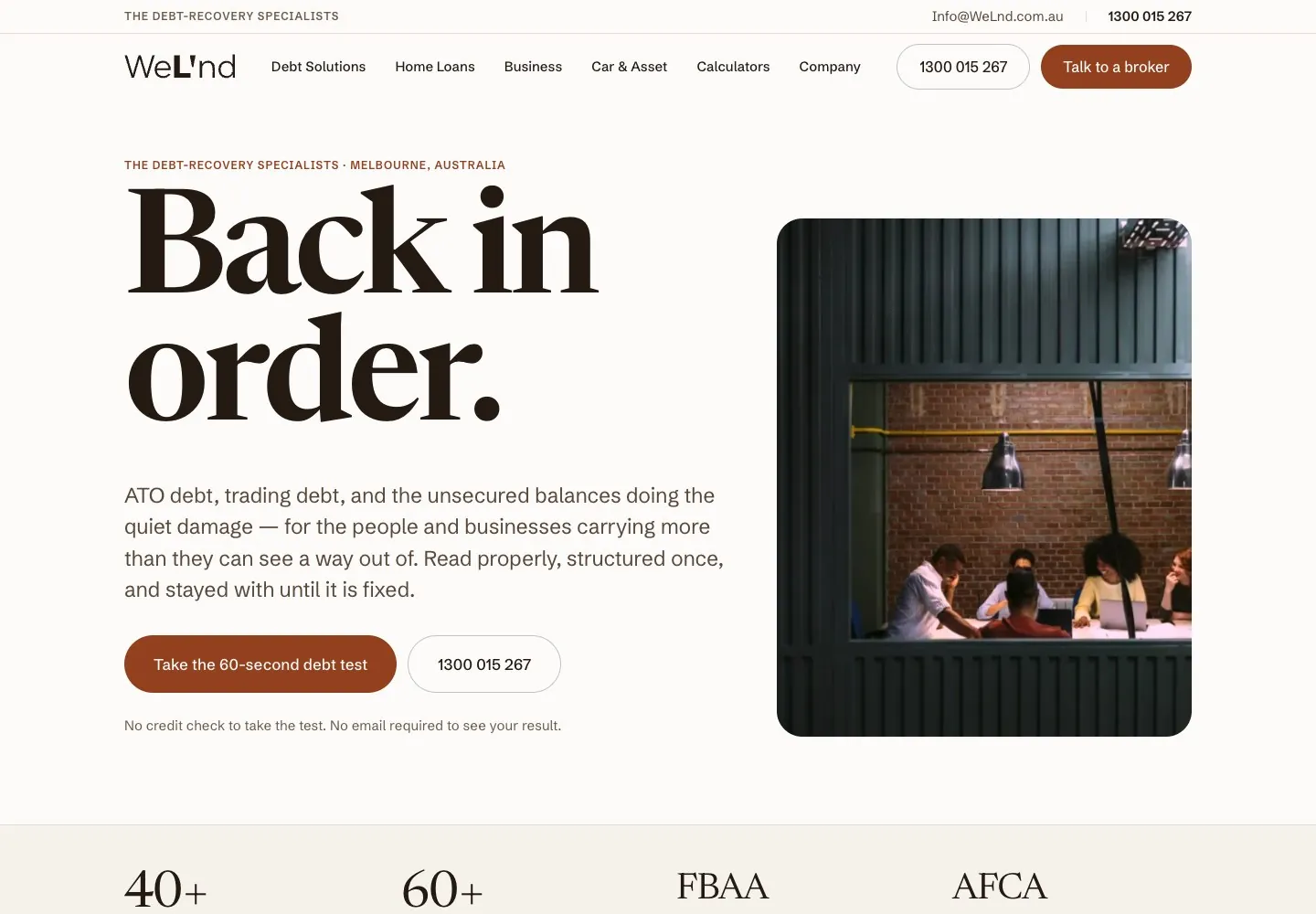
WELND’s finance website: lending-service navigation, a debt-test entry point, calculators and a responsive layout. Explore the brand and enquiry journey.
WELND is a Melbourne-based finance and mortgage brokerage serving customers across Australia.
Delivered: A warm visual identity with clear headings and finance service pages. First-home-buyer content with broker and phone choices.
Outcome: The delivered website explains finance topics in smaller steps and connects readers with tools or a broker conversation.
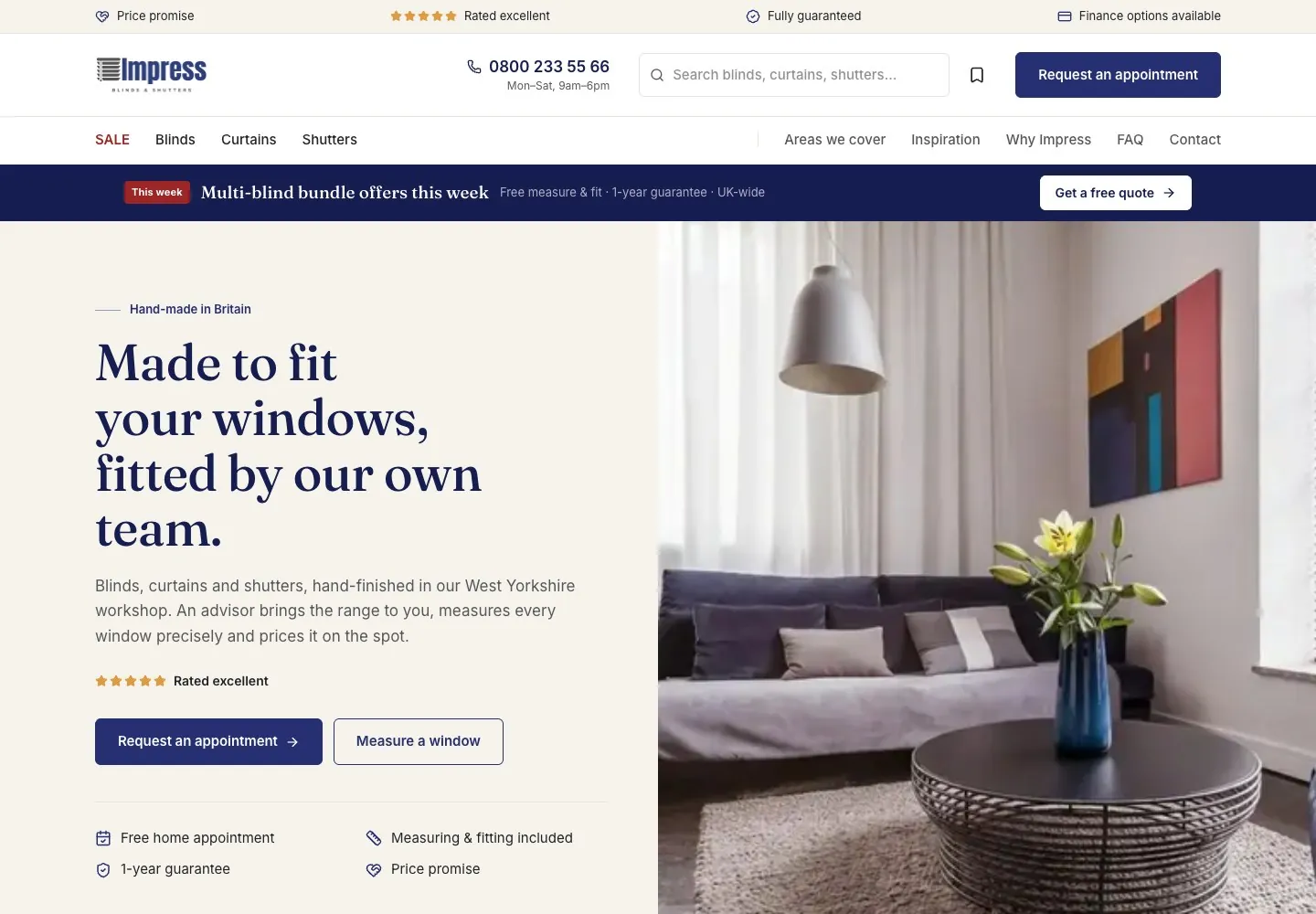
Impress Blinds’ UK website: room photography, blinds and shutters navigation, home-appointment prompts and a mobile booking bar. View the actual design.
Impress Blinds provides made-to-measure blinds and shutters in the United Kingdom.
Delivered: Product browsing for blinds, curtains and shutters. A roller-blinds page with room photography and a product explanation.
Outcome: The website lets customers look at finishes, understand a product and choose the next step towards a measure or quote.
A pixel is never simply broken. It reports something, and the system dutifully buys more of whatever that something was — which is why a bad setup looks like a bad month rather than a fault.
It only reports page views
Meta knows people arrived and nothing else. It cannot tell a browser from a buyer, so it optimises toward whoever is cheapest to show an ad to — which is never your customer.
The wrong action is marked as the goal
A campaign optimising for page views will faithfully deliver page views. Cheap ones, thousands of them, from people who were never going to enquire.
Nothing has a value on it
A quote request and a completed order weigh the same, so the system buys whichever is easier. Attaching real values is what lets it go after the money instead.
The account never leaves the learning phase
Meta publishes a threshold of roughly fifty conversions a week per ad set before delivery settles. A pixel capturing half your conversions can keep an account below it indefinitely.
Ad blockers and iOS are eating the events
A pixel runs in the visitor's browser, and browsers are increasingly hostile to it. The reported gap on Meta is commonly put around a third of events, but the honest number is the one measured on your own traffic.
The audiences were never built
Most people do not enquire on their first visit. Without audiences built from what the pixel saw, every one of those visits is bought once and then forgotten.
Consent blocks it and nobody notices
The banner went in, the pixel stopped firing, and the reports kept showing a number — just a smaller one that looked like a bad month rather than a broken measurement.
The one idea
It is training, not tracking.
Four steps, repeating. Every turn of it makes the next round of ads a little better targeted — as long as the thing being reported back is actually a customer.
Step 01
Someone clicks your ad
Meta records who they were: their interests, their behaviour, the kind of content they engage with. At this point it is a guess that they might be a customer.
Step 02
The pixel watches what they do
It notices the actions you decided are worth measuring — the form finished, the number tapped, the order placed — and nothing else.
Step 03
That gets reported back
Meta now knows that this particular kind of person converted on your site. One is noise. A few hundred is a pattern.
Step 04
Delivery moves toward that pattern
The system starts showing your ads to people who resemble the ones who converted, and stops showing them to people who resemble the ones who did not.
So these are the six moments worth reporting.
Meta recognises a standard set of actions and can only learn properly from those. Most accounts need four of the six, and one of them has to be nominated as the thing the campaign is actually buying.
Somebody arrived
The baseline. On its own it is only useful for building an audience of visitors to follow up with — it is not evidence of anything.
Somebody enquired
A form finished. For most service businesses this is the event the whole account should be optimising toward, and it is the one most often missing.
Somebody made contact
A phone tap or a chat started. Counted separately, because a call is a different level of intent to a form and often a better customer.
Somebody paid
With the amount attached, so Meta can bid for revenue rather than for orders — which matters enormously when your basket sizes vary.
Somebody looked hard
A pricing or service page read properly. Not a conversion, but the best signal available for building an audience worth following up.
Somebody signed up or booked
A registration or a booked time. The highest-value event on a lot of accounts, and worth separating from a general enquiry.
Three real accounts
Pink Flamingo · Melbourne
Search
Cleaning campaigns
Service-focused Google Ads, local targeting and a short mobile enquiry form.
NexData · Sydney
Search
CCTV enquiry campaigns
Separate commercial and residential campaigns with enquiry alerts.
Sydney Fence Painting · Sydney
Search
Painting quote campaigns
Service-focused search campaigns and conversion tracking.
These examples describe work delivered for specific businesses. Each case study explains the services, local market and campaign setup.
Ten things happen on a pixel build. Here they are, in order.
Step one is the one that decides everything downstream, and it is the one most accounts skip: choosing the single action the campaign is buying.
01
Decide which action the account is buying
We pick one primary action before we install anything. An account chasing two different things at once is chasing neither.
02
Deploy it through the tag container
Never pasted into the site's code. In the container it can be previewed, versioned and removed cleanly, and it is one of five things in one place rather than one more orphan script.
03
Build the events that matter, and only those
Enquiry, contact, booking, purchase. Named the way Meta expects so the platform recognises them, rather than as custom events it can only count and never learn from.
04
Attach values from your own numbers
Your average job size, your actual order values. This is what allows the system to bid for revenue instead of for volume, and it is skipped on most accounts we inherit.
05
Pair it with the server side from day one
The browser half and the server half share a reference so the same sale is merged rather than doubled. Running the pixel alone in the current browser climate is leaving events on the floor.
06
Send matching details, hashed
Email and phone are scrambled in the browser before they leave, so Meta receives a value it can match against a profile and never the real thing.
07
Wire consent alongside it
We build the banner and the pixel together, so the pixel respects a visitor's choice and your measurement does not silently stop the week consent goes live.
08
Build the follow-up audiences
Layered by what somebody actually did. A person who read your pricing page for three minutes gets a different message to a person who bounced off a blog post.
09
Test every path before it goes live
Real enquiries pushed through each route and watched arriving in Meta's own event tool. Nothing is published until every route has landed.
10
Reconcile against your own records
What Meta reports and what actually happened in your business have to agree, or the gap has to be explainable. That check is the job, and it is the one most accounts have never had.
01
First click
Somebody stops scrolling, taps the ad and lands on your site.
02
The visit is seen
On its own this is not evidence of anything. It is a starting point.
03
They do the one thing
The single action the campaign is actually buying — usually an enquiry.
04
It is reported back with a value
Not a count. What that enquiry is worth, from your own average job.
05
The next round is aimed better
Meta goes looking for the people who behave like the ones who bought.
06
Booked job
The end of the line, and the only thing on it worth optimising toward.
One continuous line, from a first click to a job in the diary. The pixel's only job is to make sure the far end of it is what gets reported back.
— 06 · The first six weeks
How the build runs
Two weeks to build. Longer for delivery to settle.
Week 0
The audit
What is firing, what it is firing on, whether it duplicates a hardcoded copy, and whether the events Meta is optimising toward are the ones that make you money.
Week 1
The plan
One primary action, the supporting ones, and what each is worth. We agree all of it with you before we build anything, because we cannot guess what a booking is worth to you.
Weeks 1–2
The build
Pixel through the container, events, values, hashed matching, consent and the server-side half — all in preview, nothing published while it is half-finished.
Go live
The proving run
Real enquiries pushed through every path and watched arriving in Meta's event tool, with the browser and server copies merging rather than doubling.
Weeks 2–6
Delivery settles
Meta needs a run of conversions before its delivery steadies — the platform's published guide is around fifty a week per ad set. Until then, cost per enquiry moves around and that is expected.
From there
Rhythm
Checked every reporting cycle, and re-tested whenever your site changes. A redesign or a new booking system breaks a pixel more reliably than anything else we see.
A business producing ten enquiries a week reaches a settled delivery more slowly than one producing a hundred. We would rather say that at the start than explain it in week five.
SoudCoh Compound™
The two rungs the pixel moves most.
On Meta, every ad in SoudCoh Compound is judged on what the pixel reports back. Count the wrong action and Meta finds more people who do that, not more who enquire.
Every figure here is a count of a real job or a real enquiry, because that is what the measurement underneath was built to report. Each tile links to the full breakdown.
The pixel itself is free — Meta charges nothing for it. What you are paying for is the build: deciding which action the account should be buying, wiring the events that matter, attaching values from your own job sizes, pairing it with the server-side half, handling consent, and proving each path works. A single site with a form is a much smaller job than a store with a checkout. For clients we run Meta advertising for it is part of the engagement; standalone it is a fixed price after a free audit.
The build is usually done inside two weeks. The difference takes longer, because Meta's delivery has to settle before you can judge anything — the platform's own published guide is roughly fifty conversions a week per ad set before performance steadies. For a business producing ten enquiries a week that is a slower road than for one producing a hundred, and pretending otherwise helps nobody. What we can say honestly is that until the pixel is reporting the right thing, none of that clock is even running.
No long-term lock-in. A pixel build can be a one-off project and you keep the setup, the events and the documentation whether or not we work together again. Where it sits inside an ongoing Meta engagement we ask for enough runway to be fair to the work, because an account judged in its first fortnight is being judged during the part where delivery has not settled. The terms are in plain English before anything is signed.
You do. The pixel lives in your own business account, or is moved into it if it does not already, and we are added with access rather than as the owner. The audiences built from it are yours and stay in your account if we part ways. Measurement and audience assets are yours outright — that is deliberately different to how the advertising build itself is handled, and it means leaving never costs you your data.
We say so, and we change what we are doing. The first thing checked is always whether Meta is being told the truth — a large share of what looks like a campaign problem turns out to be an event firing on the wrong page or a value that was never attached. Where the measurement is right and the campaign still is not producing, we restructure it, repoint it, or stop it. If the honest conclusion is that Meta is not the right channel for your business right now, we would rather tell you than keep billing for it.
A fixed cadence, good news or bad, in the language you use about your own business. Each report covers what was spent, what it produced, what we changed and why, and what happens next. Meta's own numbers are reported alongside what actually happened in your business, and where the two disagree the gap is named rather than smoothed over. You also get live access to see spend and performance for yourself at any time.
It is a small piece of code on your website that tells Meta when somebody does something you care about. Calling it tracking undersells it: the real job is teaching. Every time a visitor enquires, the pixel reports back that this particular person converted, and Meta builds a picture of what your customers have in common. Delivery then moves toward people who resemble them. Without it you are paying Meta to guess; with it you are paying Meta to learn.
When a campaign launches, Meta experiments — showing your ads to different kinds of people to find out who converts. Performance is unstable and costs are higher during that period. The platform publishes a rough guide of fifty conversions a week per ad set before delivery settles down. The trap is that a pixel capturing only half your conversions can hold an account below that threshold indefinitely, so the campaign never gets a chance to steady. Fixing the measurement is often what unblocks it.
Most people do not enquire on their first visit. The pixel quietly builds audiences of the people who came and did not, so you can follow up with them on Facebook and Instagram. The useful part is layering them by intent: somebody who spent three minutes on your pricing page gets a different message to somebody who read one blog post and left. We also build audiences of people who resemble your actual converters, which get better the more real conversion data the pixel has collected.
They broke part of it. Apple's App Tracking Transparency, ad blockers and the phase-out of third-party cookies all reduce what a browser-based pixel can report. The gap on Meta is commonly put at around a third of events, though the honest answer is that the real figure depends on your traffic and is something we measure on your account rather than assume. The fix is not to abandon the pixel — it is to stop relying on it alone and report the same events from your own server as well.
Not in the form you are imagining. Where an email or phone number is used to help Meta match a conversion to a profile, it is scrambled into an unreadable value before it leaves your site — Meta receives something it can compare, never the actual address or number. Consent is wired at the same time as the pixel, so a visitor who declines is not measured. And the promise we make everywhere else applies here: our learnings, never your data. What travels between client accounts is de-identified structure, never your customers.
Yes, and it is the most common way this starts. We audit what is firing first, check for a hardcoded duplicate, and confirm whether the action the account is optimising toward is actually the one that makes you money. We do not switch off anything that is working while that is going on. Most of the time the pixel does not need replacing — it needs the right events, real values and the server-side half beside it.
— 10 · Nearby
The pixel is half of Meta measurement.
The other half runs on your server, and in the current browser climate you want both. Tracking and analytics is the hub page that compares all five side by side, if you would rather start there.
We check what your pixel is firing, what your campaigns are optimising toward, and how much of it Meta is actually receiving. Yours to keep either way.