
Fence painting Sydney: cost per lead down 33.68%
Sydney Fence Painting · Painting · Sydney, NSW
The short version · one measured period to the next
Nobody has a fence emergency, and that single fact sets the economics of this category.
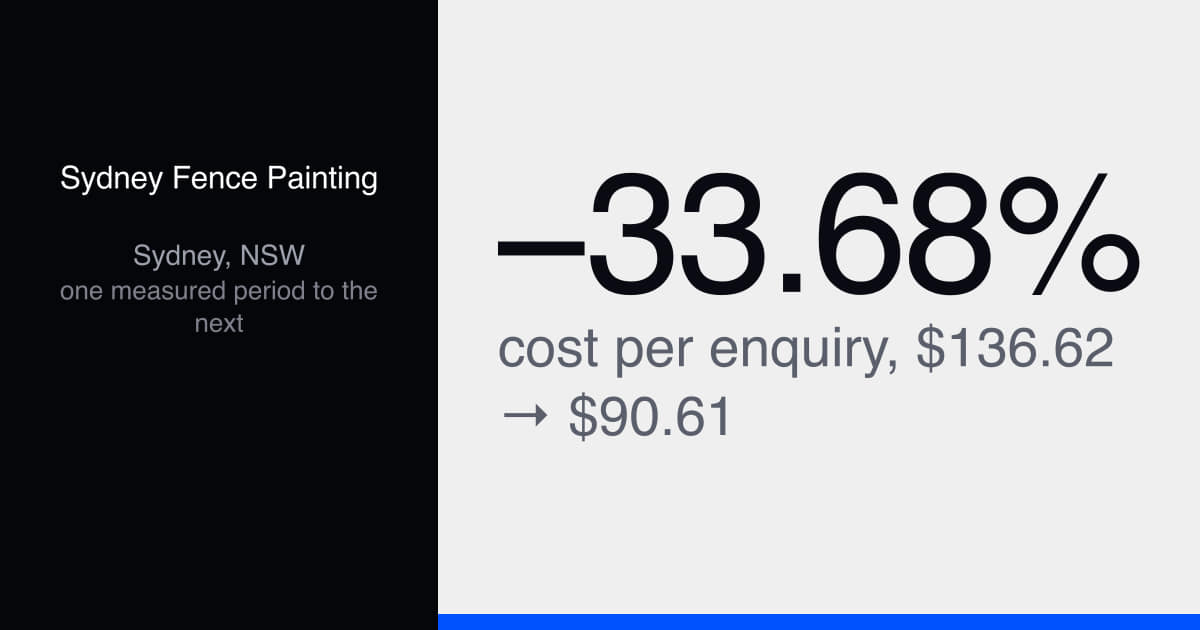
What follows is a handful of measured periods out of the account, reported without dates on purpose. Taken over the whole account it produced 237 enquiries and 24 tracked phone calls from 1,843 clicks at a blended $50.47 each. Cost per enquiry ran at $15.83 in the account's opening month and $24.06 in its best month for volume, then climbed to $136.62 as the demand went out of the market — and came back to $90.61 the month after, a 33.68% drop in a single month, driven by the click-to-enquiry rate improving 71.67% over the same two months.
The result.
−33.68%
cost per enquiry, $136.62 → $90.61
one measured period to the next
237
enquiries and 24 tracked phone calls
across the account's wider run
69
enquiries at $24.06 each
a measured period
$15.83
cost per enquiry, from 44 enquiries
a 14-day period
25.88%
click-to-enquiry conversion rate
a 14-day period
- Industry
- Painting
- Discipline
- Painting Services
- Ad spend band
- $10K–$25K
- Measured over
- one measured period to the next
Every figure above was read out of this client's live account and is reproduced exactly as the study publishes it. It is a record of what happened on one account, in one market, at one budget — not a forecast for yours.
What would this look like on your account?
Different market, different budget, different numbers. The first call is where we work out whether the same approach fits yours at all.
The case study
What moved for Sydney Fence Painting.
The short list
- Cost per enquiry fell 33.68% from $136.62 to $90.61 — one complete month against the next.
- The recovery came from better traffic, not cheaper traffic: 4.85% of clicks converted in the dear month against 8.33% in the one after it, a 71.67% improvement.
- 237 enquiries and 24 tracked phone calls across the account's wider run, at a blended $50.47 each.
- The seasonal swing is stark and it is in the data: 69 enquiries in the strongest month against 14 in the quietest.
- Residential fence work produced 221 of the 237 enquiries at $33.06 each while holding only 10.19% impression share — nine in ten eligible searches still went past.
Each line above belongs to the period printed with it. None of them is an average across the account, and none of them is a forecast.
Nobody has a fence emergency
Sydney Fence Painting sells a job most people think about once. A fence or a run of Colorbond needs painting when it starts to look tired, which makes the work discretionary, seasonal and very easy to put off. In an advertising account that shows up as swing — cheap enquiries when the weather is good and people are out in the yard, expensive ones when they are not.
That opening line is not a throwaway. It sets the economics of the entire category. With no urgency there is no bidding war over the moment, so the clicks cost a fraction of what an emergency trade pays for theirs. The same absence of urgency means the buyer can walk away at any point, and plenty do. The job of an account like this is not to catch a panic. It is to reach somebody at the exact point in the year when the yard has started to annoy them, and to get there before the thought passes.
Timing is therefore the whole game. People look at their fence while standing in the yard, and they only stand in the yard when the weather is worth being outside for. When it turns, the yard goes unused and painting quotes get filed for later. This account shows that pattern about as plainly as a set of numbers can.
It also includes a stretch where things went the wrong way. Partway through the run the cost of an enquiry climbed steeply, and at the worst of it the business was paying $136.62 for one — well above where the account had been sitting. That is the honest shape of a seasonal trade in a competitive Sydney market, and it is the part most agencies leave out of a case study. We have left it in, because the interesting question was never whether it happened. It is what happened next.
What we took on
Three campaigns, covering residential fence painting, commercial painting and Colorbond work. The periods below were picked out of the account and reported without dates, deliberately, so nothing here maps back to the client's calendar. Over the whole account it was served 31,257 times, produced 1,843 clicks at a 5.90% click-through rate, and converted 12.86% of those clicks into an enquiry.
Enough of the months in that run have the trading behind them to plot honestly. Enquiries landed across a wide spread of separate days, which tells you this is not a business that gets one busy fortnight and then waits.
The problem was not solved by spending more. It was solved by going back through what people were actually searching for and rebuilding around the enquiries that end in a quote and a booked job, rather than the ones that merely arrive. We do not publish how that is done. We publish what it did.
Cost per enquiry down 33.68% in a single month
A month later the cost of an enquiry was back to $90.61 — a 33.68% drop on the $136.62 before it, on 14 enquiries in that month.
One full month against the next, with nothing selected in between.
The line is worth reading properly, because it is the seasonal argument in one picture. It opens at $15.83. The next two points sit at $24.52 and $24.06 — flat and cheap while the demand was still there. Then it drifts to $41.54. Then it spikes to $136.62, the highest point on the chart. The point after that comes back to $90.61. Everything to the left of the spike was a market that wanted the product. The spike was a market that had stopped, plus an account that had not adjusted to it yet.
The volume chart shows the same story from the other direction: 229 tracked enquiries across the complete months on it, peaking at 69 and bottoming at 14. Look at that first bar, though.
44 enquiries in the account's opening month, from only 14 days of trading, at $15.83 each.
That is the strongest half-month of the run, and it is what a fence painting business in Sydney looks like when the season is with it.
- Cost per enquiry $136.62 → $90.61 from one complete month to the next, a 33.68% reduction
- 237 enquiries and 24 tracked phone calls across the account's wider run
- Best month for volume: 69 enquiries at $24.06 each, including 6 tracked calls, converting at 18.65%
- Best month for cost: $15.83 per enquiry, from 44 enquiries in 14 days, converting at 25.88%
- Cost per enquiry taken over the whole account: $50.47
The opening month was a 14-day month in the account and a very good one. The volume peak came later. Later still was the worst of it. Each of those is a fact about that month, and none of them describes the others.
What actually drove the recovery is visible in the data and worth naming, because it is not the mechanism people assume. In the dear month, 4.85% of clicks became an enquiry. In the one after it, 8.33% did — a 71.67% improvement in the same month the cost came down. So the recovery did not come from buying traffic more cheaply. It came from buying traffic that converted. Click-through rate moved on a similar arc across the run: 5.57% early on, rising to 8.20% later, 47.31% higher.
Two other things the account records. It is an overwhelmingly mobile audience — 1,459 of the 1,843 clicks came from a phone and produced 200 of the 237 enquiries. And the enquiries arrived in a mix that suits a quoting trade: 137 clicks straight onto the phone number, 84 submitted forms, 13 tracked phone leads and 3 calls placed from the ad itself. The best single day saw 11 clicks produce 11 enquiries.
The three campaigns did very different jobs, and the difference is instructive. Residential fence work produced 221 of the 237 enquiries at $33.06 each. Commercial painting produced 8 at $163.06. Colorbond roof and fence produced 5 at $234.64. Those are facts about those campaigns over that window rather than a verdict on any of the three, but they are the sort of fact that decides where next season's budget points. Worth adding: the campaign behind those 221 enquiries held only 10.19% impression share, so nine in ten of the eligible searches were still going past.
What it meant for the business
For a painting business the number that matters is how many quotes you get to write. Across the window that was 237 enquiries plus 24 phone calls — Sydney homeowners and property managers asking for a price on a fence or a Colorbond repaint, from an account that averaged $50.47 to produce each one.
Seasonal shape has staffing consequences that are easy to underestimate. 69 enquiries in one month and 14 in another are not the same business. Knowing that shape in advance is what lets an owner put a second crew on for the busy stretch without carrying them through the quiet one, and it heads off both the panic hiring a good month causes and the panic cutting a bad one causes. The enquiry data is, in effect, a workforce plan nobody had to guess at.
The recovery is the more useful story though. Costs in a seasonal trade will drift. What decides whether a business can advertise year-round is how quickly somebody notices the drift and pulls it back. Here that took a month, and it took the cost of an enquiry down by a third.
Worth a conversation
If your cost per enquiry has crept up and nobody has explained why, that is usually a fixable problem rather than a market one. Send us your last three months and we will tell you which of the two you are looking at.
Tags
- Painting
- Sydney, NSW
- $10K–$25K
That is one account. Yours is a different one.
We read your ads, your search presence and your tracking the same way this one was read, and tell you what we would change first.
What every number on this page actually means.
Marketing words get used loosely, and a loose word can make a small result look like a big one. Here is exactly what we mean by each of them.
- Conversion
- One real action by one real person: a phone call that lasted long enough to be a conversation, a submitted enquiry form, a booking, or a purchase. Not a page view and not a form that merely loaded.
- Cost per job · cost per lead
- The advertising money spent, divided by the number of those actions. It is the only figure that tells you whether the advertising is worth doing, which is why we publish it next to the count.
- Conversion rate
- The share of people who clicked the ad and then did the thing. A high click count with a low conversion rate usually means the ad and the page are promising different things.
- Ad spend
- Money that went to the advertising platform, not to us. Our management fee is separate and is never included in a cost-per-job figure, because mixing them would flatter the number.
- The measurement window
- The dates the figure covers, named every time. Where a study covers a launch, the clock starts the day campaigns went live — not the day the graph started looking good.
- A starting point
- Where a study knows what a figure was before the work began, that number is printed next to the one it became. Where the account had no history to compare against, the result is printed on its own rather than measured from a number nobody recorded.
- Qualified lead
- An enquiry that matched the service and the service area, so it was worth someone picking up the phone for. Where a study says qualified, somebody checked.
- An anonymised client
- Government, council and cultural-institution engagements are published as sector and jurisdiction only. The work and the measured outcome are described in full; the organisation is not named.
One more, because it matters most: nothing on this page is a guarantee. It is a record of what happened on one account, in one market, at one budget.
What this study cannot tell you is what the same figure looks like on your account — so what one more point of win rate is worth, with your own click price and close rate. It takes about a minute and asks for nothing.
This page exists because of two of the six stages.
Compound is how our team works on any account — six stages every change passes through. Two of them are why there is anything honest to publish.
Meter
If it can't be measured, it doesn't get bought.
Before a dollar moves, every action worth money to the business is tracked as itself — calls, forms, bookings, purchases — with values attached. Without that stage there is no honest number to publish afterwards.
Ledger
Every change we make becomes a record you can open.
Every change lands in a dated record as it happens — what was added, what was stopped, what was rewritten and what it cost. Writing this page afterwards was reading a file, not reconstructing a memory.
What actually happens after the first call.
No mystery and no lock-in before you have seen anything. This is the sequence every account on this site went through.
- The call
Thirty to forty-five minutes, free
What you sell, who buys it, and what one customer is worth to you. No deck. You leave with a real number for your situation rather than a range.
- Week 0
The audit
We open your account — or your competitors' ground, if you do not have one yet — and write down every leak we can find. That list is yours whether or not you work with us.
- Week 1
The build
Everything the account needs before it can spend a dollar: what it will bid on, what it must never pay for, the ad copy, the assets, the landing pages and the tracking. A second person checks all of it before anything is live.
- Day one
You press go
Campaigns are created paused, every time, so you can read the whole build first. You activate when you are ready, not when we are.
- Days 1–14
The clean
The busiest fortnight your account will ever have. Search terms read daily, waste negated, early winners promoted, ad copy iterated against what is actually being served.
- From there
Rhythm
Weekly optimisation, reporting on a fixed cadence whether the news is good or bad, and a proper conversation each quarter about where the next block of budget should go.
Before you ask us anything
Here is what everybody asks first.
The questions this raises.
Whether the figures are real, how they were measured and over what length of window, what it costs, and whether any of it would hold for painting businesses.
The first call is free and there is no deck.
Book a callWhat does a fence painting lead cost in Sydney?
In this account it ranged widely, and the range is the honest answer. $15.83 in the cheapest month. $24.06 in the month that carried the most volume. $136.62 at the worst of it. $90.61 in the month after that, once the correction had landed. Blended across the account's wider run it was $50.47. Anyone quoting you a single number for this trade without saying which stretch it came from is not telling you much.
Is fence painting advertising really that seasonal?
In this account, yes, and plainly. 69 enquiries in the strongest month against 14 in the quietest, with cost per enquiry moving from $24.06 to $90.61 across roughly the same stretch. People think about the fence when they are standing in the yard, and they only stand in the yard when the weather is worth being outside for. It does not mean advertising through the quiet stretch is pointless — it means the same budget buys a different thing, and you should know that before the invoice tells you.
My cost per enquiry has crept up. Is that the market or my account?
Usually some of both, and it is separable. Here one month was a genuinely worse market and an account that had not adjusted to it. The adjustment took a month and took cost per enquiry down 33.68%. The tell is the conversion rate: if the market alone had moved, the share of clicks becoming enquiries would have stayed put. It went from 4.85% to 8.33%.
Do commercial painting and Colorbond enquiries cost more than residential fence work?
In this account, considerably. Over the window residential fence work produced 221 enquiries at $33.06 each, commercial painting produced 8 at $163.06 and Colorbond roof and fence produced 5 at $234.64. Those are facts about those campaigns in that period rather than a verdict on the services — but they are exactly the sort of fact that should decide where next season's budget points.
Are the figures in this Sydney Fence Painting case study real?
Yes. Every number on this page was read out of the client's own advertising account and is printed here exactly as the study publishes it, beside the period it covers. The dashboard and ad images are screen-grabs of that account rather than recreations. If one of these figures matters to your decision, ask about it on the first call and we will walk you through where it came from.
How were these numbers measured, and over what window?
The headline figure covers one measured period to the next, and every other figure on the page is printed beside the period it belongs to. We publish the LENGTH of a measurement window and the year, and withhold the exact dates — when a client advertised, and how their trading calendar looks, is their commercial information rather than ours. A conversion means one real action by one real person: a phone call that lasted long enough to be a conversation, a submitted enquiry form, a booking, or a purchase. Not a page view, and not a form that merely loaded.
How much was being spent to produce this?
The study publishes this account's advertising spend as a band — $10K–$25K — rather than an exact figure, because the precise number is the client's business. Our management fee is separate from that and is never folded into a cost-per-lead figure anywhere on this site; mixing the two would flatter every number on the page.
Would this work for painting businesses like mine?
We cannot promise you the same numbers, and nobody honestly can. What this page tells you is what was achievable in that market, at that budget, for that service. Your competition, your service area, your margins and what one customer is worth to you all move the answer. On the first call we build the picture from your figures rather than someone else's, and if the honest answer is that this channel is wrong for you right now, we will say so.
More accounts, same discipline.
Studies from the same kind of work, so you can see how the pattern holds across different businesses.
Home Services
Rubbish removal Perth: cost per lead down 53.18%
Rubbish removal Perth: cost per enquiry fell from $71.02 in an earlier measured period to $33.25 in a later one, a 53.18% drop, with 213 enquiries and 40 tracked calls.
Read case study
Automotive & Transport
Towing leads Melbourne at $19.22 each in a 12-day period
Towing leads in Melbourne: Any Car Towing paid $19.22 per enquiry in a 12-day period in 2026 and took 85 enquiries in a later 14-day period at $20.72, converting at 36.48%.
Read case study
Automotive & Transport
Car detailing Sydney: 122 enquiries in a 31-day period
Mobile car detailing in Sydney: Monza Detailing took 122 enquiries at $40.73 each in a 31-day period in 2026 — its first full month — and 135 across the wider account.
Read case study
The work that produced this.
Everything above was delivered by one of a handful of things we do. These are the ones this account leant on, written up in full rather than summarised, alongside the page written for painting businesses generally.
- Marketing built for painting businessesInterior, exterior and commercial repaints are three different buyers with three different budgets, and this is what each of them is worth chasing.
- Paid social for trades with something to showFinished work photographs well and converts cheaply. This is the creative and targeting side of the campaign type above.
- The reporting behind these cost-per-lead figuresCost per lead only means something when every lead is counted the same way. This is how that is set up.
The briefing behind the work.
The case study records what happened. These two explain the channel, measurement or operating decision that made the result interpretable in the first place.
Why the primary and secondary categories must match the work a business actually wants. That case is argued in Google Business Profile categories as a silent rank constraint.
The profile and service-area rules for the mobile businesses represented throughout this library. The other half of it is set out in Ranking a service-area business without publishing a storefront.
The work behind this one is written up in full under marketing built for painting businesses, and the operating sequence behind every study on this site sets out the sequence in order.
Want results like this?
Thirty minutes on your numbers rather than somebody else's, and a written list of what we would change first. Yours to keep either way.
No pitch deck. No upsell. A real conversation and a written list of leaks.