
Sydney plumbing leads: 158 enquiries in a 23-day period for Wilco Plumbing
Wilco Plumbing · Plumbing and drainage · Sydney, NSW
The short version · a 23-day period in 2026
Wilco Plumbing needed the hard version of growth: more enquiries, without the cost of each one drifting up.
What follows is one measured window out of the account, reported without dates on purpose. Taken over the whole account rather than that one stretch, it was served 38,895 times, drew 1,920 clicks at a 4.94% click-through rate and recorded 257 enquiries. The best complete month inside that run produced 158 enquiries at $133.23 each across 23 days, converting 14.03% of clicks — and it came in 8.72% cheaper than the $145.95 of the month before it, while nearly doubling the volume.
The result.
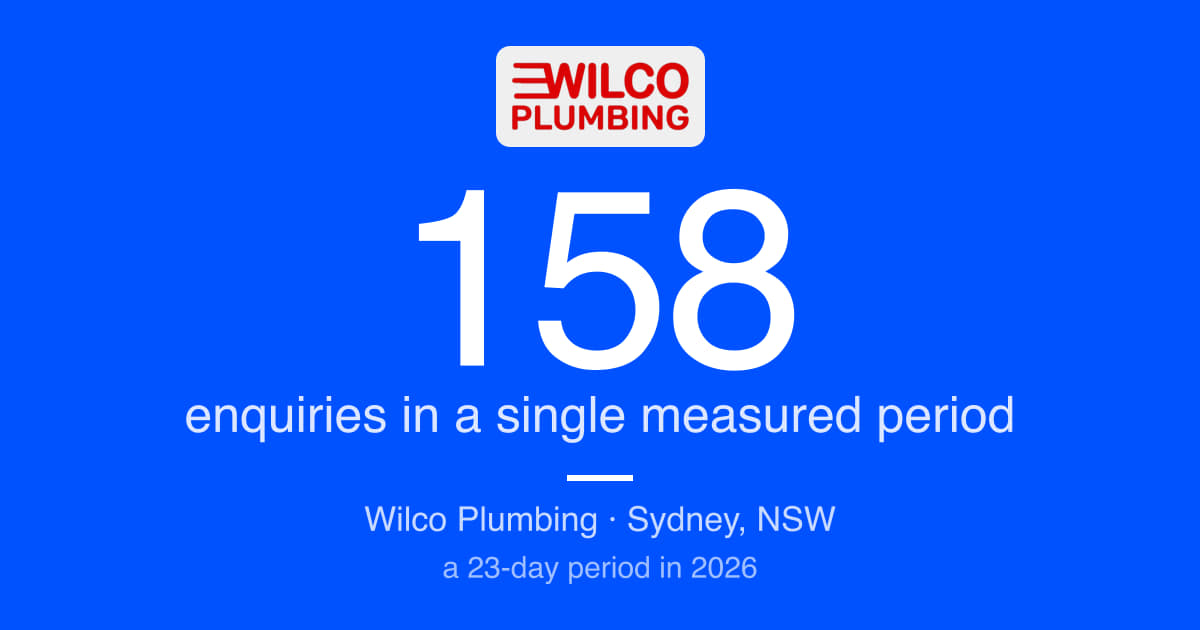
158
enquiries in a single measured period
a 23-day period in 2026
$133.23
cost per enquiry
a 23-day period in 2026
8.72%
lower cost per enquiry
one measured period to the next, 2026
257
enquiries in total
across the account's wider run
14.03%
of clicks became enquiries
a 23-day period in 2026
- Industry
- Plumbing and drainage
- Discipline
- Home Services
- Ad spend band
- $25K–$50K
- Measured over
- a 23-day period in 2026
Every figure above was read out of this client's live account and is reproduced exactly as the study publishes it. It is a record of what happened on one account, in one market, at one budget — not a forecast for yours.
What would this look like on your account?
Different market, different budget, different numbers. The first call is where we work out whether the same approach fits yours at all.
The case study
What moved for Wilco Plumbing.
The short list
- 158 enquiries in a 23-day period in 2026, at $133.23 each — the account's best complete month.
- Cost per enquiry fell 8.72% from $145.95 in one complete month to $133.23 in the next, while monthly volume rose from 83 to 158.
- 257 enquiries in total across the account's wider run, at a blended $136.59, from 1,920 clicks and 38,895 impressions.
- Enquiries landed on most of the days the campaigns traded — a pipeline you can roster against, not one that arrives in lumps.
- The campaign carrying most of the volume held 22.68% impression share, so most of the Sydney market was still going past.
Each line above belongs to the period printed with it. None of them is an average across the account, and none of them is a forecast.
Why a plumbing click in Sydney costs what it does
Sydney plumbing produces some of the most expensive clicks a trade business will ever buy, and the reason is straightforward. The job at the end of a plumbing search might be a $200 tap washer or a $12,000 drain replacement. Everybody bidding is pricing against the chance of the big one, which pushes the cost of that moment up for everyone — including the plumber who was only ever going to get the tap.
Speed is the second thing to understand. A blocked drain, a burst pipe, no hot water on a Sunday: bought in minutes, by someone who will ring the first plumber who looks capable of turning up. No research phase, no shortlist. Competition piles into a very small set of high-intent searches and prices them hard, while the browsing and the comparing and the people six weeks away from doing anything stay comparatively cheap and comparatively worthless.
Then there is the gap between an enquiry and a booked job, which in plumbing is wide. Most enquiries are phone calls, and phone calls include price-checkers, landlords collecting quotes for an insurer, and people who have already rung three others. An account that produces plenty of enquiries and no work is an expensive way to keep somebody on the phone.
Wilco Plumbing needed the account to do two things that usually pull against each other. Produce enough enquiries to keep a team busy week after week. And stop the cost of each one drifting upward as the spend went up. That second half is where most plumbing accounts come unstuck, because scaling is easy if you are willing to accept a worse cost per enquiry every time you add budget. Holding the line while volume climbs is the hard version.
What we took on
What follows is one measured window out of the account, left undated on purpose so nothing here says when this business trades. Taken over the whole account rather than that one stretch, it was served 38,895 times, drew 1,920 clicks at a 4.94% click-through rate and recorded 257 enquiries. One campaign carried the bulk of it — 214 of those enquiries at $126.99 each.
Our attention went almost entirely to one distinction: a search that sounds like plumbing versus a search that is a job. Someone comparing hot water system brands and someone with water coming through a ceiling use the same words, and only one of them justifies a premium click. Most of the improvement came from getting steadily better at telling those two apart, and from writing ads that speak to the job in front of the customer rather than to the category.
The number we actually watch on an account like this is not the monthly total. It is whether the phone rings on a Tuesday as well as on a Monday.
On the large majority of the days this account traded, something landed in the inbox.
A pipeline that turns up in two big lumps and then goes quiet for a fortnight cannot be rostered against. This one could.
158 enquiries at $133.23 each
This was the account's best complete month. Across 23 days it produced 158 enquiries at $133.23 each, from 1,126 clicks and 25,026 impressions, with 14.03% of clicks converting into an enquiry. The month before it ran 18 days and produced 83 enquiries at $145.95 each from 689 clicks and 11,634 impressions, converting at 12.05%.
Those two columns are complete months set beside each other, not a good fortnight against a bad one. Red is the earlier month at $145.95 an enquiry. Green is the later one at $133.23, which is 8.72% cheaper.
The line has only two points on it, and we would rather show that plainly than pad it out. What it shows is a downward slope in the one direction that matters, achieved in the month when volume nearly doubled.
Same story from the other side in the bars: 241 tracked enquiries across the two complete months, 83 in the earlier one and 158 in the later. The later month was the longer of the two in the account, 23 days against 18. It was not only longer, though. The daily rate rose as well as the total, which is why the cost came down instead of holding flat.
- 158 enquiries across a 23-day period in 2026
- $133.23 cost per enquiry in that period, down 8.72% from $145.95 in the month before
- 14.03% of clicks became enquiries in that period, against 13.39% across the account's wider run
- 25,026 impressions and 1,126 clicks in that period
- 257 enquiries in total over the wider account, at a blended $136.59 each
An 8.72% reduction is not a dramatic number and we are not going to dress it up as one. It is a real one, measured between two complete months rather than plucked from a good fortnight, and it happened while volume was rising — the harder direction to move in.
The opening days of the month after continued the same way: 16 enquiries at $121.23 each across 2 days, converting at 15.24%. Two days is not a month and we will not present it as one. Measured from the earlier complete month through to those first few days, cost per enquiry is 16.94% lower and the click-to-enquiry rate 26.49% higher. A partial reading of a partial month, offered as exactly that.
Of the 257 enquiries, 203 were phone leads and 54 were submitted forms, which fits the trade exactly. Mobile supplied 1,137 of the 1,920 clicks and produced 139 enquiries; desktop supplied 740 clicks and produced 114. Desktop converted at the better rate, which is a reminder that a fair share of Sydney plumbing work gets sourced by somebody sitting at a desk. A strata manager. An office manager. A landlord who has just had a tenant ring. The single strongest day in the account returned 16 enquiries from 59 clicks.
One figure cuts against the flattering reading, so here it is. The campaign carrying most of the volume held 22.68% impression share over the window. Most of the market was still going past. Everything above happened on roughly a fifth of the available searches.
What changed for the business
158 enquiries in a month turns a sales problem into a scheduling problem. The value is not only in the total, either — it is in the arrival pattern, because enquiries landing on most trading days is what lets an owner roster crews with some confidence instead of reacting to whatever the week brings.
Cost movement compounds quietly. Holding a lower cost per enquiry while volume grows means the next increase in budget buys more than the last one did, and the account stops quietly penalising the business for wanting to get bigger. An advertising line with a ceiling and one without are very different things to own.
Owners tend to notice a second-order effect before they can name it. Once cost per enquiry is known and stable — $133.23 in the measured period — the rest of the arithmetic becomes answerable. What share of enquiries becomes a booked job. What the average job is worth. Whether the next van and the next apprentice pay for themselves. We do not have those numbers and we are not going to invent them. The point is that a measured cost per enquiry is the input that makes the whole calculation possible, and most plumbing businesses are running without it.
Want the same read on your account?
Plumbing accounts that grow while their cost per enquiry drifts upward are the norm rather than the exception, and most owners only notice once the monthly invoice stops matching the job board. If that sounds familiar, we will go through your account with you and show you where the money is going.
Tags
- Plumbing and drainage
- Sydney, NSW
- $25K–$50K
That is one account. Yours is a different one.
We read your ads, your search presence and your tracking the same way this one was read, and tell you what we would change first.
What every number on this page actually means.
Marketing words get used loosely, and a loose word can make a small result look like a big one. Here is exactly what we mean by each of them.
- Conversion
- One real action by one real person: a phone call that lasted long enough to be a conversation, a submitted enquiry form, a booking, or a purchase. Not a page view and not a form that merely loaded.
- Cost per job · cost per lead
- The advertising money spent, divided by the number of those actions. It is the only figure that tells you whether the advertising is worth doing, which is why we publish it next to the count.
- Conversion rate
- The share of people who clicked the ad and then did the thing. A high click count with a low conversion rate usually means the ad and the page are promising different things.
- Ad spend
- Money that went to the advertising platform, not to us. Our management fee is separate and is never included in a cost-per-job figure, because mixing them would flatter the number.
- The measurement window
- The dates the figure covers, named every time. Where a study covers a launch, the clock starts the day campaigns went live — not the day the graph started looking good.
- A starting point
- Where a study knows what a figure was before the work began, that number is printed next to the one it became. Where the account had no history to compare against, the result is printed on its own rather than measured from a number nobody recorded.
- Qualified lead
- An enquiry that matched the service and the service area, so it was worth someone picking up the phone for. Where a study says qualified, somebody checked.
- An anonymised client
- Government, council and cultural-institution engagements are published as sector and jurisdiction only. The work and the measured outcome are described in full; the organisation is not named.
One more, because it matters most: nothing on this page is a guarantee. It is a record of what happened on one account, in one market, at one budget.
What this study cannot tell you is what the same figure looks like on your account — so the cost-per-lead calculator, with your own click price and close rate. It takes about a minute and asks for nothing.
This page exists because of two of the six stages.
Compound is how our team works on any account — six stages every change passes through. Two of them are why there is anything honest to publish.
Meter
If it can't be measured, it doesn't get bought.
Before a dollar moves, every action worth money to the business is tracked as itself — calls, forms, bookings, purchases — with values attached. Without that stage there is no honest number to publish afterwards.
Ledger
Every change we make becomes a record you can open.
Every change lands in a dated record as it happens — what was added, what was stopped, what was rewritten and what it cost. Writing this page afterwards was reading a file, not reconstructing a memory.
What actually happens after the first call.
No mystery and no lock-in before you have seen anything. This is the sequence every account on this site went through.
- The call
Thirty to forty-five minutes, free
What you sell, who buys it, and what one customer is worth to you. No deck. You leave with a real number for your situation rather than a range.
- Week 0
The audit
We open your account — or your competitors' ground, if you do not have one yet — and write down every leak we can find. That list is yours whether or not you work with us.
- Week 1
The build
Everything the account needs before it can spend a dollar: what it will bid on, what it must never pay for, the ad copy, the assets, the landing pages and the tracking. A second person checks all of it before anything is live.
- Day one
You press go
Campaigns are created paused, every time, so you can read the whole build first. You activate when you are ready, not when we are.
- Days 1–14
The clean
The busiest fortnight your account will ever have. Search terms read daily, waste negated, early winners promoted, ad copy iterated against what is actually being served.
- From there
Rhythm
Weekly optimisation, reporting on a fixed cadence whether the news is good or bad, and a proper conversation each quarter about where the next block of budget should go.
Before you ask us anything
Here is what everybody asks first.
The questions this raises.
Whether the figures are real, how they were measured and over what length of window, what it costs, and whether any of it would hold for plumbing businesses.
The first call is free and there is no deck.
Book a callWhat does a plumbing lead cost in Sydney?
In this account, $133.23 in the measured period and $145.95 in the month before it, with a blended $136.59 across the account's wider run. Sydney plumbing clicks are among the most expensive a trade will buy, because the job at the end might be a tap washer or a full drain replacement and everybody bidding is pricing against the big one. Your own number will depend on what you sell and where you cover — these are this account's figures for those two stretches, nothing more.
Can you grow enquiry volume without cost per enquiry going up?
It is the harder direction, and it is what happened here between two complete months. The earlier one produced 83 enquiries at $145.95. The later one produced 158 at $133.23. Volume nearly doubled and the cost came down 8.72%. We are not going to pretend 8.72% is dramatic. What matters is the sign on it, because most accounts move the other way when budget goes up.
How much of the Sydney market was this account reaching?
Less than you would guess from the results. The campaign carrying the bulk of the volume held 22.68% impression share across the window — roughly a fifth of the searches it was eligible for. Everything above was achieved on that fifth. We include the figure because it cuts against the flattering reading of the rest.
Do plumbing enquiries come in by phone or by form?
Both, and the split matters for how you staff the office. Of the 257 enquiries recorded across the account's wider run, 203 were phone leads and 54 were submitted forms. Worth knowing too: desktop supplied 740 of the 1,920 clicks and produced 114 enquiries against mobile's 139 from 1,137 clicks — a reminder that strata managers, landlords and office managers are booking plumbers from a desk, not just homeowners standing in a wet hallway.
Are the figures in this Wilco Plumbing case study real?
Yes. Every number on this page was read out of the client's own advertising account and is printed here exactly as the study publishes it, beside the period it covers. The dashboard and ad images are screen-grabs of that account rather than recreations. If one of these figures matters to your decision, ask about it on the first call and we will walk you through where it came from.
How were these numbers measured, and over what window?
The headline figure covers a 23-day period in 2026, and every other figure on the page is printed beside the period it belongs to. We publish the LENGTH of a measurement window and the year, and withhold the exact dates — when a client advertised, and how their trading calendar looks, is their commercial information rather than ours. A conversion means one real action by one real person: a phone call that lasted long enough to be a conversation, a submitted enquiry form, a booking, or a purchase. Not a page view, and not a form that merely loaded.
How much was being spent to produce this?
The study publishes this account's advertising spend as a band — $25K–$50K — rather than an exact figure, because the precise number is the client's business. Our management fee is separate from that and is never folded into a cost-per-lead figure anywhere on this site; mixing the two would flatter every number on the page.
Would this work for plumbing businesses like mine?
We cannot promise you the same numbers, and nobody honestly can. What this page tells you is what was achievable in that market, at that budget, for that service. Your competition, your service area, your margins and what one customer is worth to you all move the answer. On the first call we build the picture from your figures rather than someone else's, and if the honest answer is that this channel is wrong for you right now, we will say so.
More accounts, same discipline.
Studies from the same kind of work, so you can see how the pattern holds across different businesses.
Home Services
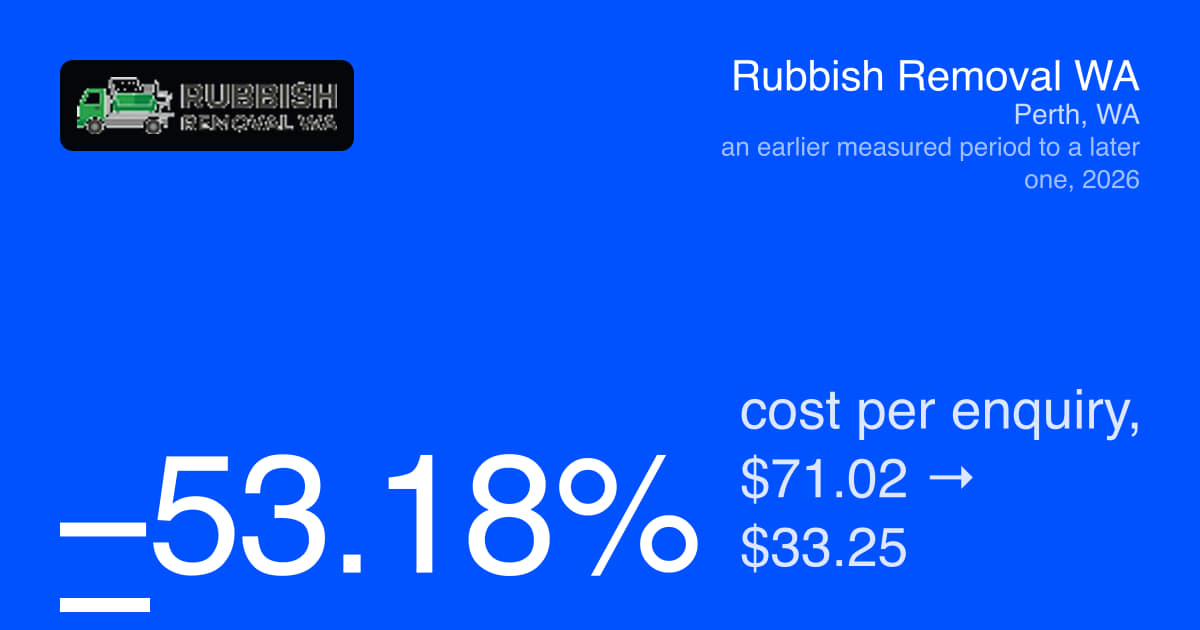
Rubbish removal Perth: cost per lead down 53.18%
Rubbish removal Perth: cost per enquiry fell from $71.02 in an earlier measured period to $33.25 in a later one, a 53.18% drop, with 213 enquiries and 40 tracked calls.
Read case study
Painting Services
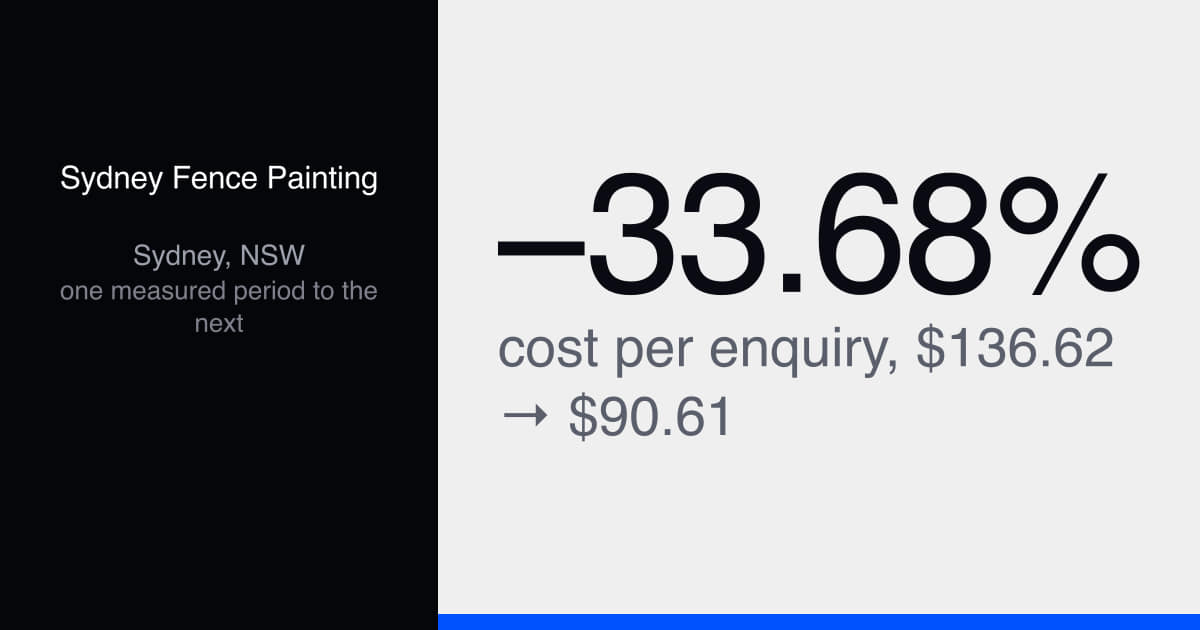
Fence painting Sydney: cost per lead down 33.68%
Fence painting Sydney: cost per enquiry climbed to $136.62 in one measured month, then came back to $90.61 in the next — a 33.68% drop. 237 enquiries in total.
Read case study
Automotive & Transport
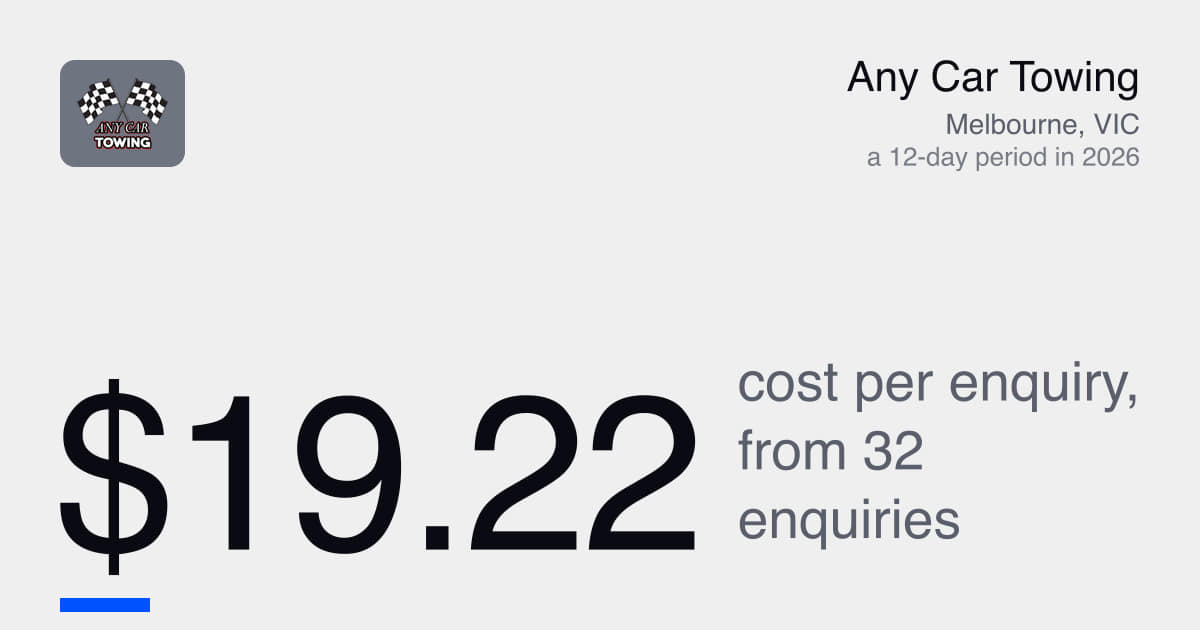
Towing leads Melbourne at $19.22 each in a 12-day period
Towing leads in Melbourne: Any Car Towing paid $19.22 per enquiry in a 12-day period in 2026 and took 85 enquiries in a later 14-day period at $20.72, converting at 36.48%.
Read case study
More plumbing businesses we have published.
One account proves very little on its own. The closest neighbour to this one is Sydney plumbing leads: 112 enquiries in Sydney Choice Plumbing's first month; its window is a 24-day period in 2026. The rest of the trade is below, with what each one is known for and how long that figure covers.
- Sydney plumbing leads: 112 enquiries in Sydney Choice Plumbing's first month112enquiries, including 23 tracked calls — a 24-day period in 2026
- Plumbing leads Sydney: 128 enquiries at $114.39 each128enquiries at $114.39 each — a 27-day period in 2026
- Plumbing leads Sydney: cost per lead down 41.96%−41.96%cost per lead — one measured period to the next, 2026
The work that produced this.
Everything above was delivered by one of a handful of things we do. These are the ones this account leant on, written up in full rather than summarised, alongside the page written for plumbing businesses generally.
- Where plumbing businesses usually lose the moneyWritten for plumbing businesses rather than for a case study: the enquiries that were never going to become work, why they cost the same as the good ones, and how that gets stopped.
- How trades accounts are built hereThe channel order we use for a home services business, what it costs to run, and what the first ninety days actually produce.
- Winning the suburbs you already serviceService-area work: the map pack, review velocity and the pages that make a suburb claim credible.
- Booked jobs, not just phone callsThe difference between a busy phone and a full diary is qualification, and it is fixable at the ad rather than at the office.
The briefing behind the work.
The case study records what happened. These two explain the channel, measurement or operating decision that made the result interpretable in the first place.
A review process that follows a real completed job and stays inside Google's rules. That case is argued in Review requests that do not sound automated.
The external entity data underneath any local-service acquisition programme. The other half of it is set out in The citation inconsistencies that still move local rankings.
The work behind this one is written up in full under where plumbing businesses usually lose the money, and the ninety-day plan that produced results like these sets out the sequence in order.
Want results like this?
Thirty minutes on your numbers rather than somebody else's, and a written list of what we would change first. Yours to keep either way.
No pitch deck. No upsell. A real conversation and a written list of leaks.