We built 1,007 range pages and 116 product-type pages built from one catalogue. We also added 570 location pages across 48 counties and 521 towns.
The business
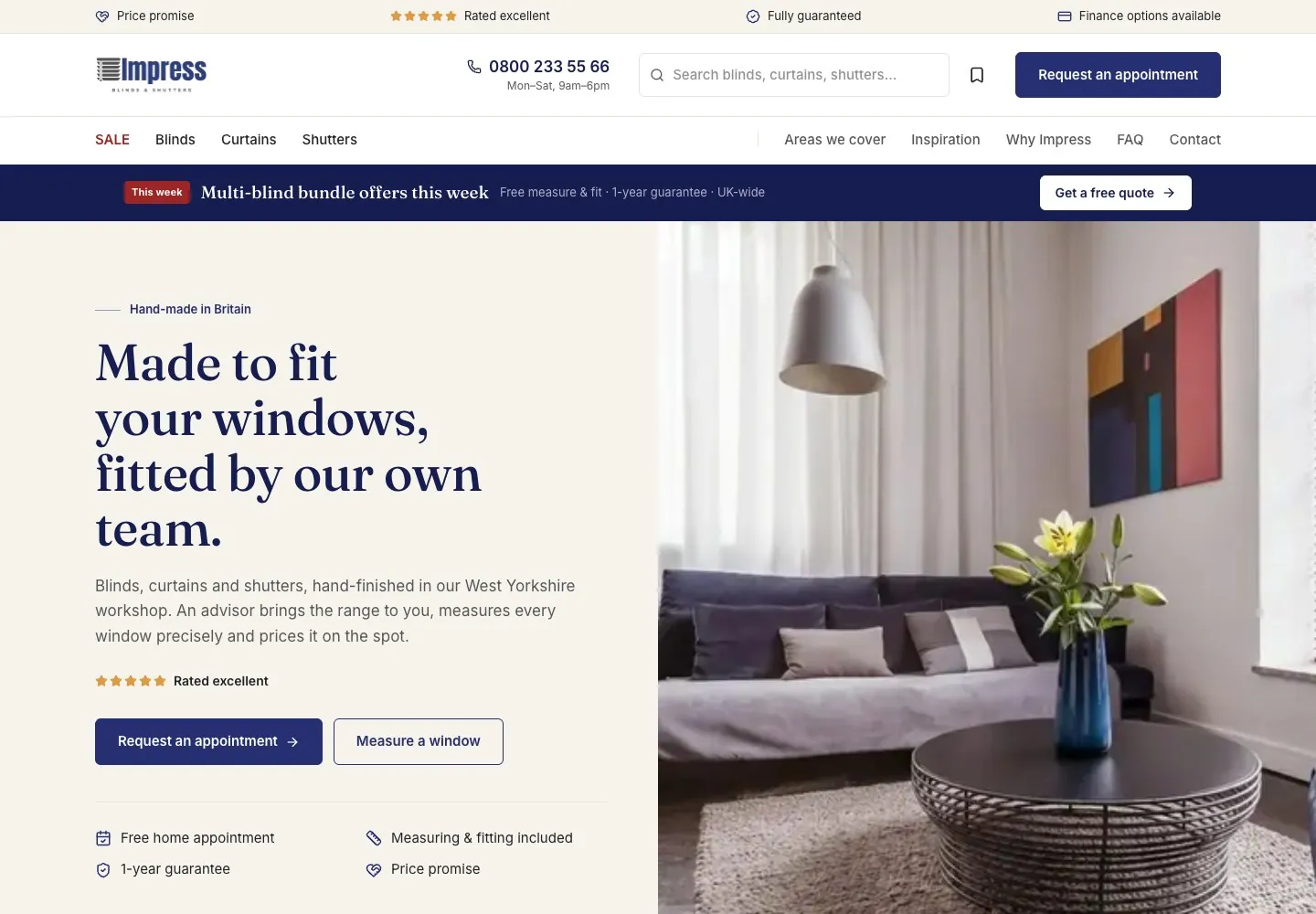
Impress Blinds makes and fits made-to-measure blinds, curtains and shutters for homes across England and Wales. The sale happens in the home. An advisor brings the samples, measures every window and gives a written quote on the day, and the business's own team does the fitting.
That model shapes the website. Nobody buys a made-to-measure blind from a web page. They look, compare and decide whether to invite someone round. The website's job is to make that decision easy and to make the appointment the obvious next step.
The brief
Impress sells a very large range: more than a thousand named ranges across 116 blind, curtain and shutter types. The brief was to show all of it without overwhelming anyone, in a calm and premium style that suits an interiors product.
Visitors start from different places. Some know the product they want. Others know the room, the window, the colour or the style they are after, or simply the town they live in. The site needed a route for each of those starting points, and every route needed to end in the same place: a free home appointment, with free samples and a phone call as the alternatives.
A catalogue of 1,007 ranges
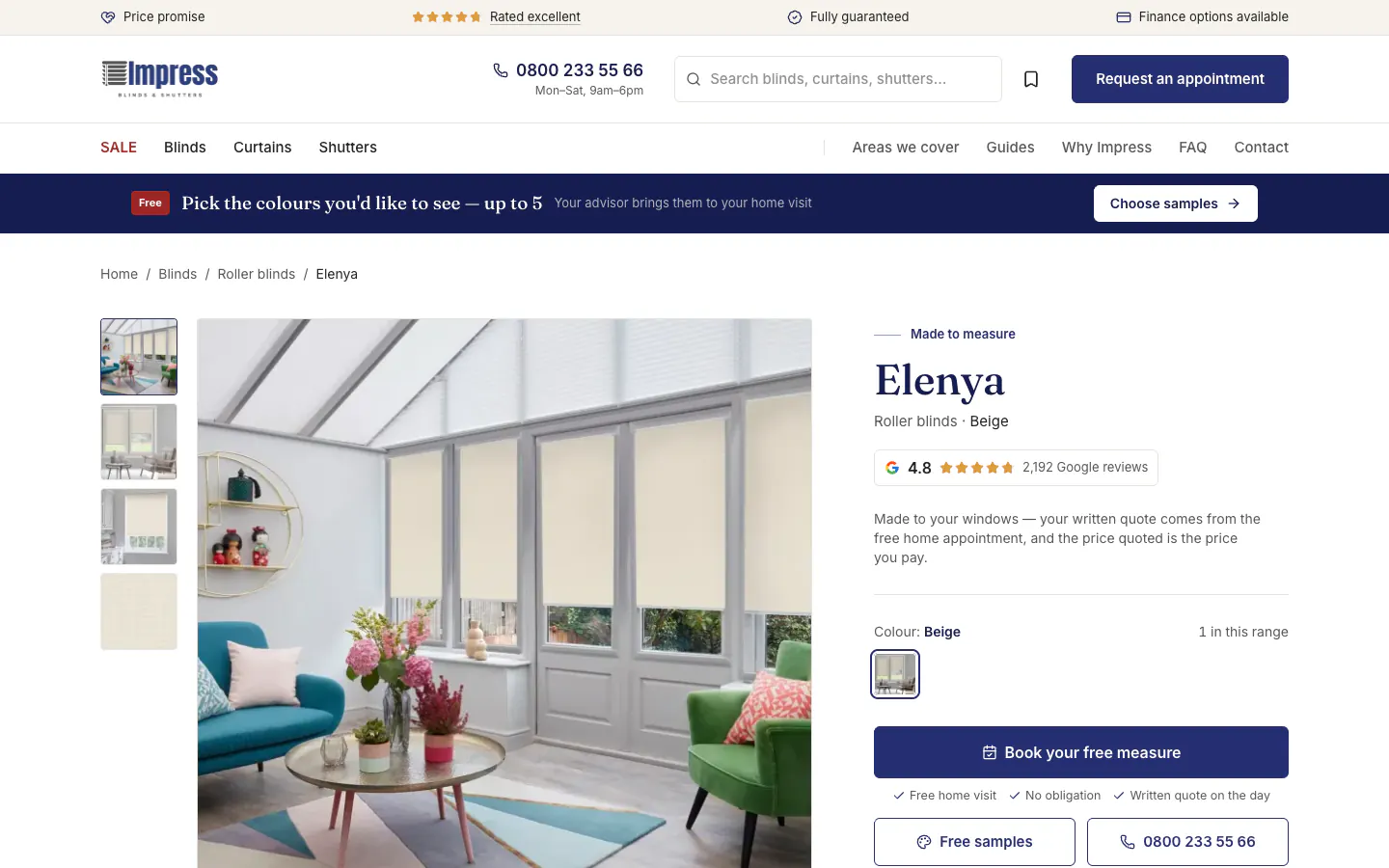
Every named range has its own page, built from one catalogue so each gets the same treatment: a photo gallery, the colours in that range, the Google rating, and buttons to book a free measure, order free samples or call. Breadcrumbs place each range under its product type. Above the ranges sit 116 product-type pages, with 71 for blinds, 32 for curtains and 13 for shutters, and four category hubs.
A menu with seven ways in
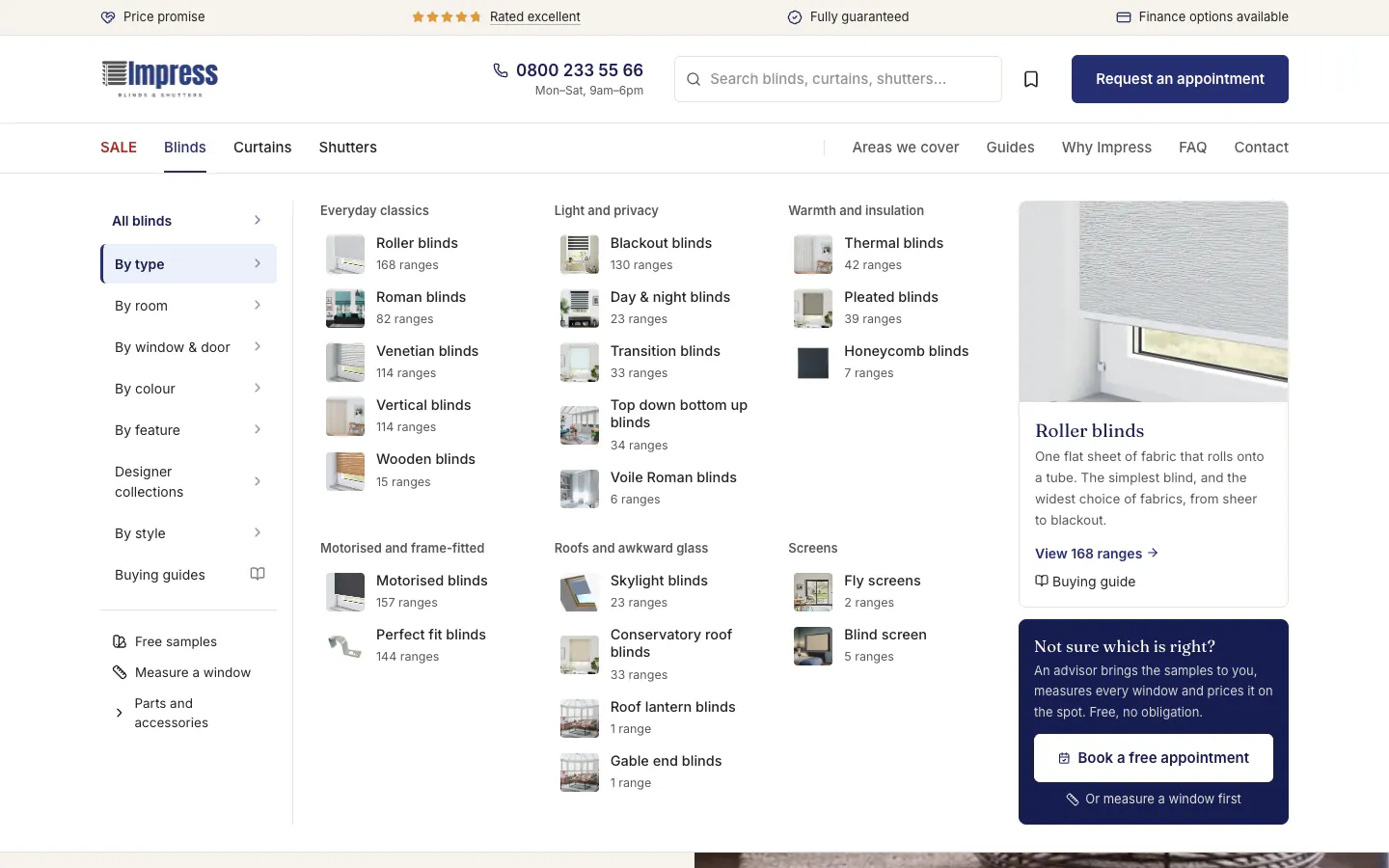
The Blinds menu lets a visitor browse by type, room, window and door, colour, feature, designer collection or style. Under type alone, 21 blind types sit in six plain groups, such as light and privacy, warmth and insulation, and roofs and awkward glass, each showing how many ranges it holds. A featured card explains the selected blind in two short sentences, and a panel beside it offers a free appointment to anyone still unsure. Product search and a bookmark for saved items sit in the header on every page.
Products explained part by part
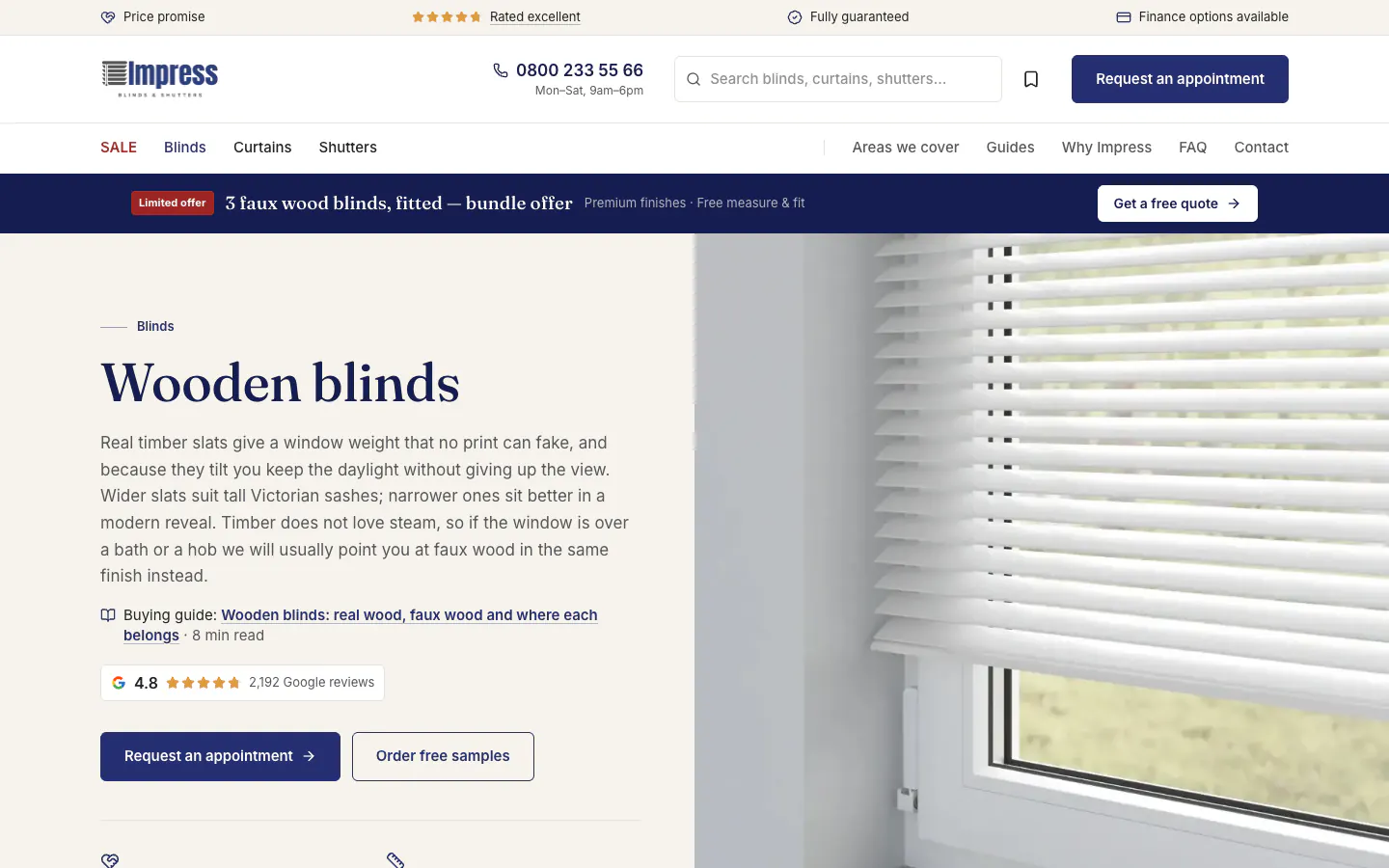
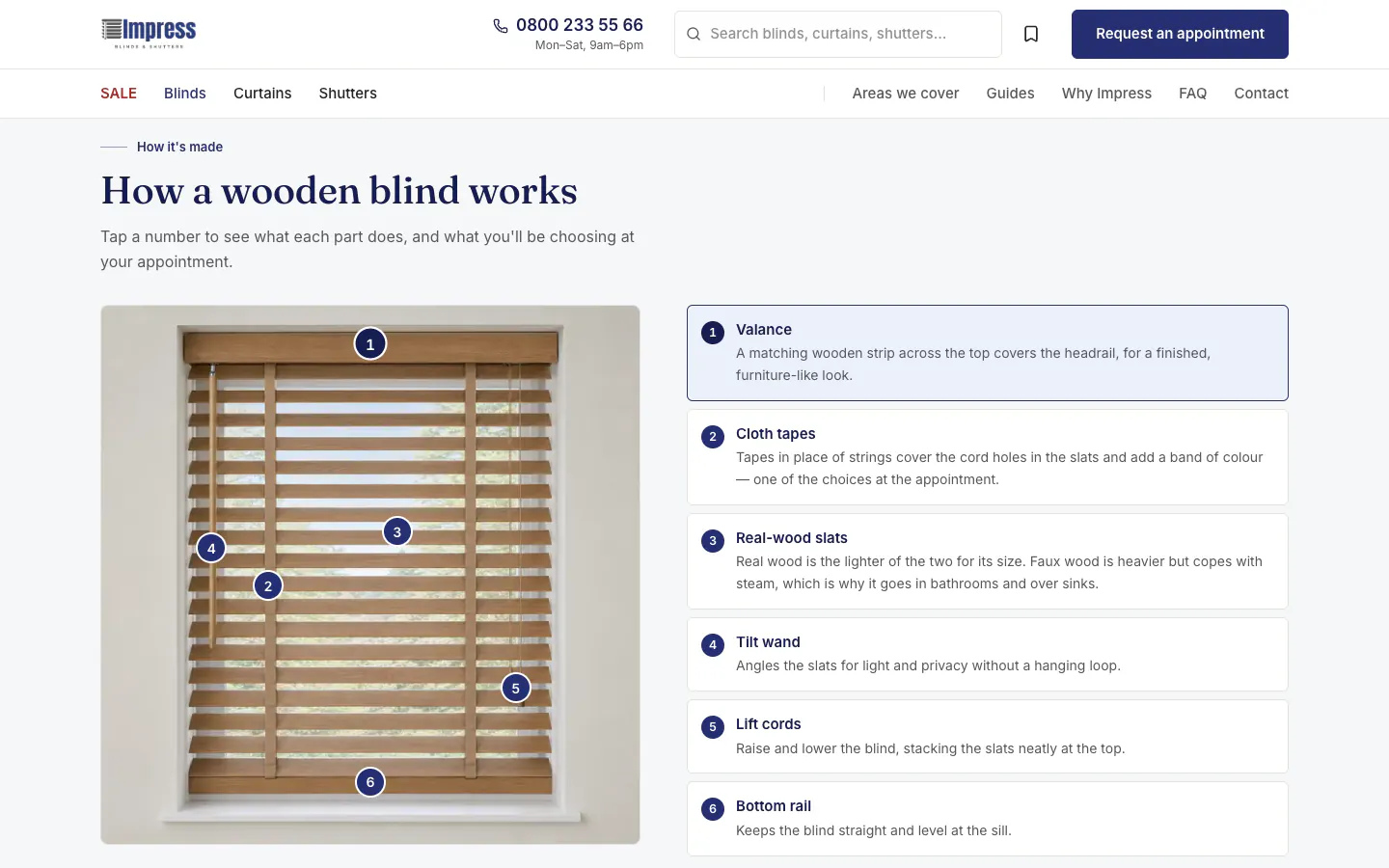
Product pages open with a plain explanation rather than a sales line. The wooden blinds page explains the difference between real and faux wood and when faux wood is the better choice, then links to its buying guide. How-it's-made explainers go further: a numbered diagram of a wooden blind describes each part, from the valance to the bottom rail, and what the customer will be choosing at the appointment. Shutter pages do the same for full-height, tier-on-tier and cafe-style shutters.
570 location pages, county by county
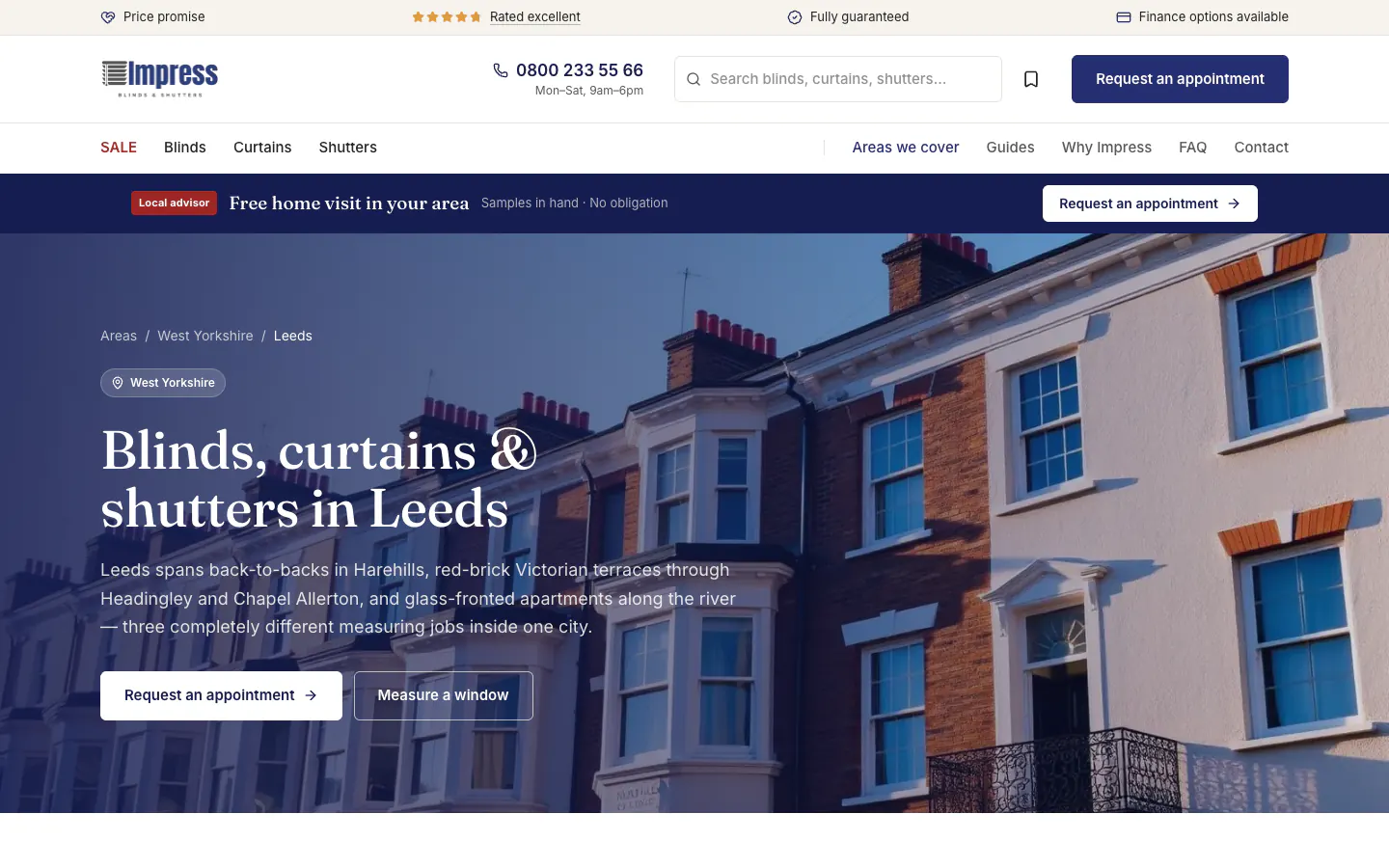
Location pages cover 48 counties and 521 towns across England and Wales, plus a hub. Each town sits under its county in the address and the breadcrumb, so Leeds is reached through West Yorkshire. The town pages are written for the place: the Leeds page describes the city's back-to-backs, Victorian terraces and riverside apartments as three different measuring jobs, then offers an appointment or the measuring tool.
Guides, styles, inspiration and offers
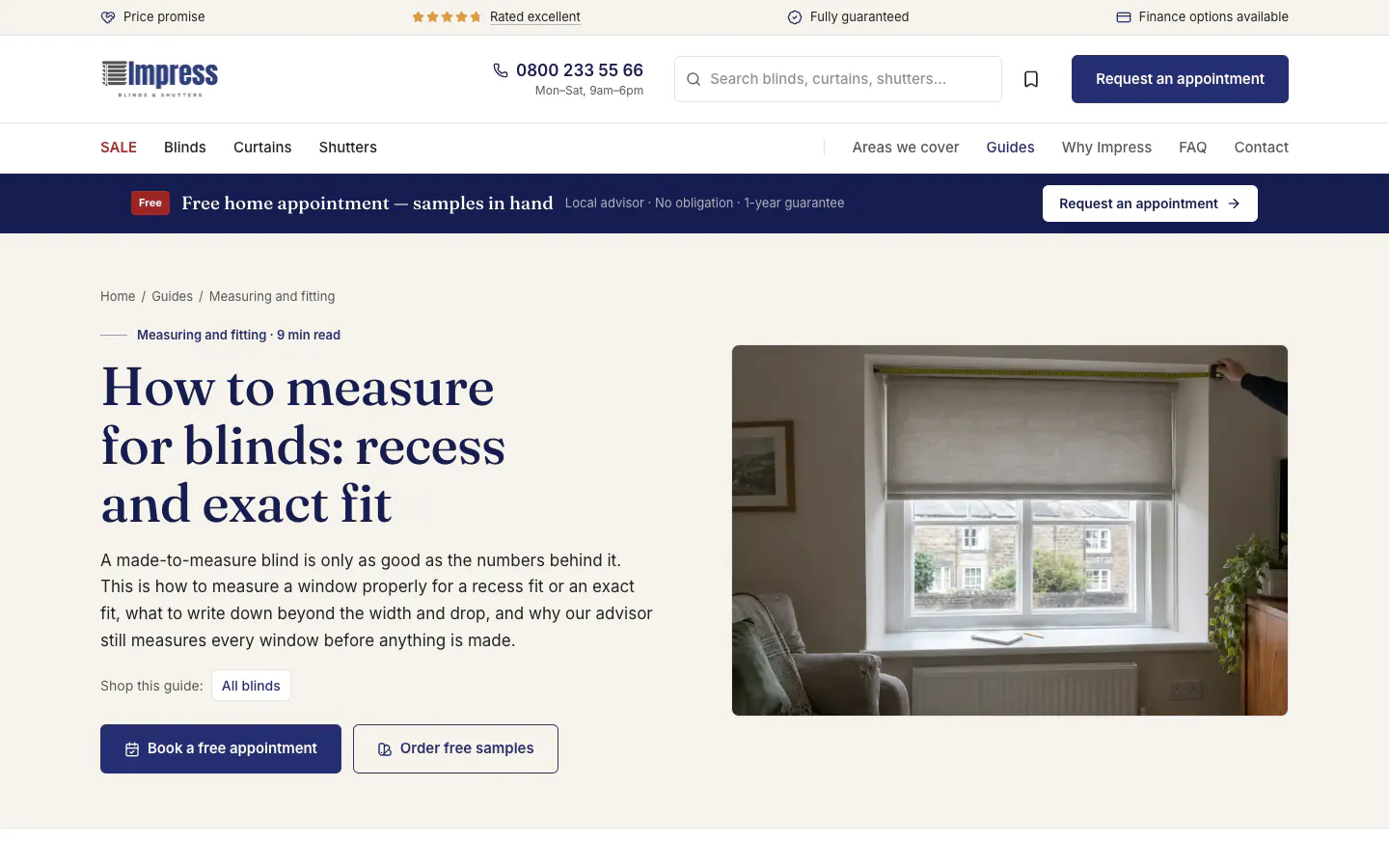
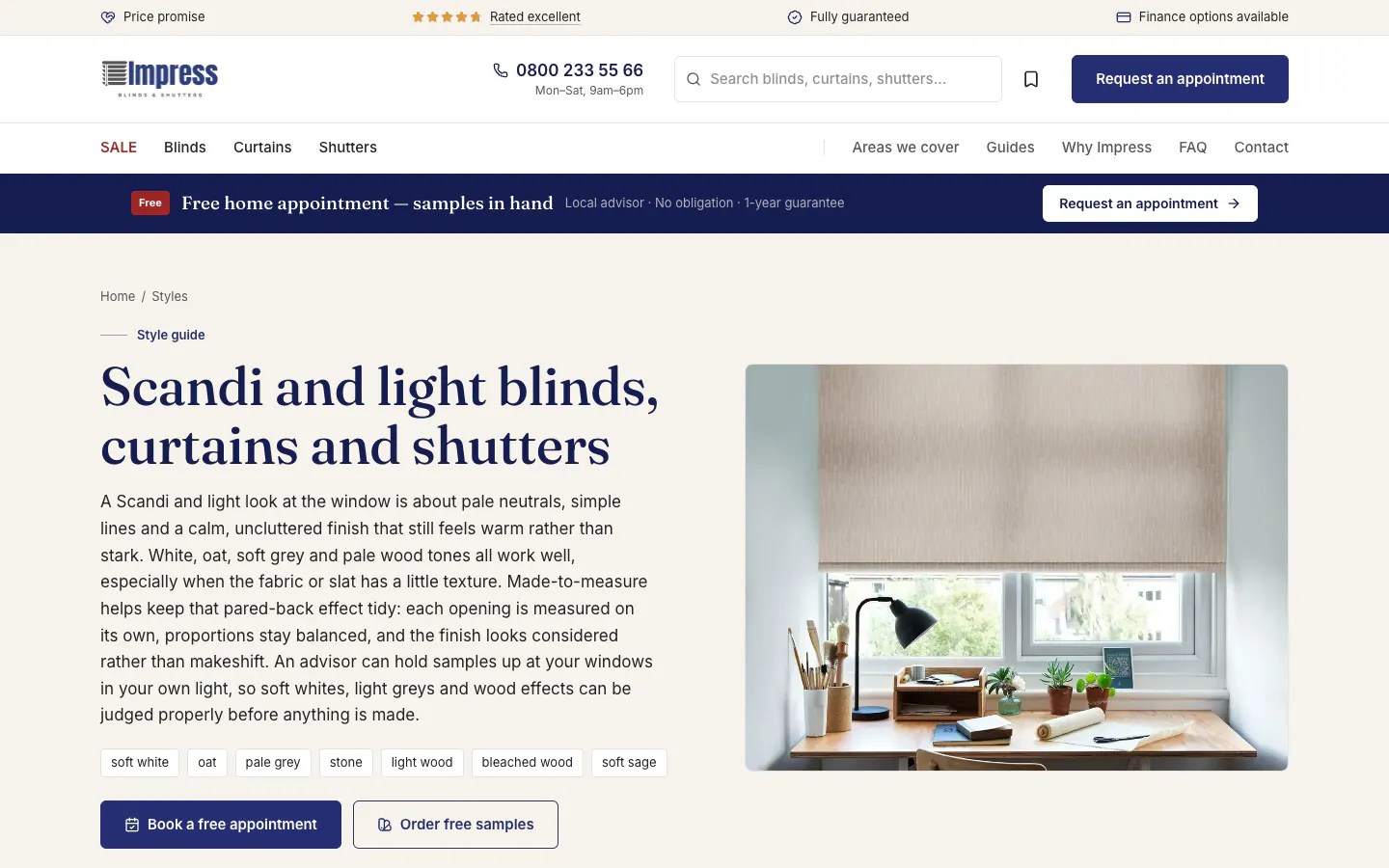
Sixty-three guides are grouped as buying guides, comparisons, measuring and fitting, room by room, and care and safety. Ten style pages, from Scandi to coastal, describe a look and the colours that suit it. Eight inspiration pages each follow one room project, from a country kitchen to a loft, and six offer pages give each product line on offer its own page.
A measuring tool that starts with one photo
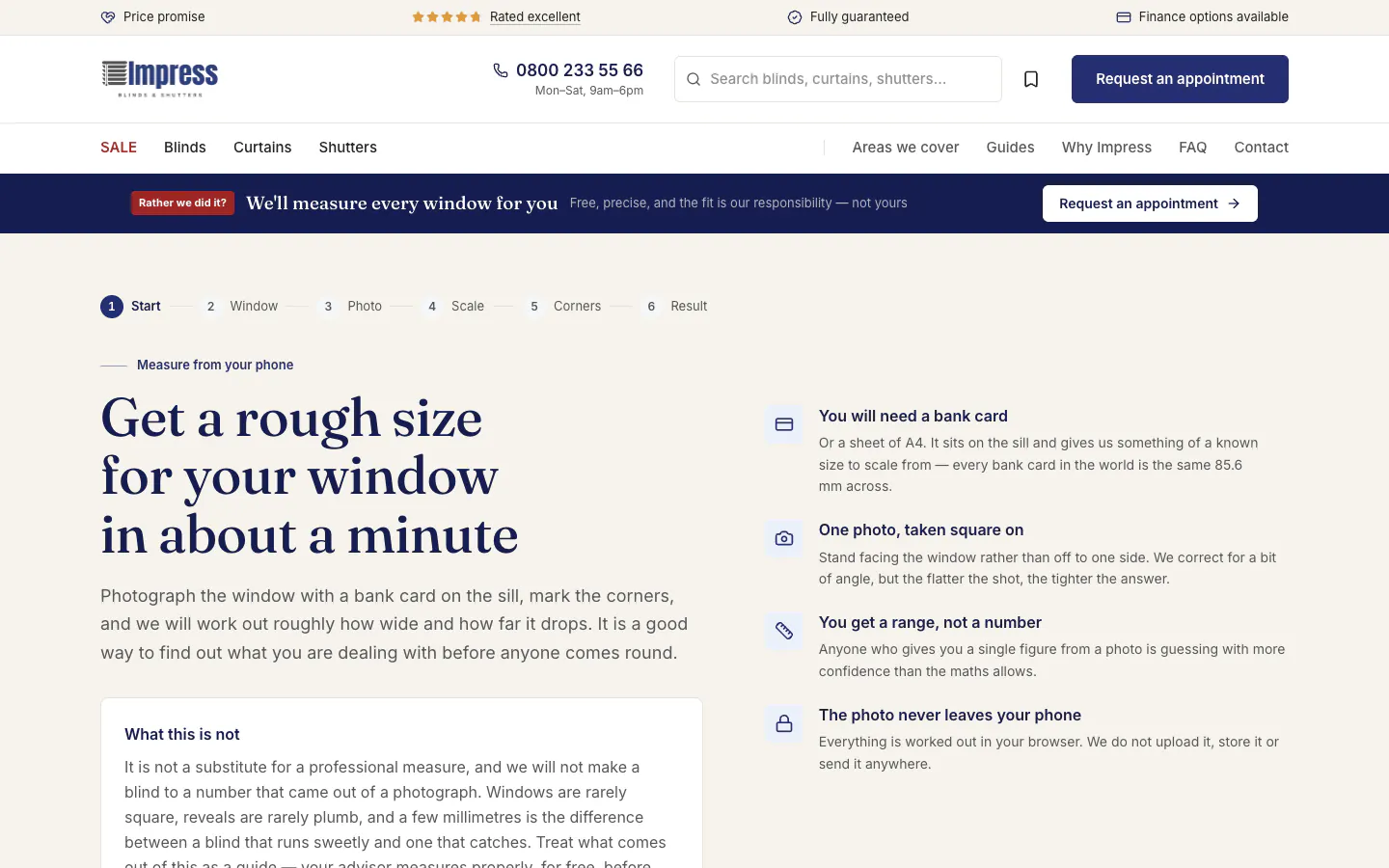
The measuring tool works in six steps: start, window, photo, scale, corners and result. The visitor photographs the window with a bank card on the sill for scale and marks the corners, and the tool returns a rough width and drop as a range rather than a single figure. The photo is worked on in the browser and is not uploaded. The tool is clear that it is a planning aid and that the advisor still measures every window properly.
Built for phones
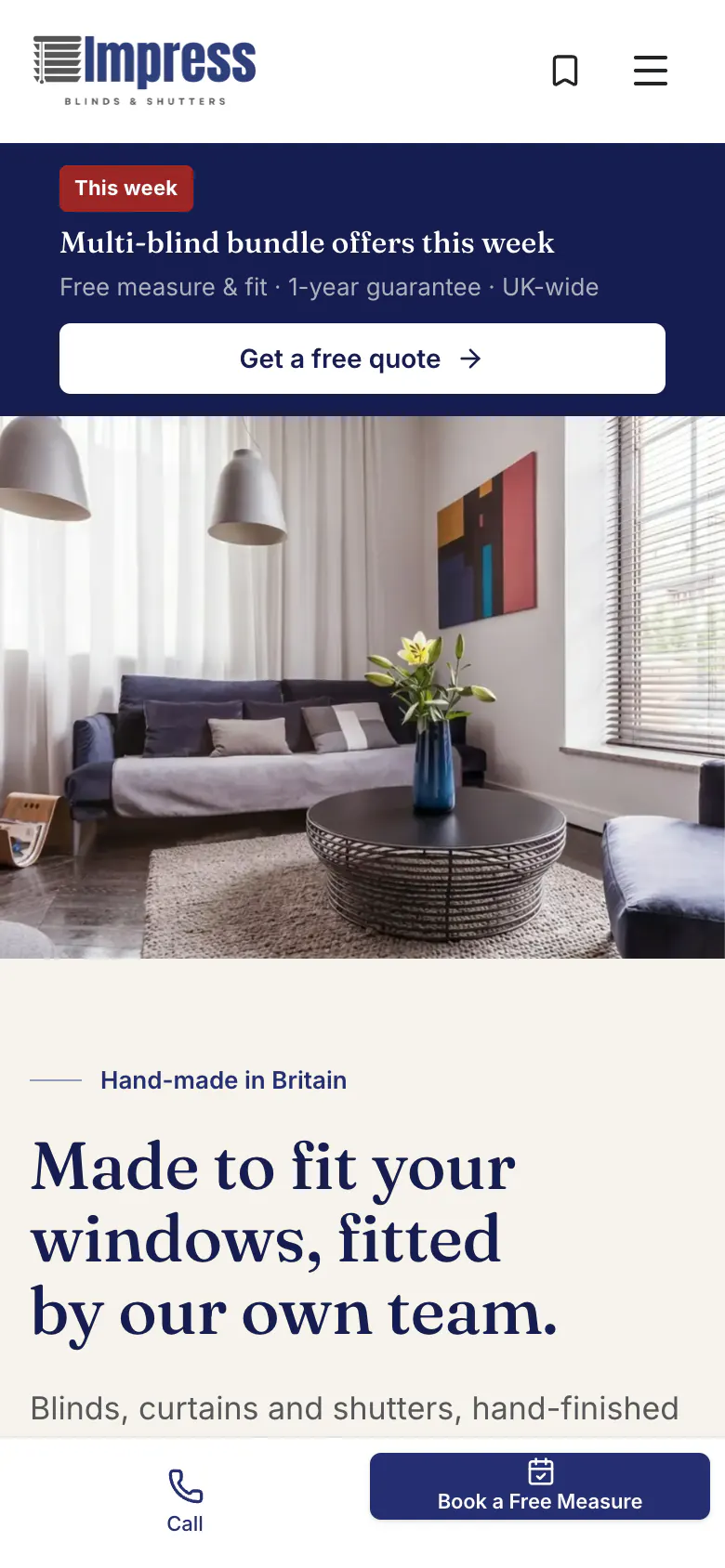
On a phone, the week's offer and a quote button come first, then the room photograph and the headline. A bar fixed to the bottom of the screen keeps two actions in reach on every page: Call, which is a tap-to-call number, and Book a Free Measure.
Product pages stack into a single readable column. The wooden blinds explanation, the link to its buying guide and the rating badge all read in order, and the menu and saved items sit behind the header icons. The measuring tool is built for the phone in the visitor's hand, since that is the camera it uses.
What it connects to
Every route through the site ends at the same next step: request a free home appointment, order free samples, ask for a quote or call. Offer banners change from page to page, and each one points to one of those actions.
Reviews come from the business's Google profile. Product pages show the reviews that mention that product first, each linking back to Google, and a review pop-up cycles in the corner of the page. Impress Blinds also runs Google Ads with us, and every product type and range has its own page, so an ad for one product can lead straight to it. Read the Impress Blinds campaign case study for that side of the work.
To plan a catalogue website around how your customers actually choose, see our website design work and our approach to conversion rate optimisation.