Proof
    Impress Blinds — cost per enquiry down 62.63%, $23.6 to $8.82SLS Solicitors — cost per enquiry down 58.48%, $84.64 to $35.14FixCare Property — cost per enquiry down 56.36%, $35.24 to $15.38Rubbish Removal WA — cost per enquiry down 53.18%, $71.02 to $33.25Floral Cakery — cost per enquiry down 49.82%, $13.83 to $6.94ILLUMINATE Laser Emporium — cost per enquiry down 48.54%, $138.65 to $71.35Aussie Plumbing — cost per enquiry down 41.96%, $117.75 to $68.34Sydney Fence Painting — cost per enquiry down 33.68%, $136.62 to $90.61Alliance Plumbing — cost per enquiry down 29.6%, $81.26 to $57.21Gridless Build Solutions — cost per enquiry down 29.16%, $78.16 to $55.37FacilityWorx — cost per enquiry down 23.62%, $157.13 to $120.01Cornerstone Roofing — cost per enquiry down 20.47%, $41.71 to $33.17A council finance platform — 194 of 194 requirements metA council finance build — 14 weeks to UAT, −34% 10-yr costA cultural institution — $634K of $750K kept workingA council platform — $470,106 built vs $503,262 SaaSA federal agency — n=5,000 prevalence survey at ±1.4%A civic mural — 36 concepts for a 71m × 9m wallA regional shire — 32-page visitor guide, 3 weeks earlyA shire council — one platform retiring 8 of 9 vendorsA pressure washing business — 138 jobs at A$20.43 eachA pressure washing business — 21.20% conversion rateA carpet cleaner — 53 jobs in 15 days at A$24.92 eachA roofing company — 68 quote requests in 35 daysA CCTV installer — 39 qualified leads in 15 daysA fence painter — 36 jobs in 24 days, quotes by day 3A maintenance business — live in 8 weeks, 3 stacks gone41 numbered clauses, published in full5.0 across every Google review$120M+ in media under management250+ active engagements across five countries
    Roofing

    Roof repair leads Sydney: 35 enquiries at $116.85

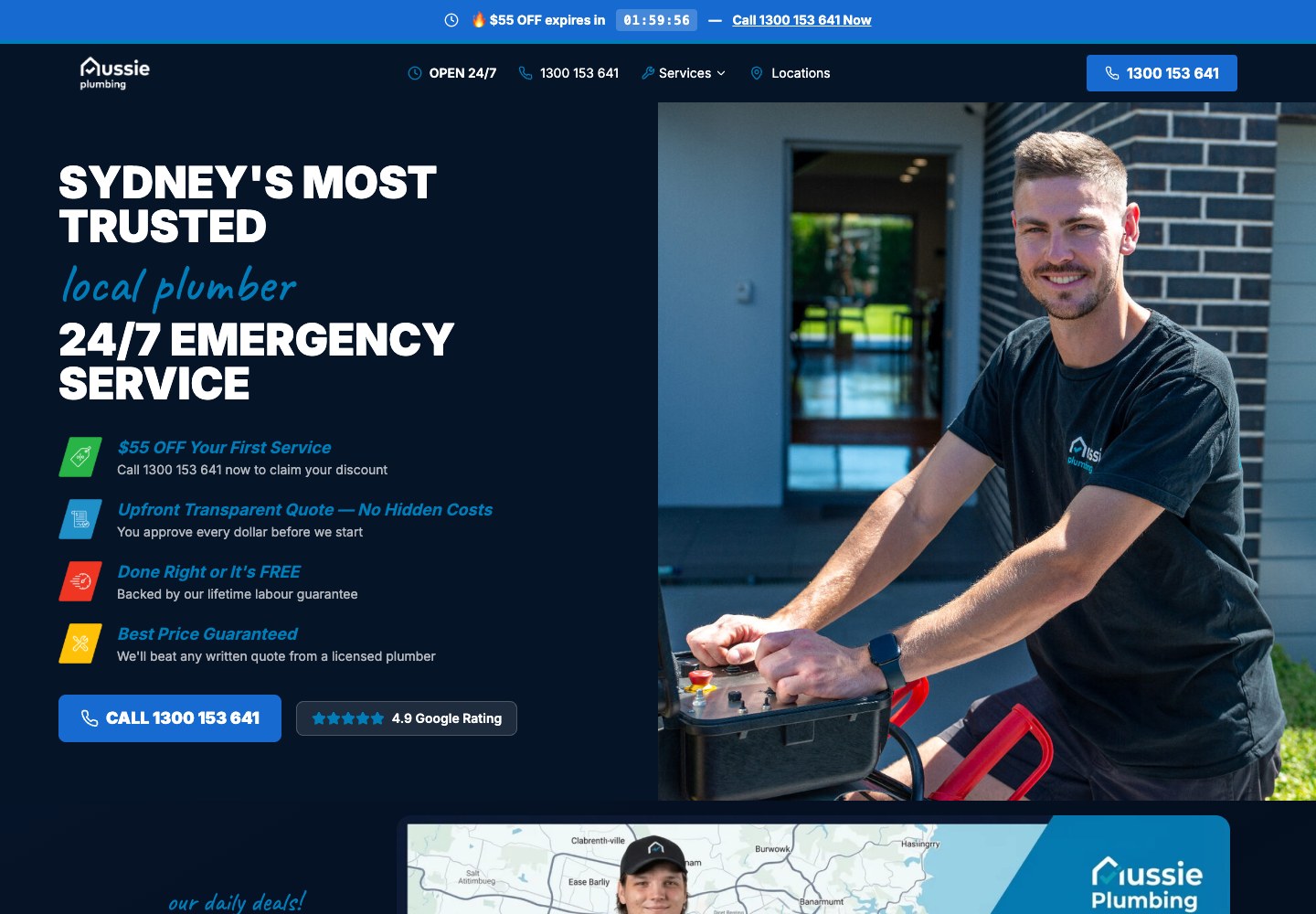
    Aussie Plumbing · Roof repairs, leaks and restoration · Sydney, New South Wales

    The short version · a 25-day period in 2026

    Aussie Plumbing already had a working Sydney plumbing account.

    Roofing was a separate problem: a different auction, different search noise, and no history to borrow. The campaign ran five days, produced 4 enquiries at $159.88, and was taken off air for five days while somebody read the search terms and rebuilt it around the words people were actually typing. The following 14 days produced 31 enquiries at $111.30 each, at roughly the same conversion rate — more of the same customer, not more of a cheaper one. Across the whole 25 days: 35 enquiries at $116.85. Dates are withheld on purpose; this is one measured window we selected out of the account.

    The result.

    35

    roof enquiries at $116.85 each

    a 25-day period in 2026

    $111.30

    cost per enquiry

    the final 14 days of that period

    $159.88

    cost per enquiry

    the first 5 days on air

    10.87%

    of clicks became an enquiry

    a 25-day period in 2026

    28 of 35

    enquiries arrived as phone calls

    a 25-day period in 2026

    Industry
    Roof repairs, leaks and restoration
    Discipline
    Roofing
    Ad spend band
    $1K–$5K
    Measured over
    a 25-day period in 2026

    Every figure above was read out of this client's live account and is reproduced exactly as the study publishes it. It is a record of what happened on one account, in one market, at one budget — not a forecast for yours.

    What would this look like on your account?

    Different market, different budget, different numbers. The first call is where we work out whether the same approach fits yours at all.

    Roof repair leads Sydney: 35 enquiries at $116.85

    The case study

    What moved for Aussie Plumbing.

    The short list

    1. Across the measured 25 days: 35 enquiries at $116.85 each, from 322 clicks and 5,595 impressions.
    2. The first 5 days on air produced 4 enquiries at $159.88. That is a ramp, not a baseline, and we do not present it as one.
    3. The campaign came off air for 5 days while it was rebuilt around what people had actually searched for.
    4. The 14 days after produced 31 enquiries at $111.30 — 2.2 a day against 0.8 a day before.
    5. Conversion rate barely moved, 11.43% to 10.80%. That is what says the account found more of the same customer rather than a cheaper, worse one.
    6. 28 of the 35 enquiries came in as phone calls, which is a rostering question as much as a marketing one.

    Each line above belongs to the period printed with it. None of them is an average across the account, and none of them is a forecast.

    A plumbing account is not automatically a roofing account

    Aussie Plumbing had a working Sydney search account before any of this started. Plumbing, drains, the emergency work that pays for a trade in this city — all of it already running, already producing enquiries at a price the business had decided it could live with. Roof repairs looked, from the outside, like the easy next step. Same brand, same vans, same suburbs, same phone.

    It is not the easy next step, and the reason is worth stating plainly. A roof leak and a burst pipe feel like the same emergency to the person searching, but they are bought differently. The roofing auction has specialist restoration firms in it who do nothing else. The searches carry a lot of noise a plumbing account has never had to deal with — roof racks, car roofs, sunroofs, people looking for a job on a roofing crew, people pricing tiles at a hardware store. And the intent splits in a way plumbing rarely does: half the market wants somebody there today because water is coming through a ceiling, the other half is pricing a restoration they might get around to next autumn.

    None of that is visible in the plumbing account's history, so none of it could be borrowed. The roofing side had to learn it the way every new campaign does — by spending money and being read closely by somebody while it did.

    What the first five days on air actually told us

    The campaign went live and ran for five days. It spent $639.50, drew 35 clicks and produced 4 enquiries, which works out at $159.88 each.

    We want to be careful about that figure, because it is the kind of number that gets quoted as a starting point and then used as the base of a percentage. Four enquiries is not a baseline. It is a ramp. Off four, a single unusually cheap week or one expensive one moves the average by thirty or forty dollars, and anybody who tells you otherwise is selling the drop rather than reporting it.

    What those five days were genuinely good for was the search terms. Somebody sat down and read what people had actually typed to reach the ads, which at 35 clicks takes about twenty minutes and is the single most useful twenty minutes in a new campaign's life. The reading is what produced the decision, and the decision was not "adjust the bids".

    The campaign was not underperforming. It was aimed at the wrong words.

    Five days off air

    We took it down. For five days the roofing campaign served nothing at all, which is an uncomfortable thing to do to a client who has just started paying for it, and the right call anyway.

    What went on in that gap was ordinary craft work, done by people at desks. The ad groups were pulled apart and rebuilt around what the search terms showed people were actually looking for — repairs, leaks, restoration, repointing, broken tiles, metal and Colorbond — rather than around the trade's own word for it. Somebody wrote fresh ads for each of those, because an ad written about roof plumbing does not speak to a person who typed "cracked roof tiles". And a long list of exclusions was written by hand, one at a time, to keep the account away from roof racks, sunroofs, hardware pricing and job seekers.

    That last part is unglamorous and it is most of the job. There is no clever way to do it. Somebody reads the terms, decides which ones are a person with a wet ceiling and which ones are a person with a Corolla, and writes the second group out of the account.

    The fourteen days after

    • 31 enquiries in 14 days — from 287 clicks and 5,233 impressions
    • $111.30 per enquiry, against $159.88 across the five days before the rebuild
    • 10.80% of clicks became an enquiry, against 11.43% in the opening stretch
    • $3,450.35 spent in those 14 days, against $639.50 in the five before
    • Roughly 2.2 enquiries a day, against 0.8 a day before

    The number worth holding onto there is not the cost per enquiry. It is the conversion rate, which barely moved — 11.43% before, 10.80% after. That is the figure that tells you what actually happened.

    If the rebuild had simply found a cheaper, softer corner of the market, the conversion rate would have fallen away as volume climbed. It did not. The account went from 0.8 enquiries a day to 2.2, spent nearly twice as much per day to do it, and kept converting at roughly the same rate — which says it found more of the same kind of person rather than a lot more of a worse one.

    Across the whole 25 days

    Taken end to end rather than split in two, the campaign spent $4,089.85, served 5,595 impressions, drew 322 clicks at a 5.76% click-through rate, and recorded 35 enquiries at a blended $116.85 each. 10.87% of clicks became an enquiry.

    Twenty-eight of the 35 came in as phone calls and 7 as submitted forms, which is the split you would expect and worth planning around. Two enquiries a day arriving as calls is a rostering question before it is a marketing one — a roof leak customer who reaches a voicemail rings the next roofer on the list, and no amount of advertising fixes that.

    The device split is less predictable than the plumbing side of the same account. Mobile produced 21 of the 35 enquiries off 222 clicks, but desktop produced 13 off only 89 — a materially better rate per click. That is a small sample and we are not going to build a theory on it, but it is consistent with the half of this market that is pricing a restoration rather than reacting to an emergency, and that half sits at a desk.

    What we are not claiming

    Three things, stated before anybody else has to ask.

    This is 25 days. It is not a trend, it is not a season, and roofing is a trade where the weather decides a good deal of the demand. A wet fortnight in Sydney will flatter any roofing account and a dry one will punish it, and 25 days is nowhere near enough to see through that.

    The $159.88 opening figure rests on 4 enquiries. We have quoted it because it is what the account did, and we have put the drop to $111.30 next to it because that is also what the account did. We are not going to render it as a headline percentage, because a percentage calculated off four events reads as far more solid than it is.

    And the roofing campaign is not the account. It sits alongside the plumbing campaigns in the same Aussie Plumbing account, which has its own longer history and its own figures. This page is about the roofing side only, over one measured window, reported without dates on purpose.

    Adding a second trade to a working account?

    The mistake we see most often is treating it as an extension rather than as a new campaign that happens to share a logo. The existing account's history does not transfer, the search noise is different, and the first fortnight will look worse than the business expects because it is genuinely starting from nothing. What it needs is not a bigger budget. It needs somebody to sit down and read what people typed, then act on it quickly enough that the learning does not cost a whole quarter. If you are putting a second trade in front of a Sydney audience, talk to us before you switch it on.

    Tags

    • Roof repairs, leaks and restoration
    • Sydney, New South Wales
    • $1K–$5K

    That is one account. Yours is a different one.

    We read your ads, your search presence and your tracking the same way this one was read, and tell you what we would change first.

    What every number on this page actually means.

    Marketing words get used loosely, and a loose word can make a small result look like a big one. Here is exactly what we mean by each of them.

    Conversion
    One real action by one real person: a phone call that lasted long enough to be a conversation, a submitted enquiry form, a booking, or a purchase. Not a page view and not a form that merely loaded.
    Cost per job · cost per lead
    The advertising money spent, divided by the number of those actions. It is the only figure that tells you whether the advertising is worth doing, which is why we publish it next to the count.
    Conversion rate
    The share of people who clicked the ad and then did the thing. A high click count with a low conversion rate usually means the ad and the page are promising different things.
    Ad spend
    Money that went to the advertising platform, not to us. Our management fee is separate and is never included in a cost-per-job figure, because mixing them would flatter the number.
    The measurement window
    The dates the figure covers, named every time. Where a study covers a launch, the clock starts the day campaigns went live — not the day the graph started looking good.
    A starting point
    Where a study knows what a figure was before the work began, that number is printed next to the one it became. Where the account had no history to compare against, the result is printed on its own rather than measured from a number nobody recorded.
    Qualified lead
    An enquiry that matched the service and the service area, so it was worth someone picking up the phone for. Where a study says qualified, somebody checked.
    An anonymised client
    Government, council and cultural-institution engagements are published as sector and jurisdiction only. The work and the measured outcome are described in full; the organisation is not named.

    One more, because it matters most: nothing on this page is a guarantee. It is a record of what happened on one account, in one market, at one budget.

    What this study cannot tell you is what the same figure looks like on your account — so the missed-call calculator, with your own click price and close rate. It takes about a minute and asks for nothing.

    SoudCoh Compound™

    This page exists because of two of the six stages.

    Compound is how our team works on any account — six stages every change passes through. Two of them are why there is anything honest to publish.

    • Meter

      If it can't be measured, it doesn't get bought.

      Before a dollar moves, every action worth money to the business is tracked as itself — calls, forms, bookings, purchases — with values attached. Without that stage there is no honest number to publish afterwards.

    • Ledger

      Every change we make becomes a record you can open.

      Every change lands in a dated record as it happens — what was added, what was stopped, what was rewritten and what it cost. Writing this page afterwards was reading a file, not reconstructing a memory.

    If you want one of these

    What actually happens after the first call.

    No mystery and no lock-in before you have seen anything. This is the sequence every account on this site went through.

    1. The call

      Thirty to forty-five minutes, free

      What you sell, who buys it, and what one customer is worth to you. No deck. You leave with a real number for your situation rather than a range.

    2. Week 0

      The audit

      We open your account — or your competitors' ground, if you do not have one yet — and write down every leak we can find. That list is yours whether or not you work with us.

    3. Week 1

      The build

      Everything the account needs before it can spend a dollar: what it will bid on, what it must never pay for, the ad copy, the assets, the landing pages and the tracking. A second person checks all of it before anything is live.

    4. Day one

      You press go

      Campaigns are created paused, every time, so you can read the whole build first. You activate when you are ready, not when we are.

    5. Days 1–14

      The clean

      The busiest fortnight your account will ever have. Search terms read daily, waste negated, early winners promoted, ad copy iterated against what is actually being served.

    6. From there

      Rhythm

      Weekly optimisation, reporting on a fixed cadence whether the news is good or bad, and a proper conversation each quarter about where the next block of budget should go.

    Before you ask us anything

    Here is what everybody asks first.

    FAQ

    The questions this raises.

    Whether the figures are real, how they were measured and over what length of window, what it costs, and whether any of it would hold for roofing businesses.

    The first call is free and there is no deck.

    Book a call
    How much does a roof repair lead cost in Sydney?

    In this campaign, $116.85 per enquiry blended across the measured 25 days, and $111.30 across the final 14 of them. That is one campaign over a short window, not a market rate. Roofing sits below Sydney emergency plumbing on cost per enquiry but the auction has specialists in it who do nothing else, and the search noise is heavier — roof racks, sunroofs, hardware pricing and job seekers all have to be written out of the account by hand before the figure settles anywhere sensible.

    Why was the campaign switched off for five days?

    Because the first five days showed it was aimed at the wrong words rather than performing badly, and continuing to spend while that was true would have bought nothing but more of the same. Somebody read the search terms, and the ad groups were rebuilt around what people were actually typing — repairs, leaks, restoration, repointing, broken tiles — instead of around the trade's own name for the work. Taking a new campaign down is uncomfortable when a client has just started paying for it. It was still the right call.

    Can you just add roofing to an existing plumbing account?

    Not in the sense most people mean. It shares the brand, the vans and the phone, but the account history that makes an established campaign work does not transfer to it — the roofing side walks into a different auction with no record of which searches produced booked jobs. Expect the first fortnight to look worse than you think it should, and expect the fix to be somebody reading search terms rather than somebody raising the budget.

    Is 25 days long enough to judge a roofing campaign?

    No, and we would rather say that here than be asked. Roofing demand moves with the weather, so a wet fortnight flatters any roofing account and a dry one punishes it. Twenty-five days establishes that the enquiries exist and can be bought at a workable price. It does not establish a trend, and reading it as one would be a mistake we are not going to invite.

    Are the figures in this Aussie Plumbing case study real?

    Yes. Every number on this page was read out of the client's own advertising account and is printed here exactly as the study publishes it, beside the period it covers. The dashboard and ad images are screen-grabs of that account rather than recreations. If one of these figures matters to your decision, ask about it on the first call and we will walk you through where it came from.

    How were these numbers measured, and over what window?

    The headline figure covers a 25-day period in 2026, and every other figure on the page is printed beside the period it belongs to. We publish the LENGTH of a measurement window and the year, and withhold the exact dates — when a client advertised, and how their trading calendar looks, is their commercial information rather than ours. A conversion means one real action by one real person: a phone call that lasted long enough to be a conversation, a submitted enquiry form, a booking, or a purchase. Not a page view, and not a form that merely loaded.

    How much was being spent to produce this?

    The study publishes this account's advertising spend as a band — $1K–$5K — rather than an exact figure, because the precise number is the client's business. Our management fee is separate from that and is never folded into a cost-per-lead figure anywhere on this site; mixing the two would flatter every number on the page.

    Would this work for roofing businesses like mine?

    We cannot promise you the same numbers, and nobody honestly can. What this page tells you is what was achievable in that market, at that budget, for that service. Your competition, your service area, your margins and what one customer is worth to you all move the answer. On the first call we build the picture from your figures rather than someone else's, and if the honest answer is that this channel is wrong for you right now, we will say so.

    More accounts, same discipline.

    Studies from the same kind of work, so you can see how the pattern holds across different businesses.

    Everything above was delivered by one of a handful of things we do. These are the ones this account leant on, written up in full rather than summarised, alongside the page written for roofing businesses generally.

    The briefing behind the work.

    The case study records what happened. These two explain the channel, measurement or operating decision that made the result interpretable in the first place.

    A review process that follows a real completed job and stays inside Google's rules. That case is argued in Review requests that do not sound automated.

    The external entity data underneath any local-service acquisition programme. The other half of it is set out in The citation inconsistencies that still move local rankings.

    The work behind this one is written up in full under how roofing accounts are built and budgeted, and the operating sequence behind every study on this site sets out the sequence in order.

    Want results like this?

    Thirty minutes on your numbers rather than somebody else's, and a written list of what we would change first. Yours to keep either way.

    No pitch deck. No upsell. A real conversation and a written list of leaks.