
Sydney plumbing leads: 80 enquiries at $110.72 for Eagle Plumbing
Eagle Plumbing · Plumbing and drainage · Sydney, NSW
The short version · a 26-day period in 2026
Eagle Plumbing answers the phone around the clock across Sydney.
The period below is a single measured window, left undated for the client's privacy. Across 26 days in 2026, 13.36% of every click became a recorded enquiry: 80 enquiries at $110.72 each. Taken over the whole account rather than one period, it recorded 103 enquiries from 696 clicks, and inside the selected window 25 of the 26 days produced at least one.
The result.
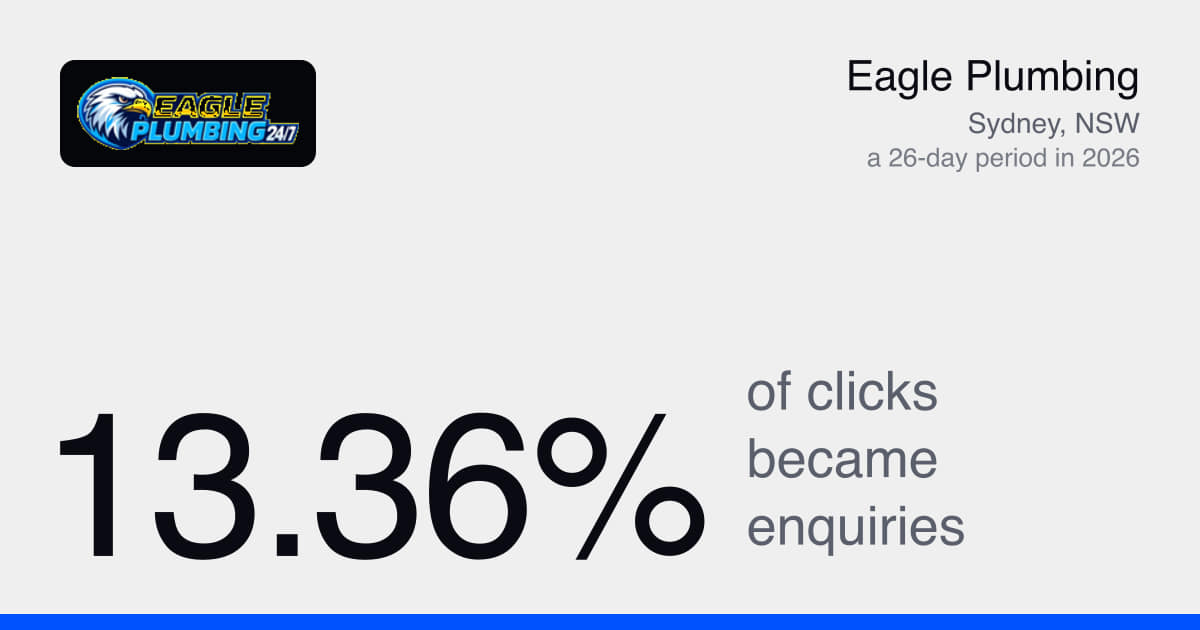
13.36%
of clicks became enquiries
a 26-day period in 2026
80
enquiries
a 26-day period in 2026
$110.72
cost per enquiry
a 26-day period in 2026
103
enquiries in total
across the account's wider run
4.79%
click-through rate
across the account's wider run
- Industry
- Plumbing and drainage
- Discipline
- Home Services
- Ad spend band
- $10K–$25K
- Measured over
- a 26-day period in 2026
Every figure above was read out of this client's live account and is reproduced exactly as the study publishes it. It is a record of what happened on one account, in one market, at one budget — not a forecast for yours.
What would this look like on your account?
Different market, different budget, different numbers. The first call is where we work out whether the same approach fits yours at all.
The case study
What moved for Eagle Plumbing.
The short list
- 13.36% of clicks became enquiries in the selected period in 2026: 599 clicks produced 80 enquiries.
- 80 enquiries at $110.72 each, across a 26-day period in 2026.
- 103 enquiries in total, taken over the whole account rather than one period, from 696 clicks and 14,535 impressions.
- 83 of those 103 enquiries arrived as a phone call, the demand an all-hours plumber is built for.
- 25 of the 26 days in that period in 2026 produced at least one enquiry; the strongest of them produced 9.
Each line above belongs to the period printed with it. None of them is an average across the account, and none of them is a forecast.
Selling 24/7 plumbing without paying for the other 23 hours
Eagle Plumbing answers the phone around the clock across Sydney, which sounds like a straightforward advantage until you try to advertise it. Genuine after-hours availability is one of the most valuable things a plumber can offer, and one of the easiest to waste money on.
A 2am search for an emergency plumber and a 2pm search for a dripping tap look nearly identical to an ad platform. So the account had to be efficient rather than large: a substantial budget doing a disproportionate amount of work.
Sydney is the hardest version of this problem
This is the largest and most expensive plumbing search market in the country. National franchises, established multi-van operators and one-man outfits all bid on the same handful of urgent phrases, and the click price reflects that fight.
So does the noise. An enormous share of plumbing traffic in this city is people pricing a job they will do next month, people looking for a part, people who want a landlord to pay for it, and people who are not in the service area at all. Buying "plumber Sydney" buys all of them.
Against that, a genuine emergency job is worth having, and an after-hours business is built to catch the enquiry the rest of the market cannot answer. The commercial question was never whether to advertise. It was whether the account could be made accurate enough that a serious budget landed on people with an actual problem, and at this spend level a five-point difference in conversion rate is thousands of dollars a month arriving as jobs, or as nothing.
What we were actually managing to
The account runs across two campaigns. The period reported below was selected and stripped of its dates on purpose, so it gives nothing away about when Eagle came on board. Account-wide the ads were served 14,535 times, drew 696 clicks at a 4.79% click-through rate, and recorded 103 enquiries, 20 of them as tracked phone calls on the ads.
The click count is modest on purpose. We managed to the proportion of traffic that ends with a phone ringing, not to traffic itself. A plumbing account can always buy more clicks; what it cannot easily buy is clicks from people ready to book.
Pause on the scale of that filtering. 14,535 impressions produced 696 clicks and 103 enquiries — roughly one in seven of the people who clicked went on to enquire, account-wide, in a category where a great many accounts are pleased with one in twenty. Every impression that did not turn into a click, and every search that never triggered an ad at all, is money that stayed in the account.
We wrote to the urgency of the job rather than the name of the service, and cut anything that read like research rather than a problem. The rest of the working is ours.
80 Sydney plumbing enquiries in a 26-day period in 2026
Its first complete month ran 26 days in 2026. In that period 13.36% of every click became a recorded enquiry, producing 80 enquiries at $110.72 each.
- 13.36% of clicks became enquiries in the selected period of 2026
- 80 enquiries across a 26-day period in 2026
- $110.72 cost per enquiry in the same period
- 17 tracked phone calls in that period, and 20 account-wide
- 12,333 impressions and 599 clicks in the same period
- 103 enquiries in total, taken across the whole account, from 696 clicks
The 13.36% is the figure we would point at, rather than the enquiry count. Eighty enquiries is a solid month for an account this size, but the conversion rate is what makes the month repeatable, because it means the budget is landing on people with a plumbing problem rather than people with a plumbing curiosity.
Of the 26 days in that period in 2026, 25 produced at least one enquiry. The pattern held in the days either side of it as well.
The strongest single day brought in 9 enquiries from 27 clicks. For a business promising to answer the phone at any hour, that near-daily arrival is the difference between staffing a roster and hoping.
Four in five wanted to talk to somebody
Of the 103 enquiries recorded account-wide, 83 were phone-call conversions and 20 submitted web forms. That is a different measure from the 20 tracked calls on the ads themselves, which count only the calls placed straight from an ad.
Four in five people who enquired wanted a plumber on the line rather than in their inbox. That is exactly the demand an all-hours operator is built to win, and exactly the demand that gets wasted when the ads pull in researchers. Device data says the same thing: 68 of the 80 enquiries in that period of 2026 came from a mobile phone.
Since then the account has recorded a lower cost per enquiry: $62.99 in the period that followed, at a 23.71% conversion rate, a 43.11% fall in cost per enquiry and a 77.54% lift in conversion rate against the period before it. We are deliberately not leading with it. That later period is four days long at the time of writing, and short windows in a plumbing account throw up flattering cost-per-enquiry figures that mean nothing on their own. The 26-day period is the one we would stand behind.
What it means at this spend level
Efficiency is the metric that matters most to a business running an all-hours promise, because the cost of answering the phone at 3am is real and it gets paid in sleep as much as money. When 13.36% of clicks turn into an enquiry, the channel stops being a bet and becomes a line item you can plan around.
The 17 calls inside that period in 2026 are the clearest version of that. Those were people who wanted a plumber on the line immediately, which for a business built on out-of-hours work is precisely the enquiry it is set up to win. Widen the frame to the whole account and it is plainer still: 83 of 103 enquiries came in by phone.
Practical effects compound at this budget. Enquiries on 25 of 26 days means the on-call roster gets written properly rather than guessed at, and the truck already out can be routed to the next job instead of coming home empty. It also means the business can choose its work, taking the after-hours jobs it is genuinely built for rather than every quote request that comes past.
We have no visibility over Eagle Plumbing's close rate, job values or revenue and will not estimate any of them. The count, the period it belongs to, and the price paid per enquiry are what is provable.
Where to start
If you run an emergency or after-hours plumbing service and suspect your ads are bringing in browsers rather than jobs, check the conversion rate first. Not the click count, and not the spend.
Ask us and we will pull it apart with you.
Tags
- Plumbing and drainage
- Sydney, NSW
- $10K–$25K
That is one account. Yours is a different one.
We read your ads, your search presence and your tracking the same way this one was read, and tell you what we would change first.
What every number on this page actually means.
Marketing words get used loosely, and a loose word can make a small result look like a big one. Here is exactly what we mean by each of them.
- Conversion
- One real action by one real person: a phone call that lasted long enough to be a conversation, a submitted enquiry form, a booking, or a purchase. Not a page view and not a form that merely loaded.
- Cost per job · cost per lead
- The advertising money spent, divided by the number of those actions. It is the only figure that tells you whether the advertising is worth doing, which is why we publish it next to the count.
- Conversion rate
- The share of people who clicked the ad and then did the thing. A high click count with a low conversion rate usually means the ad and the page are promising different things.
- Ad spend
- Money that went to the advertising platform, not to us. Our management fee is separate and is never included in a cost-per-job figure, because mixing them would flatter the number.
- The measurement window
- The dates the figure covers, named every time. Where a study covers a launch, the clock starts the day campaigns went live — not the day the graph started looking good.
- A starting point
- Where a study knows what a figure was before the work began, that number is printed next to the one it became. Where the account had no history to compare against, the result is printed on its own rather than measured from a number nobody recorded.
- Qualified lead
- An enquiry that matched the service and the service area, so it was worth someone picking up the phone for. Where a study says qualified, somebody checked.
- An anonymised client
- Government, council and cultural-institution engagements are published as sector and jurisdiction only. The work and the measured outcome are described in full; the organisation is not named.
One more, because it matters most: nothing on this page is a guarantee. It is a record of what happened on one account, in one market, at one budget.
What this study cannot tell you is what the same figure looks like on your account — so the cost-per-lead calculator, with your own click price and close rate. It takes about a minute and asks for nothing.
This page exists because of two of the six stages.
Compound is how our team works on any account — six stages every change passes through. Two of them are why there is anything honest to publish.
Meter
If it can't be measured, it doesn't get bought.
Before a dollar moves, every action worth money to the business is tracked as itself — calls, forms, bookings, purchases — with values attached. Without that stage there is no honest number to publish afterwards.
Ledger
Every change we make becomes a record you can open.
Every change lands in a dated record as it happens — what was added, what was stopped, what was rewritten and what it cost. Writing this page afterwards was reading a file, not reconstructing a memory.
What actually happens after the first call.
No mystery and no lock-in before you have seen anything. This is the sequence every account on this site went through.
- The call
Thirty to forty-five minutes, free
What you sell, who buys it, and what one customer is worth to you. No deck. You leave with a real number for your situation rather than a range.
- Week 0
The audit
We open your account — or your competitors' ground, if you do not have one yet — and write down every leak we can find. That list is yours whether or not you work with us.
- Week 1
The build
Everything the account needs before it can spend a dollar: what it will bid on, what it must never pay for, the ad copy, the assets, the landing pages and the tracking. A second person checks all of it before anything is live.
- Day one
You press go
Campaigns are created paused, every time, so you can read the whole build first. You activate when you are ready, not when we are.
- Days 1–14
The clean
The busiest fortnight your account will ever have. Search terms read daily, waste negated, early winners promoted, ad copy iterated against what is actually being served.
- From there
Rhythm
Weekly optimisation, reporting on a fixed cadence whether the news is good or bad, and a proper conversation each quarter about where the next block of budget should go.
Before you ask us anything
Here is what everybody asks first.
The questions this raises.
Whether the figures are real, how they were measured and over what length of window, what it costs, and whether any of it would hold for plumbing businesses.
The first call is free and there is no deck.
Book a callWhat does a Sydney plumbing lead cost?
In this account, $110.72 per enquiry across a 26-day period in 2026. Sydney is the most expensive plumbing search market in the country, and whether that figure is good depends on your average job value and how many of the enquiries you close.
Is a 13.36% conversion rate good for a plumbing account?
It is the number we would judge this account on. In the selected period in 2026, 599 clicks produced 80 enquiries. Many plumbing accounts convert a much smaller share of their traffic, which means they need far more clicks, and far more budget, to reach the same number of jobs.
Do emergency plumbing enquiries come by phone?
Overwhelmingly. Of the 103 enquiries recorded account-wide, 83 arrived as a phone call and 20 as a web form, and 68 of the period's 80 enquiries came from a mobile device. If you advertise an after-hours service, someone has to be able to answer at any hour, because the enquiry does not wait.
Should I be worried that the click volume looks low for the spend?
Not on its own. This account bought 696 clicks and turned them into 103 enquiries. Click volume is easy to buy and tells you almost nothing; the share of clicks that becomes an enquiry is what decides whether the budget produces work.
Are the figures in this Eagle Plumbing case study real?
Yes. Every number on this page was read out of the client's own advertising account and is printed here exactly as the study publishes it, beside the period it covers. The dashboard and ad images are screen-grabs of that account rather than recreations. If one of these figures matters to your decision, ask about it on the first call and we will walk you through where it came from.
How were these numbers measured, and over what window?
The headline figure covers a 26-day period in 2026, and every other figure on the page is printed beside the period it belongs to. We publish the LENGTH of a measurement window and the year, and withhold the exact dates — when a client advertised, and how their trading calendar looks, is their commercial information rather than ours. A conversion means one real action by one real person: a phone call that lasted long enough to be a conversation, a submitted enquiry form, a booking, or a purchase. Not a page view, and not a form that merely loaded.
How much was being spent to produce this?
The study publishes this account's advertising spend as a band — $10K–$25K — rather than an exact figure, because the precise number is the client's business. Our management fee is separate from that and is never folded into a cost-per-lead figure anywhere on this site; mixing the two would flatter every number on the page.
Would this work for plumbing businesses like mine?
We cannot promise you the same numbers, and nobody honestly can. What this page tells you is what was achievable in that market, at that budget, for that service. Your competition, your service area, your margins and what one customer is worth to you all move the answer. On the first call we build the picture from your figures rather than someone else's, and if the honest answer is that this channel is wrong for you right now, we will say so.
More accounts, same discipline.
Studies from the same kind of work, so you can see how the pattern holds across different businesses.
Home Services
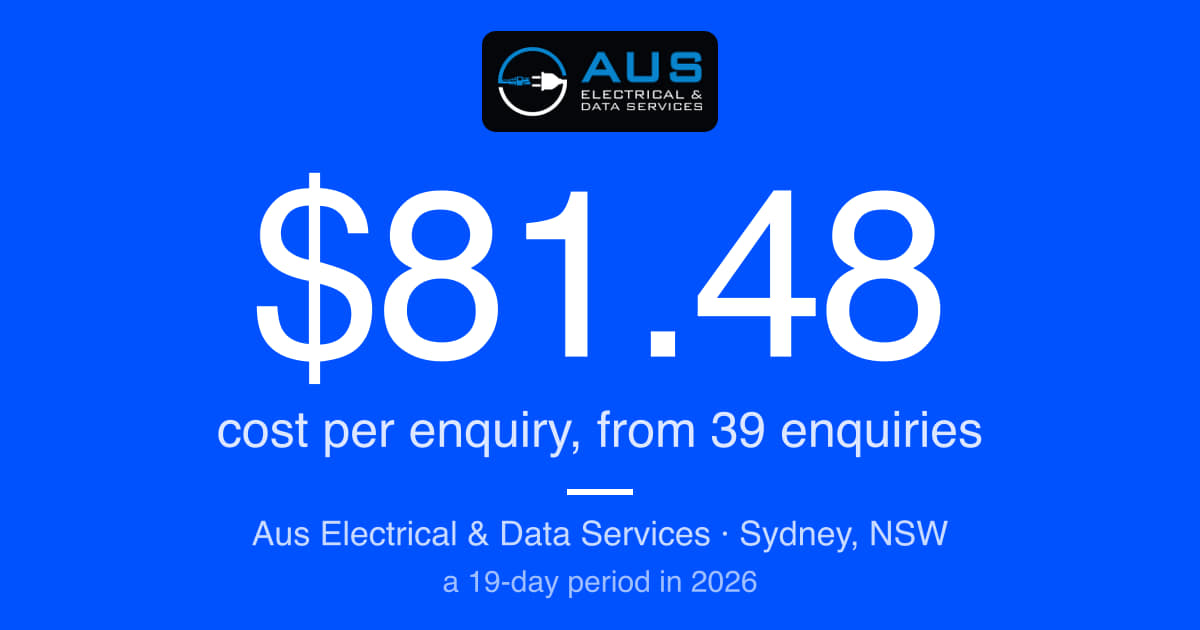
Electrician leads Sydney at $81.48 each in a 19-day period
Electrician leads in Sydney: Aus Electrical & Data Services paid $81.48 per enquiry across a 19-day period in 2026, then took 89 enquiries in the next period at $85.03 each.
Read case study
Plumbing
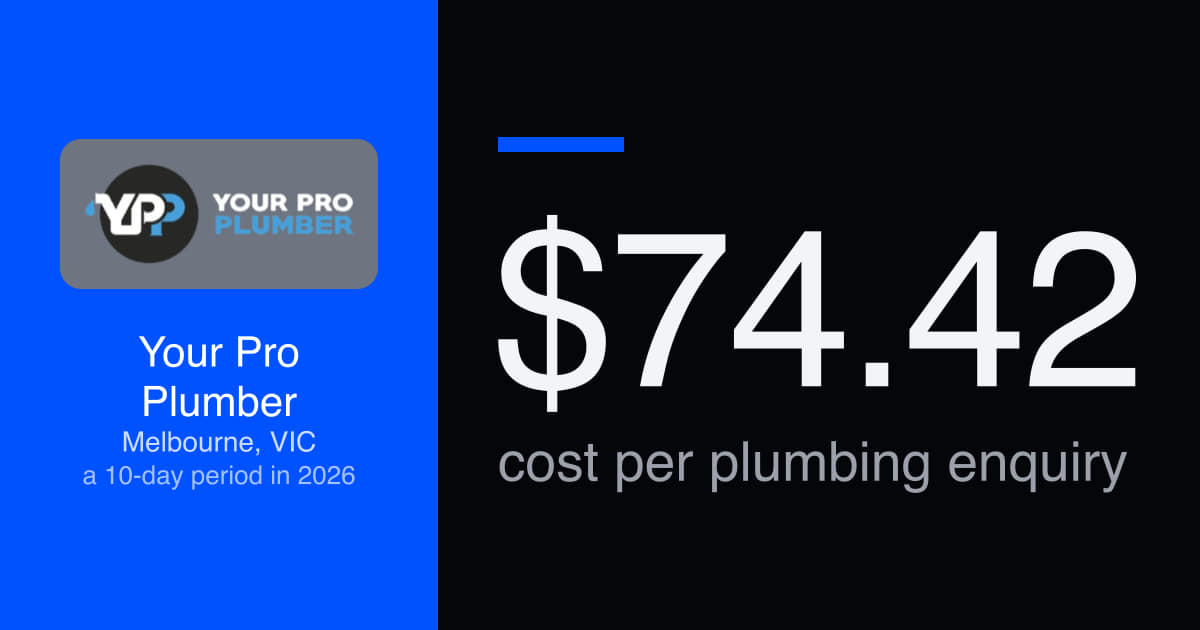
Melbourne plumbing leads at $74.42 — a 10-day period
Melbourne plumbing leads for Your Pro Plumber: 16 enquiries at $74.42 each in a 10-day period in 2026, and 50 enquiries in a later 23-day period.
Read case study
Plumbing
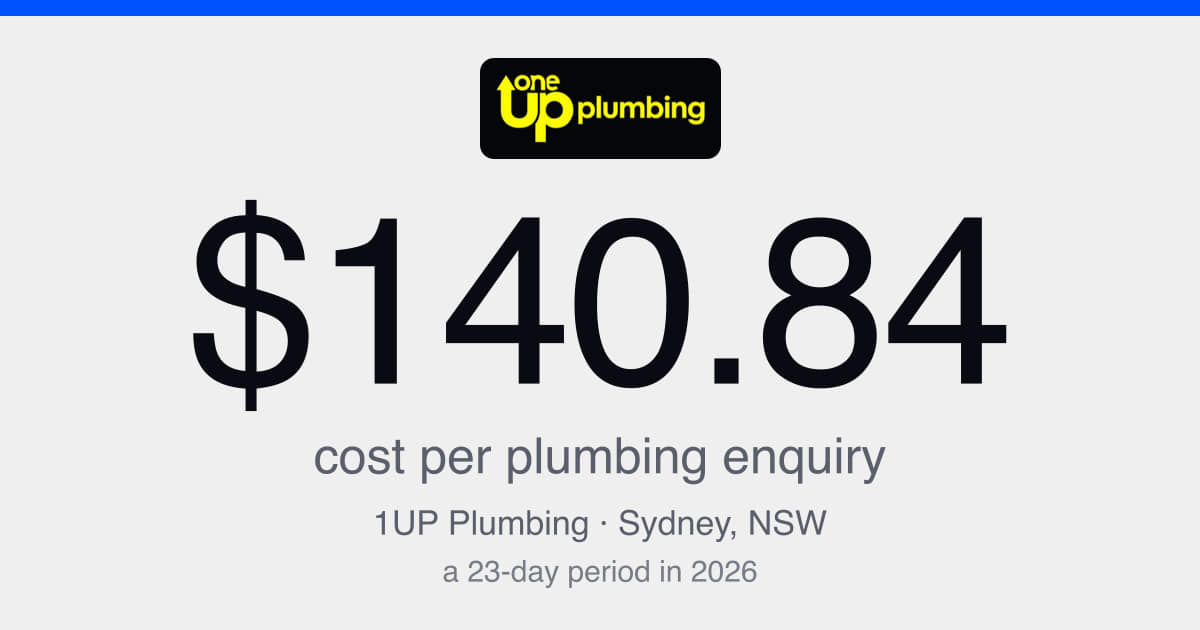
Sydney plumbing: 84 enquiries in a 23-day period
Sydney plumbing leads for 1UP Plumbing: 84 enquiries at $140.84 each in a 23-day period in 2026, from 639 clicks in a single campaign.
Read case study
More plumbing businesses we have published.
One account proves very little on its own. The closest neighbour to this one is Brisbane Plumbing Leads at $176.78 Each in a 12-Day Period; its window is a 12-day period in 2026. The rest of the trade is below, with what each one is known for and how long that figure covers.
- Brisbane Plumbing Leads at $176.78 Each in a 12-Day Period$176.78Cost per enquiry — a 12-day period in 2026
- Sydney plumbing leads: 158 enquiries in a 23-day period for Wilco Plumbing158enquiries in a single measured period — a 23-day period in 2026
- Sydney plumbing leads: 112 enquiries in Sydney Choice Plumbing's first month112enquiries, including 23 tracked calls — a 24-day period in 2026
The work that produced this.
Everything above was delivered by one of a handful of things we do. These are the ones this account leant on, written up in full rather than summarised, alongside the page written for plumbing businesses generally.
- Where plumbing businesses usually lose the moneyWritten for plumbing businesses rather than for a case study: the enquiries that were never going to become work, why they cost the same as the good ones, and how that gets stopped.
- How trades accounts are built hereThe channel order we use for a home services business, what it costs to run, and what the first ninety days actually produce.
- Winning the suburbs you already serviceService-area work: the map pack, review velocity and the pages that make a suburb claim credible.
- Booked jobs, not just phone callsThe difference between a busy phone and a full diary is qualification, and it is fixable at the ad rather than at the office.
The briefing behind the work.
The case study records what happened. These two explain the channel, measurement or operating decision that made the result interpretable in the first place.
A review process that follows a real completed job and stays inside Google's rules. That case is argued in Review requests that do not sound automated.
The external entity data underneath any local-service acquisition programme. The other half of it is set out in The citation inconsistencies that still move local rankings.
The work behind this one is written up in full under where plumbing businesses usually lose the money, and the operating sequence behind every study on this site sets out the sequence in order.
Want results like this?
Thirty minutes on your numbers rather than somebody else's, and a written list of what we would change first. Yours to keep either way.
No pitch deck. No upsell. A real conversation and a written list of leaks.