
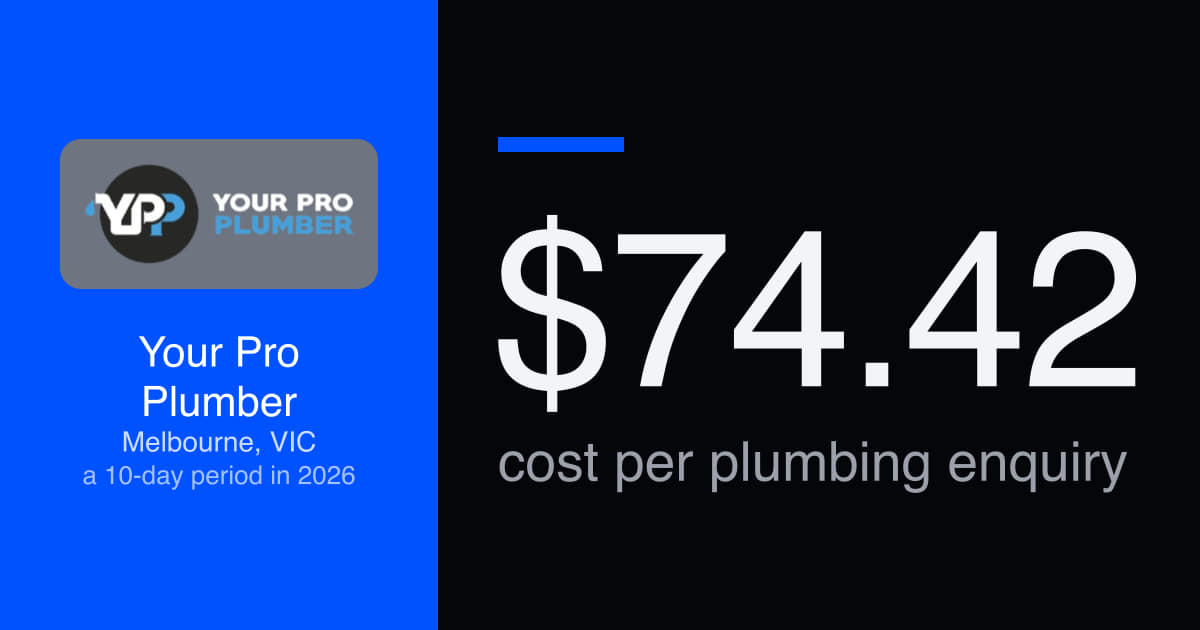
Melbourne plumbing leads at $74.42 — a 10-day period
Your Pro Plumber · Plumbing and drainage · Melbourne, VIC
The short version · a 10-day period in 2026
Melbourne plumbing has one honest problem: enough enquiries to keep the vans busy, at a price the margin will carry.
Your Pro Plumber needed both halves at once. The periods below are selected and reported without dates, deliberately. Across three campaigns the account produced 101 enquiries at a blended $127.07 each, with 15.49% of clicks converting. The cheapest period was the earliest: 16 enquiries at $74.42 each across 10 days in 2026, converting at 17.58%. The biggest was a later 23-day period, at 50 enquiries for $139.44 each. Both are published here, because the trade between them is the actual story.
The result.
$74.42
cost per plumbing enquiry
a 10-day period in 2026
50
enquiries in a single measured period
a 23-day period in 2026
101
total enquiries
across the account's wider run
17.58%
of clicks became enquiries
a 10-day period in 2026
5.37%
click-through rate
across the account's wider run
- Industry
- Plumbing and drainage
- Discipline
- Plumbing
- Ad spend band
- $10K–$25K
- Measured over
- a 10-day period in 2026
Every figure above was read out of this client's live account and is reproduced exactly as the study publishes it. It is a record of what happened on one account, in one market, at one budget — not a forecast for yours.
What would this look like on your account?
Different market, different budget, different numbers. The first call is where we work out whether the same approach fits yours at all.
The case study
What moved for Your Pro Plumber.
The short list
- 101 enquiries taken over the whole account at a blended $127.07 each, with 15.49% of clicks converting.
- The cheapest period was the earliest: 16 enquiries at $74.42 each across 10 days in 2026, at a 17.58% conversion rate.
- The biggest was a 23-day period in 2026: 50 enquiries at $139.44 each — exactly double the 25 in the period before it.
- Efficiency and volume pulled against each other, and both periods are published rather than only the flattering one.
- 84 of the 101 enquiries arrived as phone leads and 74 came from a mobile phone, which makes whoever answers the phone the real constraint.
Each line above belongs to the period printed with it. None of them is an average across the account, and none of them is a forecast.
Why a plumbing lead in Melbourne costs what it costs
Melbourne is an expensive place to buy plumbing enquiries, and the reason is arithmetic rather than mystique. A blocked drain, a dead hot water unit, a pipe letting go under a slab — nobody shops those around. The customer wants it fixed today, the job is worth real money, and every plumbing business in the city already knows both of those things.
So the price of a click is not set by what a click is worth in the abstract. It is set by what the job behind the click is worth to whoever wins it. Where a drain excavation or a full hot water changeover runs into four figures, that number is high, and it stays high all year.
The inner-east and bayside suburbs are the most contested part of that market, and they are also where the better jobs live. Older housing stock, higher property values, owners who approve the proper fix instead of the patch. Everyone bids there. Nobody bids cheaply.
That is the market Your Pro Plumber walked into, and nothing about it rewards a business that turns up hoping to be noticed.
Plumbing is a phone business, and the data says so
Of the 101 enquiries this account recorded, 84 arrived as phone leads and 15 as submitted forms, with a further 2 placed as calls directly from the ad. 74 of the 101 came from someone holding a mobile phone, against 27 from a desktop.
Picture who that actually is. Somebody standing in a wet laundry, making a decision in under a minute, ringing whoever looks most likely to pick up. Advertising cannot fix what happens after they dial. It only decides how many of those moments your business is present for.
What Your Pro Plumber needed
A plumbing business coming into Melbourne cold is usually facing one of two problems. It cannot get enough enquiries to keep the vans busy, or it can get them but not at a price a plumbing margin will carry. This one needed both halves solved at the same time.
The account ran across three campaigns. Everything below is measured on selected periods with the dates taken off, so none of it tells you when the work started or how long it has run. Account-wide the ads served 12,151 impressions, earned 652 clicks at a 5.37% click-through rate, and produced 101 recorded enquiries at a blended $127.07 each. Taken over the whole account, 15.49% of clicks became an enquiry.
Four periods from 2026 are represented in that data, and only two of them — the middle pair — are complete months. The first and the last are part-periods, cut short at one end. That matters when you read the rest of this, so we will come back to it rather than quietly average it away.
The work itself was a rebuild around the enquiries that turn into booked jobs. Plumbing searches look similar on the surface and behave nothing alike underneath. Some are people who will book within the hour. Some are pricing a job they intend to do months from now. Some will never book at all, from anyone, at any price. Separating those groups, then writing to the specific job in front of the customer instead of to the trade in general, is where the whole result comes from.
Twelve thousand impressions is not a large footprint, and that was deliberate. In a market this expensive, reach is not the scarce resource. Relevance is.
The cheapest period was the earliest: $74.42 an enquiry in 2026
That period ran 10 days in 2026 and produced 16 enquiries at $74.42 each, from 91 clicks and 1,711 impressions. Just over one click in six became an enquiry — a 17.58% conversion rate.
The line chart plots only periods of 14 days or more, which is why the first and the last are missing from it. At 10 and 9 days respectively they are part-months, and putting them on the same axis as a full month would flatter one end and punish the other. What is left is the fair comparison: $104.47 an enquiry in the 19-day period, $139.44 in the 23-day one.
The bars underneath explain the shape of that line. The 19-day period in 2026 produced 25 enquiries. The 23-day period produced 50 — exactly double, in a window four days longer. Cost per enquiry rose because the account was asked to go and find twice as many people, and in Melbourne the twenty-sixth to fiftieth enquiry always costs more than the first twenty-five.
Every period we measured in 2026, unedited
- The earliest period (10 days): 16 enquiries at $74.42 each, 17.58% conversion rate, 91 clicks from 1,711 impressions
- The one after it (19 days): 25 enquiries at $104.47 each, 13.51% conversion rate, 185 clicks from 3,737 impressions, 4.95% click-through rate
- The one after that (23 days): 50 enquiries at $139.44 each, 16.34% conversion rate, 306 clicks from 5,536 impressions
- The last (9 days, cut short at the end): 10 enquiries from 70 clicks
- Account-wide: 101 enquiries at a blended $127.07, 15.49% conversion rate, 5.37% click-through rate
Two movements inside those rows are worth pulling out. The conversion rate went from 13.51% in the 19-day period of 2026 to 16.34% in the 23-day one, a 20.92% improvement in the share of clicks that became an enquiry, achieved in the very period the volume doubled. Over a similar stretch the click-through rate climbed from 4.95% to 6.12%, up 23.6%. More people found the ad worth clicking, and more of the ones who clicked found the business worth contacting.
Both the cheap period and the dear one are published here on purpose, because the honest version of this story is more useful to you than the flattering one. The cheapest enquiries came early, at low volume. When the account was pushed for scale in the 23-day period it delivered the most enquiries it ever produced, and the price of each one went up to get there.
$74.42 is what an enquiry cost when the account was running at 16 a month. $139.44 is what it cost when it was running at 50. Both are true.
That is not a failure. It is the trade every service business has to price for itself. Cheap leads and lots of leads are two different purchases, and anyone who tells you they always arrive together is selling you something.
What 50 enquiries in a month does to a plumbing business
Fifty enquiries is a full diary. For a plumbing business that is the difference between chasing work and choosing work — being able to decline the low-value jobs because there is something better sitting in the queue behind them.
Staffing also stops being a guess and becomes a sum. When 84 of your 101 enquiries arrive by phone, the constraint on the business is no longer marketing, it is whoever picks up. A month at that rate is roughly two enquiries a working day landing on someone's handset, most of them from people who will not leave a message. Knowing that in advance is the difference between hiring for it and being buried by it.
The earliest period matters for a different reason: it shows what the efficient end of the range looks like. Hold that figure in your head when you are deciding how hard to push a budget in a given month, because which end you want depends entirely on whether your problem right now is margin or capacity.
Then there is the thing trades work rarely gets — money you can predict. Once you know an enquiry cost $74.42 in your cheapest period and $139.44 in your biggest one, the advertising line in the budget stops being a leap of faith and becomes a dial. You set it against how much work you can physically absorb, not against how brave you feel in any given month.
Want to know which end of that trade you are on?
Most plumbing accounts we open are sitting at one extreme without realising it — starved of volume, or paying far too much for what they get — and in both cases the monthly report reads fine. We can tell you which one you are from your own numbers, before you commit to anything. Send the account over and we will have a proper look.
Tags
- Plumbing and drainage
- Melbourne, VIC
- $10K–$25K
That is one account. Yours is a different one.
We read your ads, your search presence and your tracking the same way this one was read, and tell you what we would change first.
What every number on this page actually means.
Marketing words get used loosely, and a loose word can make a small result look like a big one. Here is exactly what we mean by each of them.
- Conversion
- One real action by one real person: a phone call that lasted long enough to be a conversation, a submitted enquiry form, a booking, or a purchase. Not a page view and not a form that merely loaded.
- Cost per job · cost per lead
- The advertising money spent, divided by the number of those actions. It is the only figure that tells you whether the advertising is worth doing, which is why we publish it next to the count.
- Conversion rate
- The share of people who clicked the ad and then did the thing. A high click count with a low conversion rate usually means the ad and the page are promising different things.
- Ad spend
- Money that went to the advertising platform, not to us. Our management fee is separate and is never included in a cost-per-job figure, because mixing them would flatter the number.
- The measurement window
- The dates the figure covers, named every time. Where a study covers a launch, the clock starts the day campaigns went live — not the day the graph started looking good.
- A starting point
- Where a study knows what a figure was before the work began, that number is printed next to the one it became. Where the account had no history to compare against, the result is printed on its own rather than measured from a number nobody recorded.
- Qualified lead
- An enquiry that matched the service and the service area, so it was worth someone picking up the phone for. Where a study says qualified, somebody checked.
- An anonymised client
- Government, council and cultural-institution engagements are published as sector and jurisdiction only. The work and the measured outcome are described in full; the organisation is not named.
One more, because it matters most: nothing on this page is a guarantee. It is a record of what happened on one account, in one market, at one budget.
What this study cannot tell you is what the same figure looks like on your account — so what a lead costs you at your click price, with your own click price and close rate. It takes about a minute and asks for nothing.
This page exists because of two of the six stages.
Compound is how our team works on any account — six stages every change passes through. Two of them are why there is anything honest to publish.
Meter
If it can't be measured, it doesn't get bought.
Before a dollar moves, every action worth money to the business is tracked as itself — calls, forms, bookings, purchases — with values attached. Without that stage there is no honest number to publish afterwards.
Ledger
Every change we make becomes a record you can open.
Every change lands in a dated record as it happens — what was added, what was stopped, what was rewritten and what it cost. Writing this page afterwards was reading a file, not reconstructing a memory.
What actually happens after the first call.
No mystery and no lock-in before you have seen anything. This is the sequence every account on this site went through.
- The call
Thirty to forty-five minutes, free
What you sell, who buys it, and what one customer is worth to you. No deck. You leave with a real number for your situation rather than a range.
- Week 0
The audit
We open your account — or your competitors' ground, if you do not have one yet — and write down every leak we can find. That list is yours whether or not you work with us.
- Week 1
The build
Everything the account needs before it can spend a dollar: what it will bid on, what it must never pay for, the ad copy, the assets, the landing pages and the tracking. A second person checks all of it before anything is live.
- Day one
You press go
Campaigns are created paused, every time, so you can read the whole build first. You activate when you are ready, not when we are.
- Days 1–14
The clean
The busiest fortnight your account will ever have. Search terms read daily, waste negated, early winners promoted, ad copy iterated against what is actually being served.
- From there
Rhythm
Weekly optimisation, reporting on a fixed cadence whether the news is good or bad, and a proper conversation each quarter about where the next block of budget should go.
Before you ask us anything
Here is what everybody asks first.
The questions this raises.
Whether the figures are real, how they were measured and over what length of window, what it costs, and whether any of it would hold for plumbing businesses.
The first call is free and there is no deck.
Book a callWhat do plumbing leads cost in Melbourne on Google Ads?
In this account they ranged from $74.42 to $139.44 depending on how hard the period was pushed. The earliest period produced 16 enquiries at $74.42 each across 10 days in 2026. A later one produced 50 at $139.44 each across 23 days. Taken over the whole account rather than one period, the blended figure was $127.07. That is one Melbourne plumbing account, not a market rate — but it shows the range a single account can sit across.
Does pushing for more plumbing enquiries make each one more expensive?
In this account, yes, and visibly. One measured period in 2026 produced 25 enquiries at $104.47 each. The next produced 50 at $139.44. The volume doubled and the cost per enquiry went up by roughly a third to get there. That is the trade a service business has to price for itself: whether the problem right now is margin or capacity decides which end of the range you want to buy at.
Do Melbourne plumbing enquiries come by phone or through a form?
Overwhelmingly by phone. Of the 101 enquiries recorded account-wide, 84 were phone leads and 15 were submitted forms, with 2 more placed as calls directly from the ad. 74 of the 101 came from a mobile phone against 27 from a desktop. If you are planning for a campaign like this, plan for calls landing on a handset during the working day rather than for a form inbox.
Did the account get better over time, or just more expensive?
Both movements are in the data. The conversion rate rose from 13.51% in one measured period of 2026 to 16.34% in the next — a 20.92% improvement — in the same period the volume doubled. The click-through rate rose from 4.95% in an earlier period to 6.12% in a later one, a 23.6% improvement. The cost per enquiry also rose across those periods, because the account was being asked for more. The quality signals and the price moved in different directions at the same time, which is normal when an account is being scaled.
Are the figures in this Your Pro Plumber case study real?
Yes. Every number on this page was read out of the client's own advertising account and is printed here exactly as the study publishes it, beside the period it covers. The dashboard and ad images are screen-grabs of that account rather than recreations. If one of these figures matters to your decision, ask about it on the first call and we will walk you through where it came from.
How were these numbers measured, and over what window?
The headline figure covers a 10-day period in 2026, and every other figure on the page is printed beside the period it belongs to. We publish the LENGTH of a measurement window and the year, and withhold the exact dates — when a client advertised, and how their trading calendar looks, is their commercial information rather than ours. A conversion means one real action by one real person: a phone call that lasted long enough to be a conversation, a submitted enquiry form, a booking, or a purchase. Not a page view, and not a form that merely loaded.
How much was being spent to produce this?
The study publishes this account's advertising spend as a band — $10K–$25K — rather than an exact figure, because the precise number is the client's business. Our management fee is separate from that and is never folded into a cost-per-lead figure anywhere on this site; mixing the two would flatter every number on the page.
Would this work for plumbing businesses like mine?
We cannot promise you the same numbers, and nobody honestly can. What this page tells you is what was achievable in that market, at that budget, for that service. Your competition, your service area, your margins and what one customer is worth to you all move the answer. On the first call we build the picture from your figures rather than someone else's, and if the honest answer is that this channel is wrong for you right now, we will say so.
More accounts, same discipline.
Studies from the same kind of work, so you can see how the pattern holds across different businesses.
Plumbing
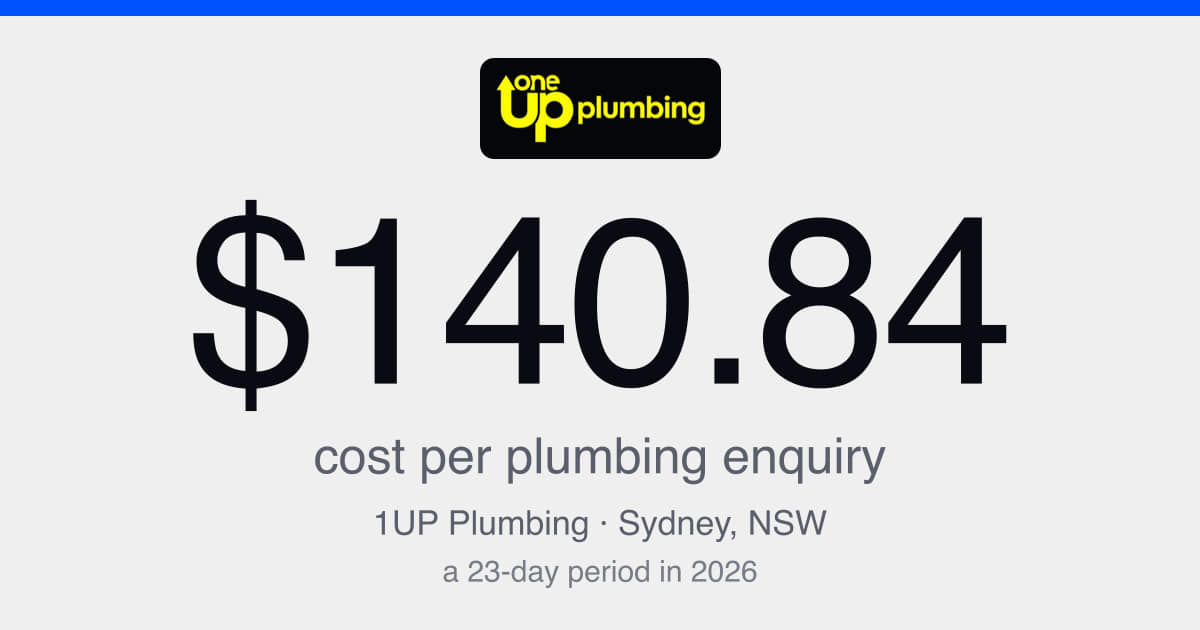
Sydney plumbing: 84 enquiries in a 23-day period
Sydney plumbing leads for 1UP Plumbing: 84 enquiries at $140.84 each in a 23-day period in 2026, from 639 clicks in a single campaign.
Read case study
Commercial cleaning
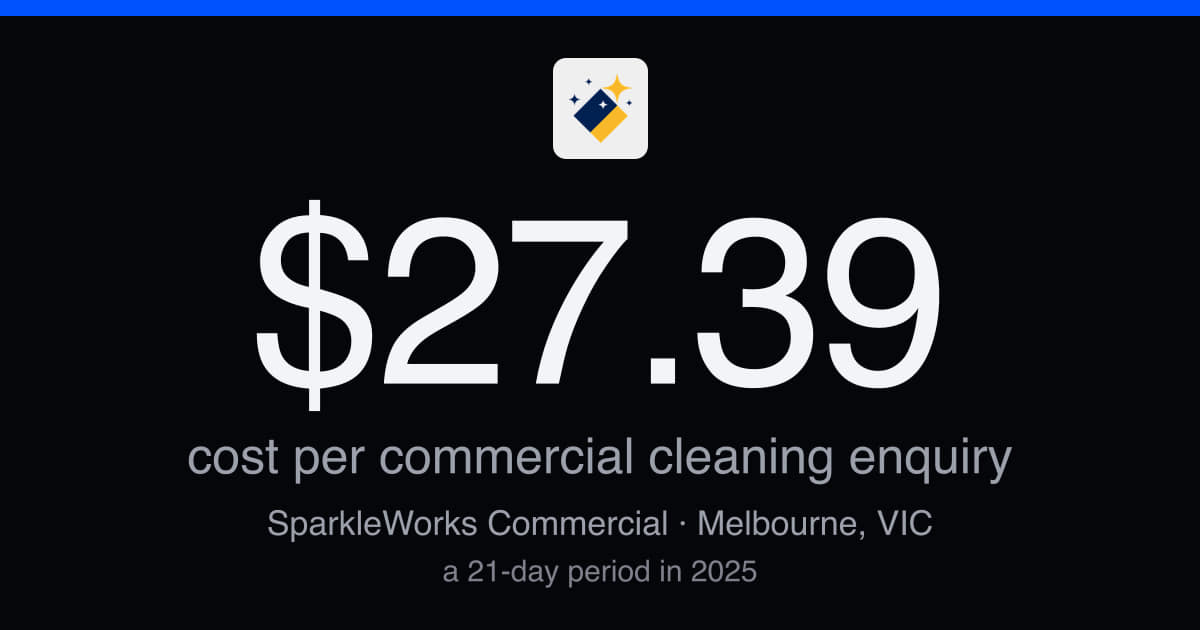
Commercial cleaning Melbourne: leads at $27.39
Commercial cleaning leads in Melbourne for SparkleWorks Commercial: 49 enquiries at $27.39 each in a 21-day period in 2025, with a 19.68% conversion rate.
Read case study
Air conditioning
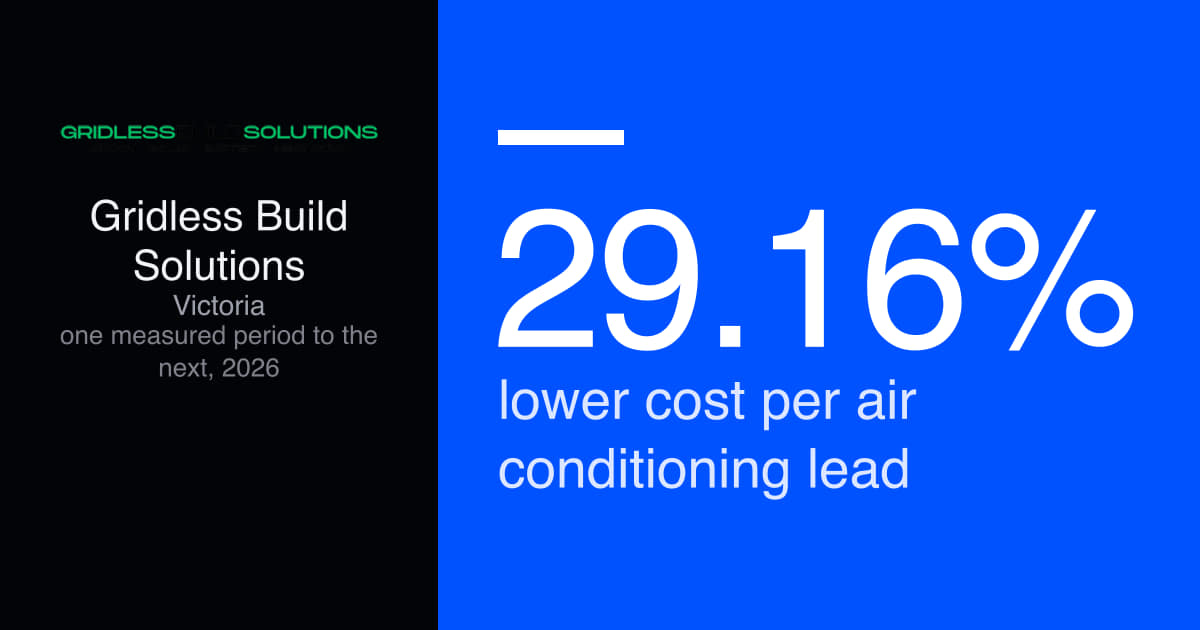
Air con leads Victoria: cost per lead down 29.16%
Air conditioning leads in Victoria for Gridless Build Solutions: cost per enquiry fell from $78.16 in one measured period in 2026 to $55.37 in the next, with 55 enquiries.
Read case study
More plumbing businesses we have published.
One account proves very little on its own. The closest neighbour to this one is Brisbane Plumbing Leads at $176.78 Each in a 12-Day Period; its window is a 12-day period in 2026. The rest of the trade is below, with what each one is known for and how long that figure covers.
- Brisbane Plumbing Leads at $176.78 Each in a 12-Day Period$176.78Cost per enquiry — a 12-day period in 2026
- Sydney plumbing leads: 158 enquiries in a 23-day period for Wilco Plumbing158enquiries in a single measured period — a 23-day period in 2026
- Sydney plumbing leads: 112 enquiries in Sydney Choice Plumbing's first month112enquiries, including 23 tracked calls — a 24-day period in 2026
The work that produced this.
Everything above was delivered by one of a handful of things we do. These are the ones this account leant on, written up in full rather than summarised, alongside the page written for plumbing businesses generally.
- Plumbing accounts, written up for plumbersWhat a plumbing business should expect a lead to cost, where the enquiries come from, and which of them are worth answering at 2am.
- Being visible when a pipe burstsBlocked drains and burst pipes are searched on a phone, urgently, by suburb. A large share of those searches are answered before any ad is seen.
- Turning a ringing phone into a booked jobPlumbing produces call volume easily. What it produces less easily is a booked job at a price that covers the truck.
The briefing behind the work.
The case study records what happened. These two explain the channel, measurement or operating decision that made the result interpretable in the first place.
The external entity data underneath any local-service acquisition programme. That case is argued in The citation inconsistencies that still move local rankings.
Why the primary and secondary categories must match the work a business actually wants. The other half of it is set out in Google Business Profile categories as a silent rank constraint.
The work behind this one is written up in full under plumbing accounts, written up for plumbers, and how the work is sequenced before any of it is published sets out the sequence in order.
Want results like this?
Thirty minutes on your numbers rather than somebody else's, and a written list of what we would change first. Yours to keep either way.
No pitch deck. No upsell. A real conversation and a written list of leaks.