
Electrician leads Sydney: 59 enquiries in a 27-day period
Sparkmaster · Electrical services · Sydney, NSW
The short version · a 27-day period in 2026
Sparkmaster is a Sydney electrical contractor covering a wide slice of the city.
The window below was picked out of the account and reported without dates, on purpose. Across 27 days it produced 59 enquiries at $138.74 each, from 438 clicks and 9,119 impressions, with 13.47% of clicks becoming an enquiry. Taken over the whole account rather than that one period — a single campaign throughout — it drew 472 clicks from 9,778 impressions at a blended $151.83 per enquiry. The problem was the ordinary one for electricians in Sydney: a service area too wide to advertise generically without paying for searches that were never going to become work.
The result.
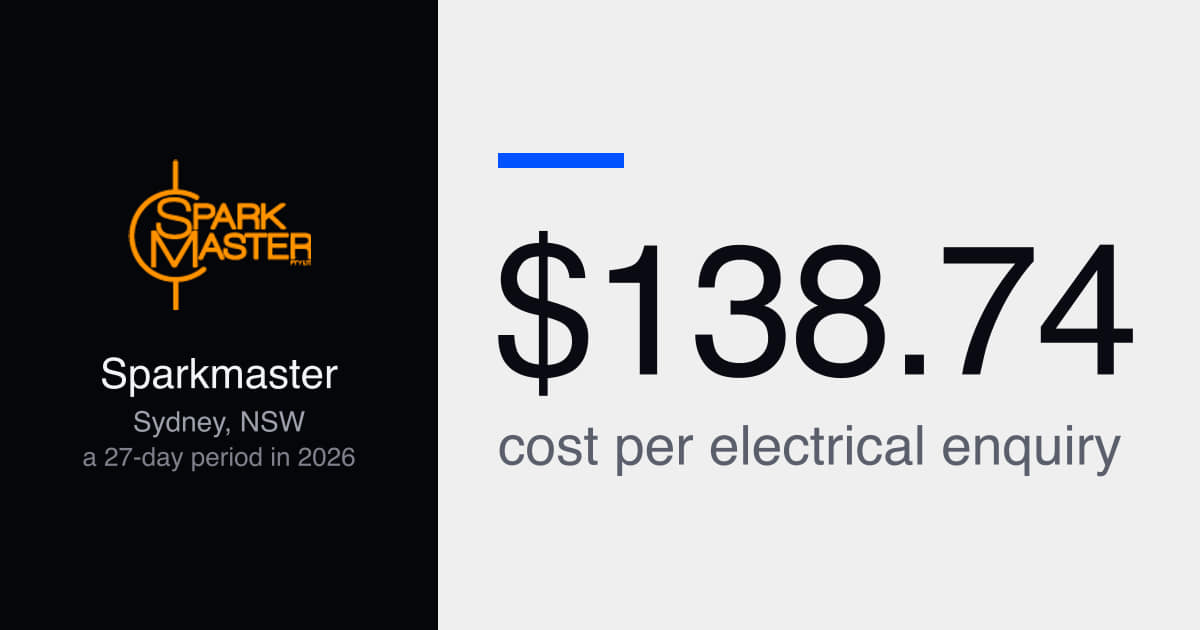
$138.74
cost per electrical enquiry
a 27-day period in 2026
59
enquiries in the measured period
a 27-day period in 2026
13.47%
of clicks became enquiries
a 27-day period in 2026
9,119
impressions served
a 27-day period in 2026
27
days of advertising
one selected period in 2026
- Industry
- Electrical services
- Discipline
- Electrical
- Ad spend band
- $5K–$10K
- Measured over
- a 27-day period in 2026
Every figure above was read out of this client's live account and is reproduced exactly as the study publishes it. It is a record of what happened on one account, in one market, at one budget — not a forecast for yours.
What would this look like on your account?
Different market, different budget, different numbers. The first call is where we work out whether the same approach fits yours at all.
The case study
What moved for Sparkmaster.
The short list
- 59 enquiries at $138.74 each across 27 days, the account's first full calendar month.
- 13.47% of clicks became an enquiry in the selected period, against 12.66% across the account's wider run.
- 47 of the 59 enquiries in that period came from mobile, off 329 mobile clicks — electrical demand in Sydney is a phone-in-hand market.
- 21.85% impression share account-wide says most of the available Sydney demand was never touched.
- This is a short record. Every figure here is measured, and none of it is a forecast.
Each line above belongs to the period printed with it. None of them is an average across the account, and none of them is a forecast.
Two different jobs, one search box
Electrical work in Sydney is really two businesses wearing the same uniform. One is the emergency — no power, a switchboard tripping every twenty minutes, a smell of hot plastic behind a wall. That customer rings whoever answers and barely asks the price.
The other is planned work. A switchboard upgrade, new circuits for a renovation, downlights, a charger for the car in the garage. Same person, calmer week, and they will gather two or three quotes over a fortnight before anybody gets a job.
Both of them type something almost identical into Google. Treat them as one customer and you pay a premium for your own confusion — you either sound urgent to somebody who is still browsing, or you sound like a quote form to somebody whose lights are off.
Why a click costs what it costs here
Sydney has an enormous number of licensed electricians, and a solid share of them are already bidding by nine on a weekday morning. Sitting above them are the franchise networks, with marketing budgets set in another state. Sitting above those are the lead brokers, who buy the click, sell the resulting enquiry to three different trades, and can therefore justify paying more for it than any single sparky ever could.
So the price is not set by what a job is worth to you. It is set by whoever in the auction has the most reasons to overpay.
If you run an electrical business you already know the shape of the loss, even if you have never seen it written down. A week's budget goes in two days. Half of it went to somebody pricing a job in an area you do not cover, somebody chasing a warranty question, and a bloke who actually wanted an antenna installer.
What we were asked to do
Sparkmaster covers a wide slice of Sydney, and the width is exactly the difficulty. Every part of that map is its own auction, with its own rivals and its own price, and no trade business can afford to answer all of it.
The window we are showing here is one selected period in 2026, reported without its dates on purpose, and everything ran through a single campaign. Taken across the account rather than that one period, Sparkmaster was shown 9,778 times, drew 472 clicks at a 4.83% click-through rate, and turned 12.66% of those clicks into enquiries.
Totals are the easy part to print. Underneath them sit 9,778 separate decisions about whether one particular search, from one particular person, in one particular part of the city, was worth paying to answer at all. How those decisions get made is the part we keep to ourselves.
What came out of it
The window we picked out was the strongest stretch in the account on every measure that matters.
- 59 enquiries in that window, at $138.74 each
- 438 clicks from 9,119 impressions across its 27 days
- 13.47% of clicks became enquiries in that period, against 12.66% across the account's wider run
- Cost per enquiry: $138.74 in that period, against a blended $151.83 account-wide
- 4 of the period's enquiries arrived as phone calls
- 21.85% impression share and 13.92% top-of-page impression share, account-wide
In that period, 13.47% of clicks became an enquiry. Roughly one click in seven ended with somebody picking up the phone or filling in a form.
Fifty-nine enquiries inside a single month is the headline, and $138.74 each is a straight-faced number for Sydney electrical work rather than a boast. What makes it worth printing is where it sits — below the account's blended $151.83 across its wider run.
The conversion rate is the figure we would point at first, though. Plenty of accounts in this category are quietly grateful for low single digits. A rate like that is not something bidding can buy; it means the traffic arriving was traffic the business could actually serve.
Nearly everyone was holding a phone
Split the period by device and the demand stops being abstract. Mobile served 6,950 impressions, took 329 clicks and produced 47 of the period's 59 enquiries. Desktop served 2,053 impressions, took 104 clicks and produced 11. Tablet managed 116 impressions, 5 clicks and a single enquiry.
Forty-seven of 59 from a phone. The person searching is standing in the room with the problem, not sitting at a desk planning next quarter, and the ad, the tap and the call all have to survive on a screen the size of a hand held by somebody who is already annoyed.
What we are not claiming
This is not a track record and we will not dress it up as one. Beyond the period we are reporting there is only a thin tail — far too slight to read anything into, so we have not tried.
The selected period stands on its own instead: a complete calendar month, 27 days of it live, 59 enquiries at $138.74 apiece. That is what happened, in the month it happened in.
What 59 enquiries does to a diary
For an electrical contractor, 59 enquiries in a month is enough work to plan around rather than react to. It supports a schedule. It justifies keeping another pair of hands on. It makes the quiet fortnight after a big job wraps up less frightening, because something other than word of mouth is filling the calendar.
The quieter change is what a known cost per enquiry does to how you think. Once you can say an enquiry cost $138.74 in a period like this one, advertising stops behaving like a monthly bill and starts behaving like a dial — you decide how busy you want to be, rather than finding out afterwards.
Most trade businesses never get to that point. The ones that do stop arguing about the invoice and start arguing about capacity, which is a much better argument to be having.
There is a lot of Sydney left
Taken over the whole account, the campaign held 21.85% impression share and sat in a top-of-page position 13.92% of the time. Put plainly, roughly four in five relevant searches in Sydney happened without Sparkmaster in them.
That is not a failure. It is the deliberate consequence of being fussy about what gets answered, and it does mean nobody has been anywhere near the ceiling of this account yet.
Questions Sydney electricians ask us
What does an electrician lead cost in Sydney?
In this account, $138.74 in the window above and $151.83 blended over the whole account. Those come from one Sydney electrical account, not an industry average. Anyone quoting you a single fixed price per electrical lead is describing a hope rather than a measurement.
How quickly can an electrical account start producing enquiries?
In this one, 59 enquiries landed across 27 days. That is fast, and it is one account rather than a rule. What it does show is that an account need not spend months warming up before it returns anything, provided the traffic it buys is narrow from the first day.
Is a 13% enquiry rate realistic for electrical work?
It was real here — 13.47% of clicks in the window we are reporting, and 12.66% on the account's broader average. The rate depends on which searches get answered rather than on how hard anybody bids, which is why it is the number worth watching. A strong click rate with a thin enquiry rate usually means an account is buying the wrong searches very efficiently.
Do electrical enquiries really come from mobile?
In that period, 47 of the 59 came from mobile, against 11 from desktop and 1 from tablet. That has consequences you can act on today: how fast the phone gets answered, and how the site behaves on a small screen, carry more weight than anything else you could change.
Wondering what your own map costs you?
Trades with a wide service area almost always leak money in the corners nobody thinks about. A few areas quietly eat the budget while the ones that book work go under-served, and nothing on the front page of a report tells you which is which.
Send the account over and we will go through it with you. We will tell you what we see, including the parts you will not enjoy hearing.
Tags
- Electrical services
- Sydney, NSW
- $5K–$10K
That is one account. Yours is a different one.
We read your ads, your search presence and your tracking the same way this one was read, and tell you what we would change first.
What every number on this page actually means.
Marketing words get used loosely, and a loose word can make a small result look like a big one. Here is exactly what we mean by each of them.
- Conversion
- One real action by one real person: a phone call that lasted long enough to be a conversation, a submitted enquiry form, a booking, or a purchase. Not a page view and not a form that merely loaded.
- Cost per job · cost per lead
- The advertising money spent, divided by the number of those actions. It is the only figure that tells you whether the advertising is worth doing, which is why we publish it next to the count.
- Conversion rate
- The share of people who clicked the ad and then did the thing. A high click count with a low conversion rate usually means the ad and the page are promising different things.
- Ad spend
- Money that went to the advertising platform, not to us. Our management fee is separate and is never included in a cost-per-job figure, because mixing them would flatter the number.
- The measurement window
- The dates the figure covers, named every time. Where a study covers a launch, the clock starts the day campaigns went live — not the day the graph started looking good.
- A starting point
- Where a study knows what a figure was before the work began, that number is printed next to the one it became. Where the account had no history to compare against, the result is printed on its own rather than measured from a number nobody recorded.
- Qualified lead
- An enquiry that matched the service and the service area, so it was worth someone picking up the phone for. Where a study says qualified, somebody checked.
- An anonymised client
- Government, council and cultural-institution engagements are published as sector and jurisdiction only. The work and the measured outcome are described in full; the organisation is not named.
One more, because it matters most: nothing on this page is a guarantee. It is a record of what happened on one account, in one market, at one budget.
What this study cannot tell you is what the same figure looks like on your account — so work out your own cost per lead, with your own click price and close rate. It takes about a minute and asks for nothing.
This page exists because of two of the six stages.
Compound is how our team works on any account — six stages every change passes through. Two of them are why there is anything honest to publish.
Meter
If it can't be measured, it doesn't get bought.
Before a dollar moves, every action worth money to the business is tracked as itself — calls, forms, bookings, purchases — with values attached. Without that stage there is no honest number to publish afterwards.
Ledger
Every change we make becomes a record you can open.
Every change lands in a dated record as it happens — what was added, what was stopped, what was rewritten and what it cost. Writing this page afterwards was reading a file, not reconstructing a memory.
What actually happens after the first call.
No mystery and no lock-in before you have seen anything. This is the sequence every account on this site went through.
- The call
Thirty to forty-five minutes, free
What you sell, who buys it, and what one customer is worth to you. No deck. You leave with a real number for your situation rather than a range.
- Week 0
The audit
We open your account — or your competitors' ground, if you do not have one yet — and write down every leak we can find. That list is yours whether or not you work with us.
- Week 1
The build
Everything the account needs before it can spend a dollar: what it will bid on, what it must never pay for, the ad copy, the assets, the landing pages and the tracking. A second person checks all of it before anything is live.
- Day one
You press go
Campaigns are created paused, every time, so you can read the whole build first. You activate when you are ready, not when we are.
- Days 1–14
The clean
The busiest fortnight your account will ever have. Search terms read daily, waste negated, early winners promoted, ad copy iterated against what is actually being served.
- From there
Rhythm
Weekly optimisation, reporting on a fixed cadence whether the news is good or bad, and a proper conversation each quarter about where the next block of budget should go.
Before you ask us anything
Here is what everybody asks first.
The questions this raises.
Whether the figures are real, how they were measured and over what length of window, what it costs, and whether any of it would hold for electricians.
The first call is free and there is no deck.
Book a callWhat does an electrician lead cost in Sydney?
In this account it cost $138.74 in the period we are reporting, and $151.83 blended across the account's wider run. Those come from one Sydney electrical account, not an industry average. Anyone quoting a single fixed price per electrical lead in Sydney is describing a hope rather than a measurement.
How fast can a brand-new electrical account start producing enquiries?
The measured period was Sparkmaster's first full calendar month and it produced 59 enquiries across 27 days. That is quick, and it is one account rather than a rule. What it does show is that a new account need not spend months warming up before it returns anything, provided the traffic it buys is narrow from the first day.
Is a 13% enquiry rate realistic for electrical work?
It was real here: 13.47% of clicks became an enquiry in the measured period, and 12.66% on the account's broader average. The rate is a function of which searches get answered rather than of how much is bid, which is why it is the number worth watching. If the click rate looks strong but the enquiry rate is thin, the account is usually buying the wrong searches very efficiently.
Do electrical enquiries really come from mobile?
In the measured period, 47 of 59 enquiries came from mobile against 11 from desktop and 1 from tablet. For urgent electrical work in Sydney that split is not surprising, and it has practical consequences — the phone number, the response time and the mobile page carry more weight than anything else on the site.
Are the figures in this Sparkmaster case study real?
Yes. Every number on this page was read out of the client's own advertising account and is printed here exactly as the study publishes it, beside the period it covers. The dashboard and ad images are screen-grabs of that account rather than recreations. If one of these figures matters to your decision, ask about it on the first call and we will walk you through where it came from.
How were these numbers measured, and over what window?
The headline figure covers a 27-day period in 2026, and every other figure on the page is printed beside the period it belongs to. We publish the LENGTH of a measurement window and the year, and withhold the exact dates — when a client advertised, and how their trading calendar looks, is their commercial information rather than ours. A conversion means one real action by one real person: a phone call that lasted long enough to be a conversation, a submitted enquiry form, a booking, or a purchase. Not a page view, and not a form that merely loaded.
How much was being spent to produce this?
The study publishes this account's advertising spend as a band — $5K–$10K — rather than an exact figure, because the precise number is the client's business. Our management fee is separate from that and is never folded into a cost-per-lead figure anywhere on this site; mixing the two would flatter every number on the page.
Would this work for electricians like mine?
We cannot promise you the same numbers, and nobody honestly can. What this page tells you is what was achievable in that market, at that budget, for that service. Your competition, your service area, your margins and what one customer is worth to you all move the answer. On the first call we build the picture from your figures rather than someone else's, and if the honest answer is that this channel is wrong for you right now, we will say so.
More accounts, same discipline.
Studies from the same kind of work, so you can see how the pattern holds across different businesses.
Electrical
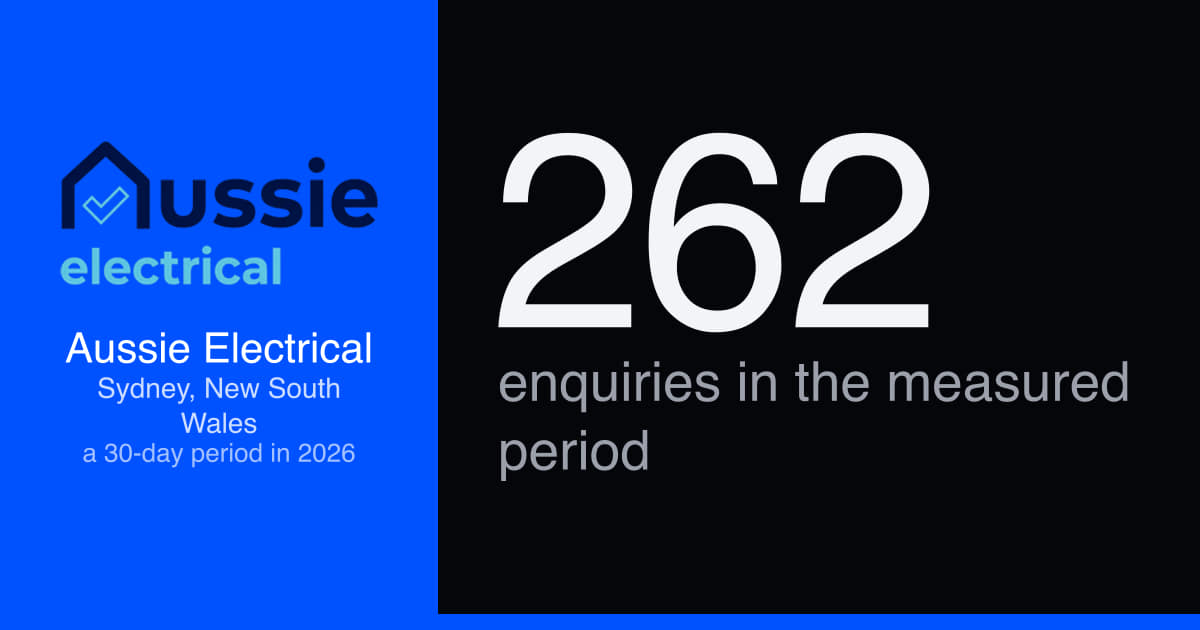
Electrician leads Sydney: 262 enquiries in a 30-day period
How a Sydney electrical contractor reached 262 enquiries in a 30-day period in 2026 and 260 at $65.01 each in the 31-day period before it. Electrician lead generation across Sydney.
Read case study
Home Services
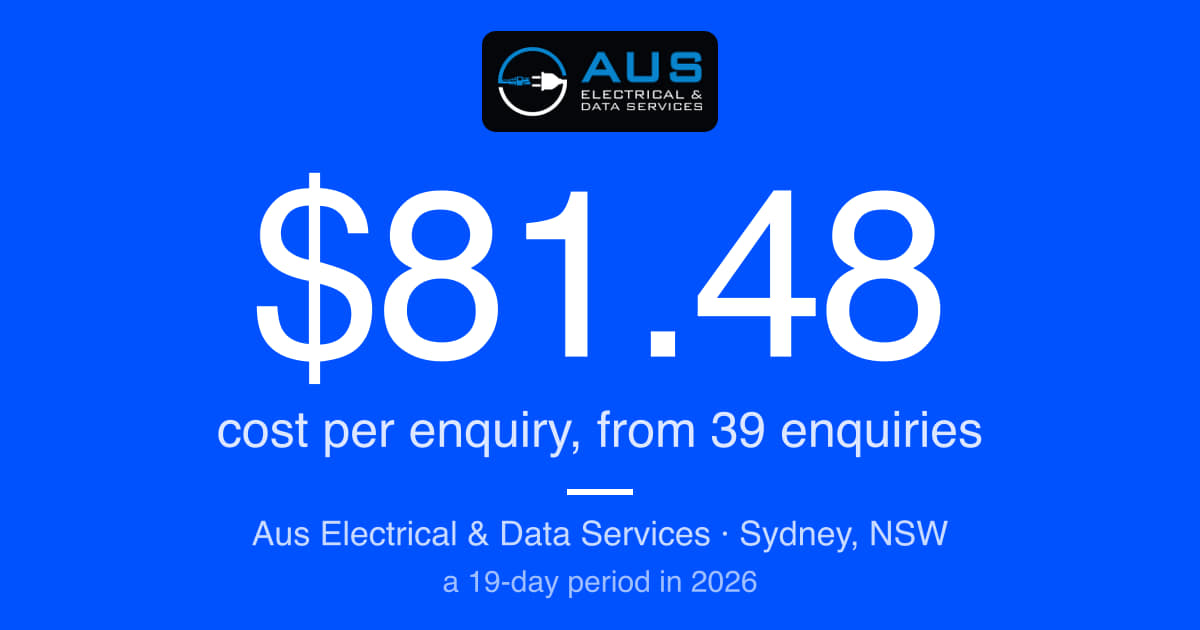
Electrician leads Sydney at $81.48 each in a 19-day period
Electrician leads in Sydney: Aus Electrical & Data Services paid $81.48 per enquiry across a 19-day period in 2026, then took 89 enquiries in the next period at $85.03 each.
Read case study
Cleaning Services
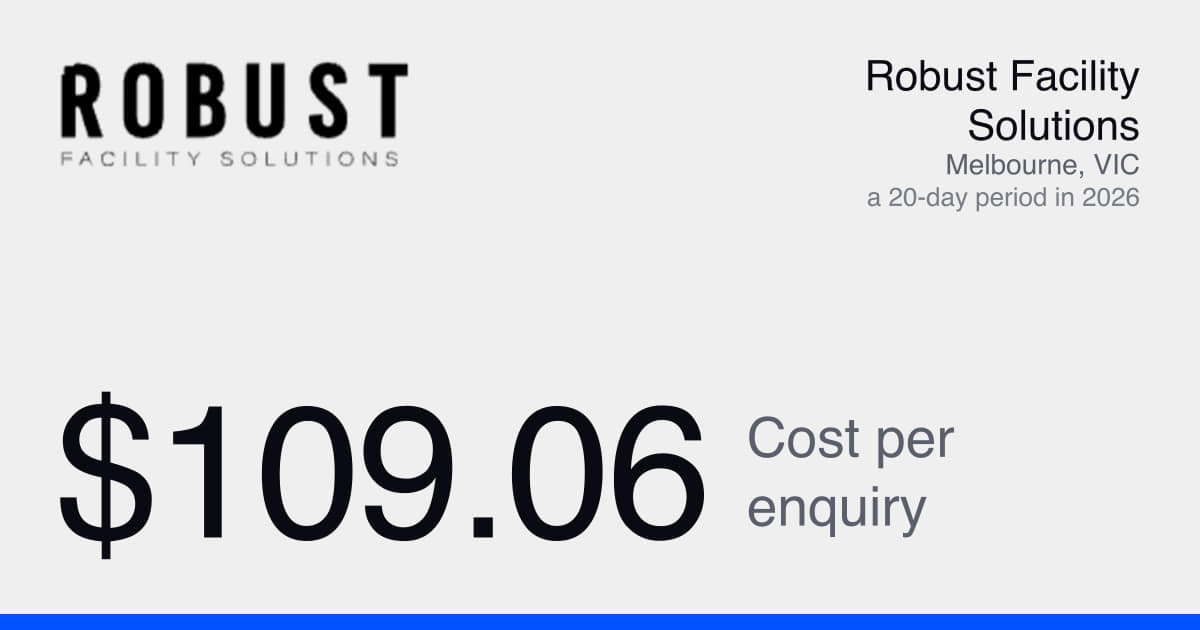
Commercial Cleaning Melbourne: 26 Leads at $109.06 in a 20-Day Period
Commercial cleaning leads in Melbourne — Robust Facility Solutions took 26 enquiries at $109.06 each in a 20-day period in 2026, and 31 across the wider account.
Read case study
More electricians we have published.
One account proves very little on its own. The closest neighbour to this one is Electrician leads Sydney: 35 enquiries in a 13-day period; its window is a 13-day period in 2026. The rest of the trade is below, with what each one is known for and how long that figure covers.
The work that produced this.
Everything above was delivered by one of a handful of things we do. These are the ones this account leant on, written up in full rather than summarised, alongside the page written for electricians generally.
- Electrical accounts, from switchboards to dataWritten for sparkies rather than as a generic services page: which work is worth advertising for, and what it realistically costs to win.
- Owning the suburbs on your service mapAn electrician's radius is a business decision. This is how the site and the Google profile get built to match the one you have chosen.
- Filtering out the jobs that never payA downlight swap and a switchboard upgrade cost the same to win. Only one of them is worth the drive.
The briefing behind the work.
The case study records what happened. These two explain the channel, measurement or operating decision that made the result interpretable in the first place.
The external entity data underneath any local-service acquisition programme. That case is argued in The citation inconsistencies that still move local rankings.
Why the primary and secondary categories must match the work a business actually wants. The other half of it is set out in Google Business Profile categories as a silent rank constraint.
The work behind this one is written up in full under electrical accounts, from switchboards to data, and how the work is sequenced before any of it is published sets out the sequence in order.
Want results like this?
Thirty minutes on your numbers rather than somebody else's, and a written list of what we would change first. Yours to keep either way.
No pitch deck. No upsell. A real conversation and a written list of leaks.