
Carpet cleaning Melbourne: 136 enquiries in a month at $25.02 each
Retro WC Cleaning · Carpet, upholstery and tile cleaning — residential and commercial · Melbourne, VIC
The short version · a 31-day period in 2026
Retro WC Cleaning covers carpet, upholstery, tile and window cleaning across Melbourne and out to Geelong and the Mornington Peninsula.
What follows is one measured period out of the account's 2026 trading, picked deliberately and reported without a calendar attached to it. Across that window it produced 136 tracked enquiries at $25.02 each from 606 clicks, with 22.44% of clicks becoming an enquiry. Taken over the whole account rather than one period, it produced 348 enquiries from 1,612 clicks and 22,921 impressions at $26.94 each, converting 21.59% of clicks at a 7.03% click-through rate. Carpet cleaning in Melbourne, with real trading evidence behind it.
The result.
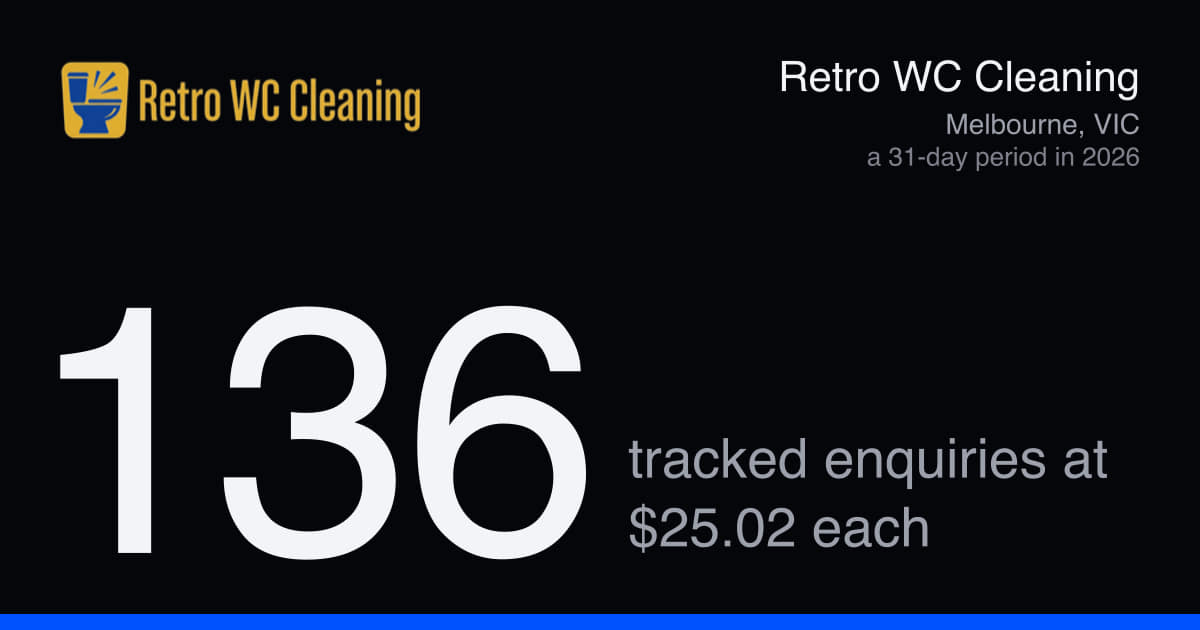
136
tracked enquiries at $25.02 each
a 31-day period in 2026
$25.02
cost per enquiry
a 31-day period in 2026
22.44%
of clicks became an enquiry
the same measured period, 2026
348
tracked enquiries
across the account's wider run
7.03%
click-through rate
across the account's wider run
- Industry
- Carpet, upholstery and tile cleaning — residential and commercial
- Discipline
- Cleaning
- Ad spend band
- $5K–$10K
- Measured over
- a 31-day period in 2026
Every figure above was read out of this client's live account and is reproduced exactly as the study publishes it. It is a record of what happened on one account, in one market, at one budget — not a forecast for yours.
What would this look like on your account?
Different market, different budget, different numbers. The first call is where we work out whether the same approach fits yours at all.
The case study
What moved for Retro WC Cleaning.
The short list
- Carpet cleaning is bought the day it is needed, and the same searches produce both a whole-house steam clean and someone hiring a machine for the afternoon. Telling them apart is the entire job.
- The account's strongest period in 2026 produced 136 tracked enquiries at $25.02 each across 31 days, converting 22.44% of clicks.
- Taken over the whole account rather than one period, it produced 348 enquiries at $26.94 each — close behind its best month, which is what a real result looks like next to a spike.
- Volume stepped down as demand cooled: 136 in the strongest period, 120 in the next, 69 in the one after, with cost per enquiry rising to $32.27. It is on the chart because it happened.
- For a multi-service cleaner, a cheap first enquiry is what opens the door to the upholstery, tile and window work behind it.
Each line above belongs to the period printed with it. None of them is an average across the account, and none of them is a forecast.
Carpet cleaning gets bought on the day it is needed
Someone spills red wine. A rental inspection lands. A couch starts to smell. A lease ends and the bond is on the line. The decision window is hours, not weeks, and whoever answers first with a believable price gets the job.
That makes carpet cleaning a good market to advertise in and a punishing one to advertise in badly. The same search that produces a whole-house steam clean also produces someone after a hire machine from the hardware store for the afternoon.
The margin is thin before the ad cost even lands
A cleaning job carries a labour cost that does not budge — the technician's hours, the van, the chemicals, the drive. The drive is not trivial when the service area runs from the inner suburbs out to Geelong and down the Mornington Peninsula. The enquiry cost sits on top of that and comes out of whatever is left.
There is no margin cushion of the kind a plumber has on a big job. The price of a lead subtracts directly from the profit on the job, every time.
The bidding is crowded in a particular way, too. National franchise networks with budgets set at head office. Single-van operators who price a job at whatever keeps the day full. End-of-lease companies who add carpet as an upsell and can afford to lose money on it, because the bond clean pays. Directories selling the enquiry three times over. All chasing the same rental-cycle demand in the same week of the month.
A full service list is a trap for an ad account
Retro WC Cleaning covers carpet steam and dry cleaning, upholstery, tile and grout, and windows, across Melbourne and out to Geelong and the Peninsula. That spread is a strength for the business and a hazard for the advertising: one service quietly absorbs the budget while the others go unsold, and the cost per enquiry drifts up unnoticed until the invoice lands.
What we took on
Dates are withheld here on purpose. What you are reading is one selected period out of a single search campaign that carried the full service range. Across the wider account those ads served 22,921 impressions, took 1,612 clicks and produced 348 tracked enquiries, at a 7.03% click-through rate and a 21.59% conversion rate.
The job was to rebuild the account around enquiries that turn into booked work across the full service range, rather than the one service easiest to sell. Demand swings with the season and the rental cycle, so this was continuous work: costs were not allowed to drift, and when they climbed they were pulled back. Maintenance, not setup. How it is done is not published.
The strongest period: 136 enquiries at $25.02 each
The period we are reporting ran 31 days and was the account's strongest on every measure that matters.
136 tracked enquiries at $25.02 each, from 606 clicks and 8,668 impressions — with better than one click in five converting, at 22.44%.
Those charts are the honest version of what sits either side of it. Cost per enquiry was $25.02 in the strongest period and $32.27 in the weakest one plotted — it rose as demand cooled, and the line goes the wrong way. We show it because it happened. Only periods carrying 14 or more days of activity are plotted, so the short stretches at either end are absent rather than smoothed over.
The volume chart says the same thing from the other side. 136 enquiries, then 120 and then 69 — 325 across the three periods long enough to count. Volume stepped down while the cost of each enquiry stepped up. That is a cleaning market cooling off, and the trade lives with it every year.
What makes that month credible is how close it sits to the account as a whole. Over the wider account, 348 enquiries came in at $26.94 each, converting 21.59% of clicks at a 7.03% click-through rate. A fluke month drags the account-wide figure far below itself. This one does not.
The numbers, in one place
- 136 enquiries at $25.02 each — across a 31-day period in 2026
- 22.44% of clicks became an enquiry — the same period
- 606 clicks from 8,668 impressions — the same period
- 120 enquiries in the next period and 69 in the one after, at $32.27 each in the last of them
- 348 enquiries from 1,612 clicks and 22,921 impressions — across the account's wider run
- $26.94 cost per enquiry and a 21.59% conversion rate — same basis
- 7.03% click-through rate — same basis
Every figure is tied to the period beside it. None is an average, none is a prediction. Where a stretch was only a handful of days long, it is left off the chart rather than dressed up as a month.
What it changed for the business
136 enquiries inside a single month is a diary a cleaning business has to staff for. The conversation moves from “where is the next job coming from” to “who is running the second van”. It changes how you quote, too: an operator with a full week does not have to win every job, and that is worth more to the margin than any discount recovers.
Cost per enquiry does the quieter work. At $25.02, a single upholstery clean or a small tile and grout job is still comfortably worth the drive. A multi-service cleaner sells the first job rather than one job: a carpet clean is how a household finds out the same company does the couch, the tiles and the windows, and that second call costs nothing to acquire. Price the first lead too high and the chain behind it never starts.
The downswing is the other half of the lesson, and it is on the chart above. When volume fell from 136 to 69 and the cost of an enquiry rose to $32.27, the business felt a quieter diary rather than a broken channel. Knowing the shape of your own seasonality, with numbers rather than a vague sense things are slow, lets an owner decide whether to push harder in the quiet months or staff for the busy ones.
Key takeaways
- Carpet cleaning is bought the day it is needed, and the same searches produce both a whole-house steam clean and someone hiring a machine for the afternoon. Telling them apart is the entire job.
- The account's strongest period in 2026 produced 136 tracked enquiries at $25.02 each across 31 days, converting 22.44% of clicks.
- Taken over the whole account rather than one period, it produced 348 enquiries at $26.94 each — close behind its best month, which is what a real result looks like next to a spike.
- Volume stepped down as demand cooled: 136 in the strongest period, 120 in the next, 69 in the one after, with cost per enquiry rising to $32.27. It is on the chart because it happened.
- For a multi-service cleaner, a cheap first enquiry is what opens the door to the upholstery, tile and window work behind it.
Frequently asked questions
What does a carpet cleaning lead cost in Melbourne?
In this account, $25.02 in its strongest period and $26.94 on the account's broader average. In the weakest period we plot it was $32.27. That is one Melbourne cleaning account across three solid stretches of trading, not a market rate.
Why did enquiries drop across the plotted periods?
Volume went from 136 to 120 to 69 as demand cooled, and the cost per enquiry rose to $32.27 in the last of them. Cleaning demand moves with the season and the rental cycle. We publish the decline because pretending it did not happen would make the headline figure meaningless.
Should a cleaning business advertise all its services or just one?
This account ran the full range and produced 348 enquiries. The risk with a broad service list is that one service silently absorbs the budget while the others go unsold — a reason to watch closely, not a reason to advertise one thing.
Is a 21.59% conversion rate normal for cleaning?
It is what this account did over its wider run, from 1,612 clicks. Cleaning converts well when the traffic is right, because the buyer usually wants the job done this week.
Booked out one month, quiet the next?
That pattern is normal in cleaning and usually manageable once you can see it. Most accounts we look at are not underspending. They are spending evenly on demand that is not even, and paying full price for searches that were never going to book. If you run a cleaning business in Melbourne and want to know which enquiries are worth their cost, SoudCoh will go through the account period by measured period.
Tags
- Carpet, upholstery and tile cleaning — residential and commercial
- Melbourne, VIC
- $5K–$10K
That is one account. Yours is a different one.
We read your ads, your search presence and your tracking the same way this one was read, and tell you what we would change first.
What every number on this page actually means.
Marketing words get used loosely, and a loose word can make a small result look like a big one. Here is exactly what we mean by each of them.
- Conversion
- One real action by one real person: a phone call that lasted long enough to be a conversation, a submitted enquiry form, a booking, or a purchase. Not a page view and not a form that merely loaded.
- Cost per job · cost per lead
- The advertising money spent, divided by the number of those actions. It is the only figure that tells you whether the advertising is worth doing, which is why we publish it next to the count.
- Conversion rate
- The share of people who clicked the ad and then did the thing. A high click count with a low conversion rate usually means the ad and the page are promising different things.
- Ad spend
- Money that went to the advertising platform, not to us. Our management fee is separate and is never included in a cost-per-job figure, because mixing them would flatter the number.
- The measurement window
- The dates the figure covers, named every time. Where a study covers a launch, the clock starts the day campaigns went live — not the day the graph started looking good.
- A starting point
- Where a study knows what a figure was before the work began, that number is printed next to the one it became. Where the account had no history to compare against, the result is printed on its own rather than measured from a number nobody recorded.
- Qualified lead
- An enquiry that matched the service and the service area, so it was worth someone picking up the phone for. Where a study says qualified, somebody checked.
- An anonymised client
- Government, council and cultural-institution engagements are published as sector and jurisdiction only. The work and the measured outcome are described in full; the organisation is not named.
One more, because it matters most: nothing on this page is a guarantee. It is a record of what happened on one account, in one market, at one budget.
What this study cannot tell you is what the same figure looks like on your account — so the same figure, on your own numbers, with your own click price and close rate. It takes about a minute and asks for nothing.
This page exists because of two of the six stages.
Compound is how our team works on any account — six stages every change passes through. Two of them are why there is anything honest to publish.
Meter
If it can't be measured, it doesn't get bought.
Before a dollar moves, every action worth money to the business is tracked as itself — calls, forms, bookings, purchases — with values attached. Without that stage there is no honest number to publish afterwards.
Ledger
Every change we make becomes a record you can open.
Every change lands in a dated record as it happens — what was added, what was stopped, what was rewritten and what it cost. Writing this page afterwards was reading a file, not reconstructing a memory.
What actually happens after the first call.
No mystery and no lock-in before you have seen anything. This is the sequence every account on this site went through.
- The call
Thirty to forty-five minutes, free
What you sell, who buys it, and what one customer is worth to you. No deck. You leave with a real number for your situation rather than a range.
- Week 0
The audit
We open your account — or your competitors' ground, if you do not have one yet — and write down every leak we can find. That list is yours whether or not you work with us.
- Week 1
The build
Everything the account needs before it can spend a dollar: what it will bid on, what it must never pay for, the ad copy, the assets, the landing pages and the tracking. A second person checks all of it before anything is live.
- Day one
You press go
Campaigns are created paused, every time, so you can read the whole build first. You activate when you are ready, not when we are.
- Days 1–14
The clean
The busiest fortnight your account will ever have. Search terms read daily, waste negated, early winners promoted, ad copy iterated against what is actually being served.
- From there
Rhythm
Weekly optimisation, reporting on a fixed cadence whether the news is good or bad, and a proper conversation each quarter about where the next block of budget should go.
Before you ask us anything
Here is what everybody asks first.
The questions this raises.
Whether the figures are real, how they were measured and over what length of window, what it costs, and whether any of it would hold for cleaning businesses.
The first call is free and there is no deck.
Book a callWhat does a carpet cleaning lead cost in Melbourne?
In this account, $25.02 in its strongest period and $26.94 on the account's broader average. In the weakest period we plot it was $32.27. That is one Melbourne cleaning account across three solid stretches of trading, not a market rate.
Why did enquiries drop across the plotted periods?
Volume went from 136 to 120 to 69 as demand cooled, and the cost per enquiry rose to $32.27 in the last of them. Cleaning demand moves with the season and the rental cycle. We publish the decline because pretending it did not happen would make the headline figure meaningless.
Should a cleaning business advertise all its services or just one?
This account ran the full range and produced 348 enquiries. The risk with a broad service list is that one service silently absorbs the budget while the others go unsold — a reason to watch it closely, not a reason to advertise only one thing.
Is a 21.59% conversion rate normal for cleaning?
It is what this account did over its wider run, from 1,612 clicks. Cleaning converts well when the traffic is right, because the buyer usually wants the job done this week.
Are the figures in this Retro WC Cleaning case study real?
Yes. Every number on this page was read out of the client's own advertising account and is printed here exactly as the study publishes it, beside the period it covers. The dashboard and ad images are screen-grabs of that account rather than recreations. If one of these figures matters to your decision, ask about it on the first call and we will walk you through where it came from.
How were these numbers measured, and over what window?
The headline figure covers a 31-day period in 2026, and every other figure on the page is printed beside the period it belongs to. We publish the LENGTH of a measurement window and the year, and withhold the exact dates — when a client advertised, and how their trading calendar looks, is their commercial information rather than ours. A conversion means one real action by one real person: a phone call that lasted long enough to be a conversation, a submitted enquiry form, a booking, or a purchase. Not a page view, and not a form that merely loaded.
How much was being spent to produce this?
The study publishes this account's advertising spend as a band — $5K–$10K — rather than an exact figure, because the precise number is the client's business. Our management fee is separate from that and is never folded into a cost-per-lead figure anywhere on this site; mixing the two would flatter every number on the page.
Would this work for cleaning businesses like mine?
We cannot promise you the same numbers, and nobody honestly can. What this page tells you is what was achievable in that market, at that budget, for that service. Your competition, your service area, your margins and what one customer is worth to you all move the answer. On the first call we build the picture from your figures rather than someone else's, and if the honest answer is that this channel is wrong for you right now, we will say so.
More accounts, same discipline.
Studies from the same kind of work, so you can see how the pattern holds across different businesses.
Cleaning
End of lease cleaning Melbourne: 104 leads in a 27-day period
End of lease and bond cleaning leads in Melbourne: 104 enquiries in a 27-day period in 2026 at a 33.12% conversion rate, out of 276 enquiries in total.
Read case study
Home Services
Plumbing leads Sydney: 128 enquiries at $114.39 each
Plumbing leads in Sydney: Champion Plumbing recorded 128 enquiries at $114.39 each across a 27-day period in 2026, with 14.33% of clicks becoming an enquiry.
Read case study
Security & Technology
CCTV installation Sydney: 45 leads at $45.14 each
CCTV installation and data cabling leads in Sydney: 45 enquiries at $45.14 each in a 23-day period in 2026, and 298 enquiries across the account's wider run.
Read case study
More cleaning businesses we have published.
One account proves very little on its own. The closest neighbour to this one is Carpet cleaning Central Coast: 37 leads at $40.69; its window is a 31-day period in 2026. The rest of the trade is below, with what each one is known for and how long that figure covers.
- Carpet cleaning Central Coast: 37 leads at $40.6937Leads at $40.69 each — a 31-day period in 2026
- End of lease cleaning Sydney: lead cost down 26.51%−26.51%Cost per lead — one measured period to the next, 2026
- Commercial cleaning Melbourne: leads at $27.39$27.39cost per commercial cleaning enquiry — a 21-day period in 2025
The work that produced this.
Everything above was delivered by one of a handful of things we do. These are the ones this account leant on, written up in full rather than summarised, alongside the page written for cleaning businesses generally.
- What this build looks like for other cleaning businessesThe same work written up for bond cleans, commercial contracts and carpet jobs, and what a cleaning business can reasonably expect from it.
- Ranking in the suburbs you actually drive toCleaning is bought locally. This is the map-pack and service-area work that runs underneath the paid side of an account like this one.
- Where the enquiry counts in this study came fromEvery number above is a counted call or a submitted form. This is the measurement that makes a claim like that checkable rather than asserted.
The briefing behind the work.
The case study records what happened. These two explain the channel, measurement or operating decision that made the result interpretable in the first place.
A review process that follows a real completed job and stays inside Google's rules. That case is argued in Review requests that do not sound automated.
The external entity data underneath any local-service acquisition programme. The other half of it is set out in The citation inconsistencies that still move local rankings.
The work behind this one is written up in full under what this build looks like for other cleaning businesses, and the ninety-day plan that produced results like these sets out the sequence in order.
Want results like this?
Thirty minutes on your numbers rather than somebody else's, and a written list of what we would change first. Yours to keep either way.
No pitch deck. No upsell. A real conversation and a written list of leaks.