
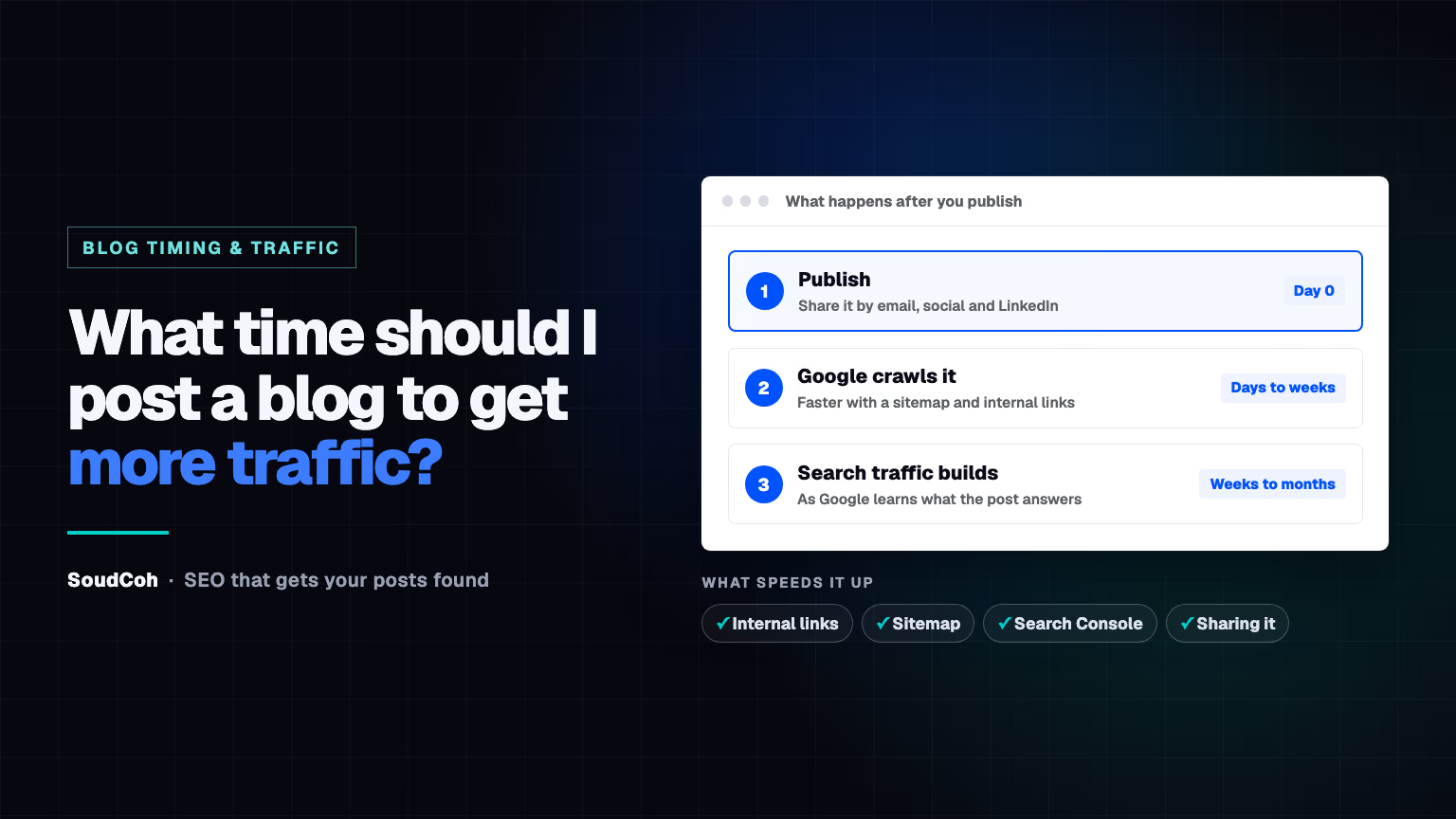
You've finished a blog post and you're wondering when to hit publish: Monday morning, Thursday lunchtime, Sunday night? It's a fair question, but for Google the answer is simpler than most advice suggests.
The hour you publish makes little difference to rankings. What decides whether a post gets traffic is how useful it is, how quickly Google finds it, and how well you share and link it. Here's when timing matters, when it doesn't, and the routine that gets new posts found.
Does the time you post a blog affect Google rankings?
No, not in any way that matters. Nothing in Google's guide to its ranking systems mentions the hour or day a page goes live. What it describes is how helpful and relevant a page is to the search. The one timing-related system is freshness: Google runs "query deserves freshness" systems that favour newer content for searches where people expect it, such as news about something that just happened. A post about choosing a plumber or fixing a slow website isn't that kind of search.
Google also doesn't see your post the moment you publish it. Its own guidance says crawling can take anywhere from a few days to a few weeks. Whether you hit publish at 9am or 9pm, the post enters the same queue.
And people search all week. In SoudCoh's research on Australian trade businesses that run search ads every day, no single day dominated: Monday brought 16% of the week's enquiries and Saturday 12%, and about one in four calls arrived before 7am, after 6pm or on a weekend. A searcher finds your post when they search, not when you posted it.
When does the time you publish matter?
Timing matters for people, not for Google. The first readers of a new post rarely come from search; they come from the places you share it. That's where timing earns its keep:
- Your email list. Send the post when your subscribers usually open emails. Your email platform's reports show when that is.
- Social media and LinkedIn. Post when your followers are online, using each platform's own insights rather than a generic "best time".
- Time zones. If you sell across Australia, remember that during daylight saving, 9am in Melbourne or Sydney is 8am in Brisbane and 6am in Perth.
- Time-sensitive topics. If the post is about news, a law change or an event, publish as soon as it's ready. That's where freshness counts.
To find your own best time, look at when visitors already arrive. In Google Analytics 4, an exploration using the Hour and Day of week dimensions shows when people visit your site. Our step-by-step guide shows how to see when your visitors arrive. Publish a little before your busiest window, then keep to that schedule.
How to get more traffic to your blog
Traffic comes from what you publish and how you connect it, far more than from when. Five habits make the biggest difference:
- Answer one real question per post. Find and use the words people search with, and put a short, direct answer at the top.
- Be specific. Narrow searches are easier to win than broad ones. Where it fits, name the service and the place: in SoudCoh's own Search Console data, two in five non-brand searches that showed our site named a place.
- Link to the post from your strongest pages. Google says it primarily finds pages through links from pages it has already crawled, so link new posts from your strongest pages: related posts and service pages.
- Share it the day it goes live. Email, social and LinkedIn bring the first readers while search catches up.
- Keep it current. Revisit posts when facts change, prices move or a better example comes along. Here's how to update old posts the right way.
A searcher finds your post when they search, not when you posted it.
How to rank a blog post fast (and what fast really means)
You can't force a ranking, but you can remove the delays. Google's guide on how to ask Google to recrawl your URLs sets out the options:
- Make sure the post can be indexed. It shouldn't be blocked by robots.txt or carry a noindex tag, and it should be in your sitemap. If posts keep failing to appear, that's a technical SEO problem worth fixing first.
- Request indexing once. In Search Console, run the URL Inspection tool and select Request indexing. Our step-by-step guide shows how to request indexing in Search Console. Google notes there's a quota, and asking again for the same URL won't get it crawled any faster.
- Submit and keep a sitemap. Google calls a sitemap an important way to discover the URLs on your site. Here's how to submit your sitemap.
- Link it from pages Google already visits, such as your blog index, related posts and service pages.
Then give it time. Google's SEO Starter Guide says some changes take effect in a few hours and others can take several months, and suggests waiting a few weeks before judging results. For a realistic timeline, read how long SEO takes in Australia. Good SEO services build this routine in from the first post.
A simple publishing routine
If you publish twice a week, this routine covers everything above:
| When | What to do | Why |
|---|---|---|
| Before publishing | Check the short answer, title, meta description and internal links | The page is ready for both readers and search |
| Publish day | Publish a little before your busiest visiting window | Your email and social readers see it while they're online |
| Same day | Request indexing once; link the post from two or three related pages; share it | Google finds it sooner, and the first readers arrive |
| After 2 to 4 weeks | Check the searches it appears for in Search Console | See what people actually searched, then tighten the wording |
| Every few months | Update facts, examples and links | Keeps the post accurate and worth ranking |
Myths about blog timing and traffic
- "There's a magic hour to publish." Google crawls on its own schedule, and searchers arrive all week.
- "Publishing more often makes Google rank you higher." Google's guidance on helpful content asks whether you're adding a lot of new content just to make your site seem fresh, and answers: "No, it won't".
- "Longer posts rank better." The same guidance asks whether you're writing to a particular word count because you've heard Google prefers one: "No, we don't".
- "Changing the date makes a post fresh." Google lists changing dates when the content hasn't substantially changed as a warning sign.
Timing matters for the people you share a post with, not for Google.
How SoudCoh helps your blog get found
The routine above is what turns a blog into steady traffic: answer-first posts, clean indexing, internal links to the pages that matter, and regular updates. If you're looking for the best marketing agency for your business, start with how we work.
Not sure why your posts aren't getting traffic? Book a free marketing audit. Tell us which posts you're proud of, and we'll show you what's holding them back and what to fix first.
Common questions about blog timing and traffic
What is the best day to publish a blog post?
For Google, no day is better than another; the page is ranked on how useful it is, not when it went live. Pick the days you can share it with your email list and social followers, and keep to them. In SoudCoh's research, no single day dominated: Monday brought 16% of the week's enquiries and Saturday 12%.
How long does it take for a new blog post to show on Google?
Google says crawling can take anywhere from a few days to a few weeks, and ranking well usually takes longer. A sitemap, links from your other pages and one indexing request in Search Console help Google find the post sooner.
Should I post at the same time every week?
A steady schedule helps readers know when to expect new posts and helps you plan the sharing. Google ranks each page on its own merits, so consistency is about your audience and your workload, not a ranking rule.
Does updating an old blog post help it rank?
Updating a post when its facts, prices or examples go out of date is worth doing, because readers need it to be accurate. Changing only the date does not help: Google lists changing dates without substantially changing the content as a sign of content made for search engines rather than people.
Questions and answers
Does publishing a blog post at night hurt SEO?
No. Google crawls new pages on its own schedule, often days later, so the hour you publish doesn't change how the post ranks. Night publishing only matters if you want readers to see your email or social post straight away.
Should I publish blog posts on weekends?
You can. People search on weekends too, and Google treats the post the same way on any day. Choose weekend publishing only if you can also share the post then, or schedule the email and social posts for a weekday.