
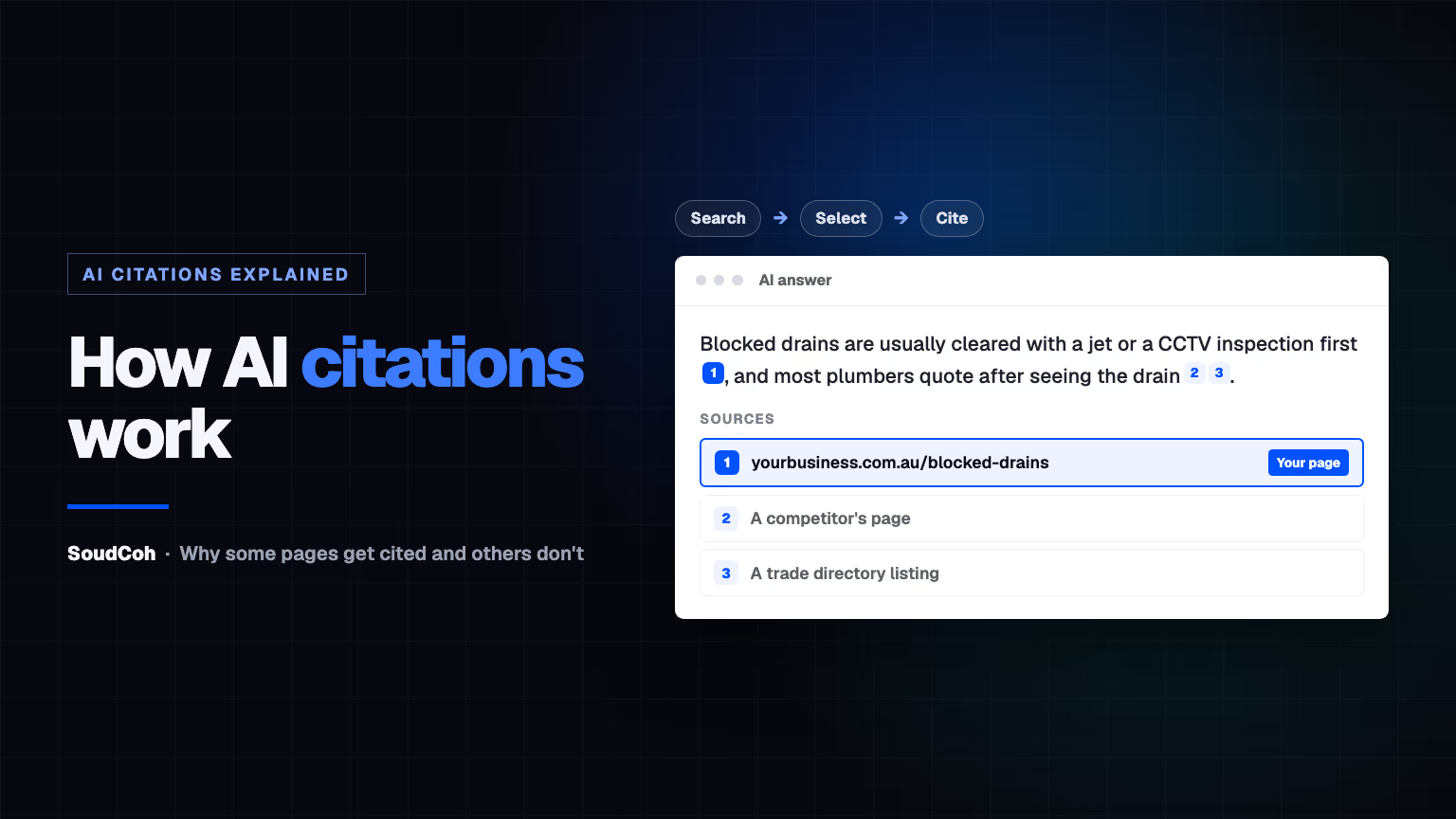
An AI citation is a link to a source shown with an AI-generated answer. When ChatGPT, Google's AI Overviews and AI Mode, Claude, Perplexity or Microsoft Copilot search the web to answer a question, they find pages, pick the passages that answer it, write a response and link the pages they drew on.
Whether your page is one of them comes down to three things: it has to be found, it has to answer part of the question more clearly than the alternatives, and it has to be trusted. Here is how each step works, and what you can do about it.
What is an AI citation?
It is the link, footnote or source card that shows where an AI answer got its information. Every major AI search tool shows them in some form:
- Google shows links to supporting websites in AI Overviews and AI Mode.
- ChatGPT links the sources it used when it searches the web.
- Claude provides direct citations when it uses web content, so answers can be checked.
- Perplexity shows numbered sources with its answers.
- Microsoft Copilot cites pages too; Bing now reports those citations to site owners.
A citation is different from a mention. A mention is your business named in the answer; a citation is a link to your page. You can have one without the other, so it is worth tracking both.
How do AI tools choose which pages to cite?
Most AI search follows the same three steps, even though each platform uses its own search providers and models.
| Step | What happens | What it means for you |
|---|---|---|
| Search | The AI runs one or more web searches. Google says AI Overviews and AI Mode may use "query fan-out": several related searches across subtopics. | Your page must be crawlable and indexed, and it can be found through any of those sub-questions. |
| Select | It picks the passages that answer each part of the question most directly. | A clear answer near the top of a specific page beats a general page. |
| Cite | It writes the answer and links the pages it relied on. | Accurate, consistent facts make your page a safe source to quote. |
Query fan-out explains why AI answers often cite pages that do not rank first for the original question: the answer is assembled from the best page for each sub-question. Google says its AI features can show a wider and more diverse set of links than a classic search for this reason.
What do cited pages have in common?
Specificity. In SoudCoh's tests of AI answers to questions about who does marketing or websites for a named trade, 60% of the pages cited were pages built for that exact trade. General home pages made up 23%, and directories, review sites and social profiles only 1.8%.
The pages that get cited tend to share a pattern:
- One topic per page, named in the title, the address and the first paragraph.
- The answer first, then the detail and the evidence.
- Facts that stand on their own: prices or how pricing works, service areas, credentials, dates.
- Evidence: real examples, case studies or original data.
There is more detail on the trade results in our guide to how ChatGPT chooses which business to recommend.
AI answers are assembled from the best page for each sub-question. Be that page for one question at a time.
Why do AI citations change from one answer to the next?
Because each answer is assembled fresh. When we asked the same buyer question three times, only 25% of the websites cited appeared in all three answers. The sub-questions an AI searches can vary, different platforms draw on different search providers, and new or updated pages change what is available.
The practical lesson: a single citation is not a ranking you own, and a missing one is not a penalty. What matters is how often you are cited across many answers, which is why citations are measured over repeated questions, not one check.
How do you earn more AI citations?
- Be reachable. Make sure robots.txt does not block the search crawlers behind AI answers, such as OAI-SearchBot, Claude-SearchBot, PerplexityBot, Googlebot and Bingbot.
- Answer one question per page. Give each service, problem and comparison its own page, with the answer near the top.
- State facts clearly and consistently. Use the same business name, services, areas and contact details everywhere, and describe them in structured data that matches the page.
- Add evidence. Original data, examples and case studies give an AI something specific to quote.
- Earn mentions elsewhere. In a 2025 Ahrefs study of 75,000 brands, mentions of a brand across the web correlated more strongly with visibility in Google's AI Overviews (0.664) than backlinks did (0.218).
None of this is separate from good search work; good SEO services already cover the foundations. The citation-specific layer is generative engine optimisation.
A citation is not a ranking you own. Measure how often you are cited, not whether you were cited once.
How do you know if you are being cited?
Ask a fixed set of customer questions every month across the main AI platforms and record which of your pages are cited, and Bing Webmaster Tools now reports how often your pages are cited in Copilot and Bing's AI summaries. Google explains how its AI features find sources in its guide to AI features and your website. Our step-by-step method is in how to measure AI visibility.
Common questions about AI citations
Is being mentioned by AI the same as being cited?
No. A mention is your business named in the answer text. A citation is a link to a page used as a source. You can be mentioned without a link, or cited for a fact without being recommended, so track both.
Do AI tools cite the same pages that rank on Google?
Often, but not always. Google says AI Overviews and AI Mode can show a wider and more diverse set of links than a classic search, because they run several related searches. Ranking well helps you be found; answering a specific question clearly helps you be chosen.
Why was my page cited once and then not again?
AI answers vary from one ask to the next. In SoudCoh's tests, only 25% of the websites cited for a question appeared in all three answers when it was asked three times. One citation is a good sign, not a permanent position.
Can you pay to be cited in an AI answer?
Not as an organic source. Citations come from what the AI finds and judges useful for the question. The way to earn more of them is clear, specific, accurate pages and genuine mentions of your business on other websites.
Questions and answers
Do AI citations send traffic?
Some. A citation is a link a reader can click, and many AI-influenced visits arrive without a referrer, so analytics undercounts them. Ask new enquiries how they found you to see the full effect.
Which pages should I make citable first?
The pages for the services you most want enquiries for, then the questions customers ask before they buy, such as price, comparisons and how the work is done.