
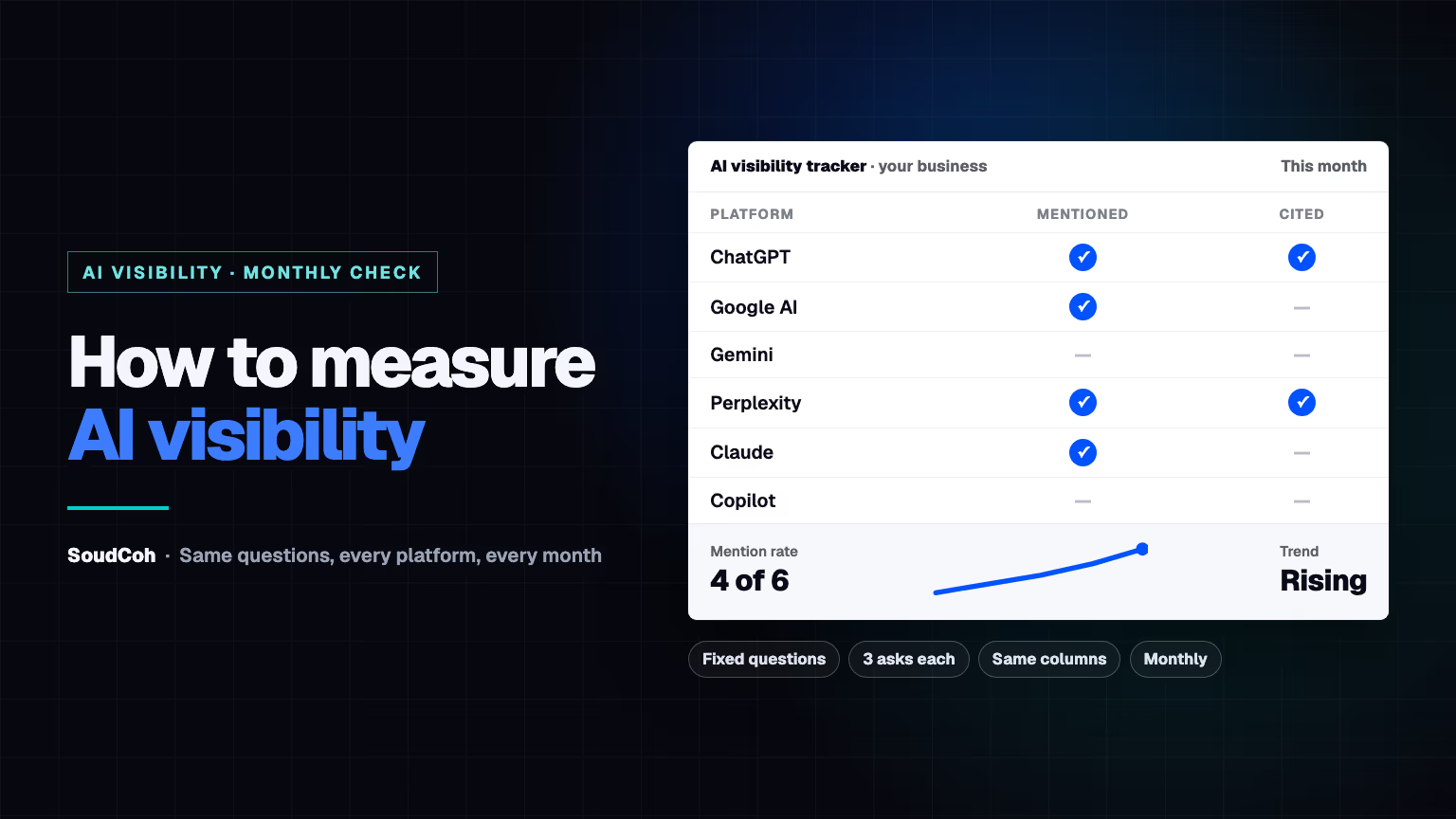
AI visibility is how often AI tools such as ChatGPT, Google's AI Overviews, Gemini, Perplexity, Claude and Microsoft Copilot mention your business or cite your website when customers ask the questions you want to be the answer to. No single report measures it, and one answer proves nothing.
The reliable way is a fixed set of customer questions, asked the same way every month across several platforms, recorded in the same columns, and read alongside the few reports the platforms do provide. Here is the method, step by step.
Why can't one check measure AI visibility?
Because AI answers change. In SoudCoh's tests of AI answers, when we asked an assistant the same buyer question three times, only 25% of the websites it cited appeared in all three answers. A single check is one draw, not a ranking.
There is also no complete report. Search engines show your impressions and clicks; most AI assistants show nothing about how often they name you. So AI visibility has to be measured the way a survey is: the same questions, asked repeatedly, recorded consistently.
Step 1: build a fixed set of customer questions
Write 10 to 20 questions in the words your customers actually use, and keep the wording identical every month. Cover five kinds of question:
| Type | Example | What it shows |
|---|---|---|
| Category | Who is the best plumber in Frankston? | Whether you are recommended |
| Problem | Why does my hot water keep running out? | Whether your advice is used |
| Comparison | Is pipe relining better than replacing the pipe? | Whether your pages are a source |
| Price | How much does it cost to fix a blocked drain in Melbourne? | Whether your pricing pages are read |
| Brand | What does [your business] do, and is it any good? | Whether you are described accurately |
Step 2: ask on more than one AI platform
Each AI tool uses its own search providers and sources, so being named in one says little about the others. Test at least ChatGPT, Google (AI Overviews and AI Mode), Gemini, Perplexity, Claude and Microsoft Copilot, plus any tool your customers favour.
- Start a fresh chat for every question, so earlier answers do not steer the next one.
- Ask each question three times and record all three answers.
- Keep the setting the same: the same location, the same account state and, where the tool offers it, web search switched on.
One AI answer is a snapshot. A fixed set of questions, asked every month, is a measurement.
Step 3: record the same fields every time
| Field | What to record |
|---|---|
| Date | The day you ran the check |
| Platform | ChatGPT, Gemini, Perplexity and so on |
| Question | The exact wording from your set |
| Mentioned? | Yes or no: is your business named |
| Cited? | Yes or no: is your website linked as a source |
| URL cited | Which of your pages, if any |
| Competitors | Businesses named instead of, or alongside, you |
| Accurate? | Whether what it says about you is correct |
Those columns give four numbers worth tracking: your mention rate (answers that name you, out of all answers), your citation rate (answers that link your site), the pages cited most often, and the competitors named most often. Accuracy matters too: a wrong phone number or service area in an AI answer is something to fix, not just a statistic.
Step 4: add the reports that do exist
A few platforms now report part of the picture. Use them alongside your question set, not instead of it.
- Google Search Console counts visibility in AI Overviews and AI Mode inside the normal Performance report, under the Web search type, so it cannot be separated from ordinary search. Google explains this in its guide to AI features and your website.
- Bing Webmaster Tools added an AI Performance report in February 2026, in public preview. It shows how often your pages are cited in Microsoft Copilot and Bing's AI summaries, and for which queries, but not clicks.
- Google Analytics can show visits from AI tools if you give them their own channel, matching referrers such as chatgpt.com, perplexity.ai, gemini.google.com, copilot.microsoft.com and claude.ai. OpenAI says ChatGPT tags its links with utm_source=chatgpt.com, but do not rely on tags alone.
Expect analytics to undercount. On SoudCoh's own website, visits that analytics could attribute to AI assistants were just 0.2% of sessions, because most AI-influenced visits arrive with no referrer and are filed as Direct. Ask every new enquiry how they found you, and record the answer.
Analytics undercounts AI. Ask every new enquiry how they found you.
Step 5: compare each month, then fix one thing
Compare each month with the first, your baseline. Look for the questions where a competitor is named and you are not, then check why: does their page answer the question more directly, show stronger evidence, describe the business more clearly, or have more mentions on other websites? Fix the weakest page or profile, then ask the same questions again next month.
That loop is the core of generative engine optimisation. If the basics are not in place yet, start there: good SEO services already cover most of it. For the background, read what AEO and GEO are and how ChatGPT chooses which business to recommend.
Common questions about measuring AI visibility
How often should you measure AI visibility?
Monthly suits most businesses. AI answers vary from one ask to the next, so a fixed question set checked once a month, with each question asked three times, gives a trend you can trust more than weekly spot checks.
What is a good AI citation rate?
There is no published benchmark, because results depend on the industry, the questions and the platforms. Compare yourself with your own baseline and with the competitors named in the same answers. A rising mention rate on the questions that matter is the goal.
Can Google Search Console show AI Overviews traffic?
Partly. Google includes visibility in AI Overviews and AI Mode in the Performance report under the Web search type, but it is combined with ordinary search, so it cannot be separated there.
Do you need a paid tool to track AI visibility?
No. A spreadsheet with the columns in this guide is enough to start. Paid tools can run more questions more often, but they still sample answers, so the same caution applies: look at trends, not single results.
Questions and answers
Which AI platforms should a business track?
Start with ChatGPT, Google's AI Overviews and AI Mode, Gemini, Perplexity, Claude and Microsoft Copilot. Add any tool your own customers mention when you ask how they found you.
How long does it take for AI visibility to change?
It varies. Changes to your own pages can be picked up once they are crawled again, while reviews and mentions on other websites build over months. That is why the same questions are asked every month and compared with a baseline.