
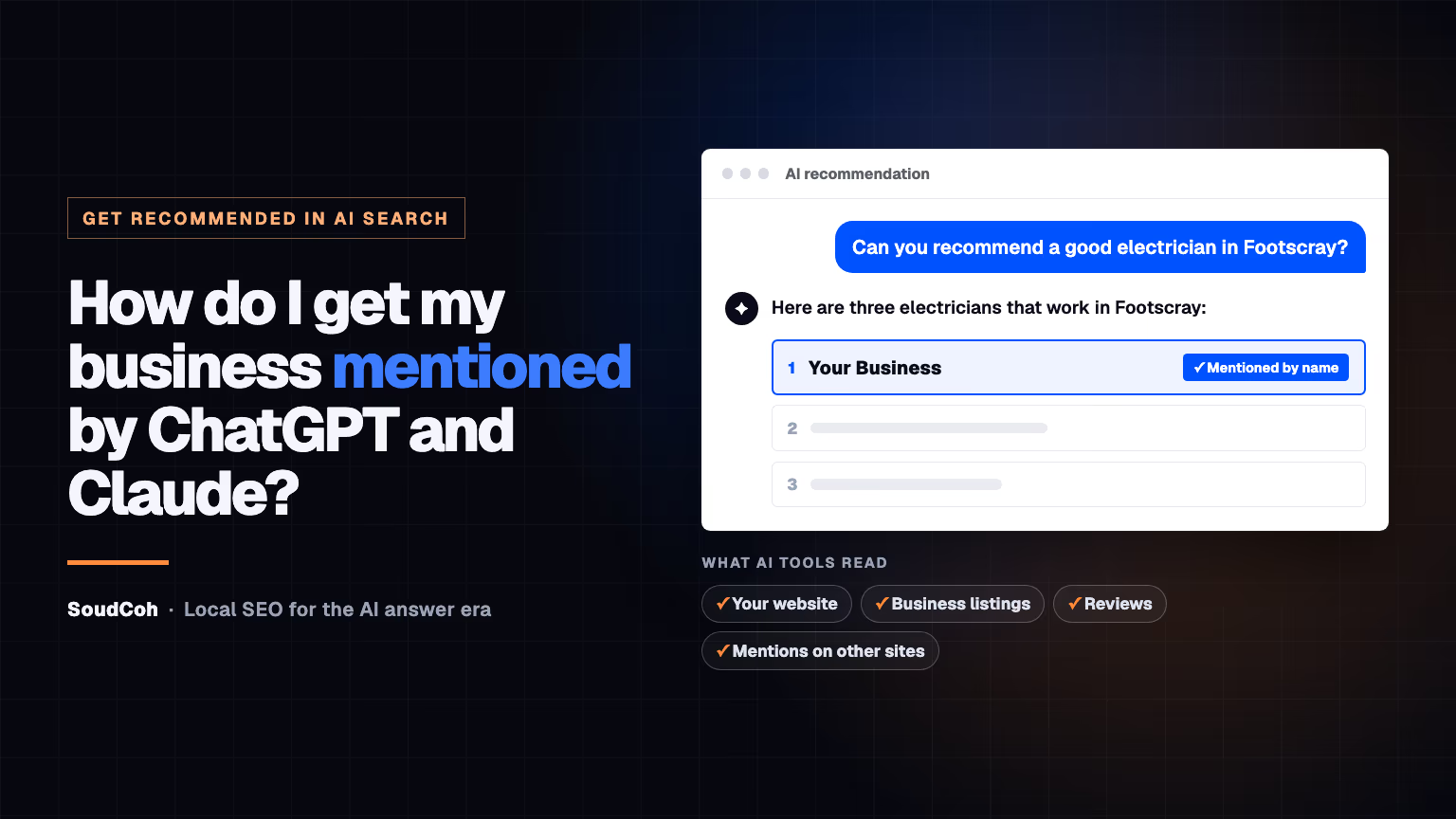
When someone asks ChatGPT or Claude to recommend a plumber, a physio or an accountant, the answer names a handful of businesses. Getting yours named isn't luck. These tools search the web, read what's published about each business, and mention the ones they can find, understand and trust.
The audience is already large: OpenAI said in February 2026 that ChatGPT had more than 900 million weekly active users, and 48.6% of Australians have used generative AI at least once. Here is what these tools look at, and five steps that make your business easier to mention.
Are people really asking AI to recommend businesses?
Yes, and quickly more of them. In BrightLocal's 2026 Local Consumer Review Survey of US consumers, use of ChatGPT and other generative AI tools for local recommendations rose from 6% to 45% in a year, making AI the third most popular source of business recommendations. 40% said they trust AI platforms to provide business recommendations.
Australians are using these tools too. In an ANU survey run with Google, 48.6% of Australians had used generative AI at least once, and OpenAI said in February 2026 that ChatGPT had more than 900 million weekly active users worldwide. Someone choosing a plumber, a physio or a bookkeeper may now ask an AI tool for a shortlist before they ever see your website.
How do ChatGPT and Claude decide which businesses to mention?
Both tools can search the web while they answer, which matters for a question like "who's a good electrician in Footscray?" that needs current, local information. OpenAI says ChatGPT search sometimes partners with other search providers and can share your general location with trusted third-party providers to show local information such as nearby business listings. Claude's web search also uses outside providers: Anthropic's list of subprocessors names Brave Search among them.
The answer is built from what those searches return: business websites, listings, reviews and other pages that mention a business. The tool then summarises what it found. That has three consequences:
- Your website has to be reachable. If an AI search crawler is blocked, your pages can't be used.
- The facts about you have to be easy to find and agree with each other. An AI tool can only repeat what it can read.
- There is no fixed ranking. In SoudCoh's tests of AI answers, only 25% of the websites cited appeared in all three answers when the same question was asked three times.
For more from those tests, read how ChatGPT chooses which business to recommend, or start with what AEO and GEO are if the terms are new.
Step 1: Let AI search tools read your website
OpenAI and Anthropic each run separate crawlers for search and for training, and you control them in your website's robots.txt file. The ones that decide whether you can be recommended are the search crawlers.
| Crawler | Company | What it does | If you block it |
|---|---|---|---|
| OAI-SearchBot | OpenAI | Finds pages to show in ChatGPT's search features | Your site won't be shown in ChatGPT search answers |
| Claude-SearchBot | Anthropic | Indexes pages for Claude's search results | Your site may be less visible in Claude's search results |
| Claude-User | Anthropic | Fetches a page when someone asks Claude a question | Claude can't retrieve your pages for that question |
| GPTBot | OpenAI | Collects content that may be used to train OpenAI's models | Training only; controlled separately from OAI-SearchBot |
| ClaudeBot | Anthropic | Collects content that could be used to train Anthropic's models | Training only |
Open yourdomain.com.au/robots.txt and check that the three search crawlers aren't blocked. A blanket rule against "AI bots", added by a developer or a security plugin, can block them along with the training crawlers. OpenAI says a robots.txt change takes about 24 hours to apply, and Anthropic says its bots follow robots.txt.
Step 2: Give each service and area its own answer-first page
AI tools quote pages that answer the question asked. In SoudCoh's tests of AI answers, buyer questions about who does marketing or websites for a named trade, asked repeatedly on more than one model, 60% of the pages cited were pages built for the exact trade asked about. Home pages made up 23%, and directories, review sites and social profiles less than 2%.
Your customers' questions work the same way. "Who does switchboard upgrades in Footscray?" is best answered by a page about switchboard upgrades that names Footscray, not by a home page listing twelve services. Each main service page should say:
- what you do, in the words customers use;
- where you work, by suburb or service area;
- what the job involves: the steps, the timing and what affects the price;
- why customers choose you: licences, experience and reviews; and
- how to get in touch.
Put the direct answer in the first paragraph and keep the page fast and easy to crawl. Google says there are no special requirements to appear in its AI features and that the usual SEO best practices still apply; the same groundwork is what ChatGPT and Claude have to read. Good SEO services already cover most of it.
AI tools can only recommend the businesses they can find, read and trust.
Step 3: Make your business details match everywhere
When an AI tool looks up a business, it may read your website, your listings and directory pages together. If your name, phone number, services or suburbs differ between them, it has less reason to trust any of them, and you can't control which source it reads first. OpenAI says ChatGPT can use trusted third-party providers for local information such as nearby business listings, without naming them, so every listing matters.
This is the core of local SEO:
- a complete Google Business Profile with the right primary category, services, areas and hours;
- the same business name, address or service area and phone number on directories such as True Local, Yellow Pages and Hotfrog;
- an About page and contact page that state the same facts as everything else.
It pays off on Google as well. Google says prominence, meaning how well known a business is, is based partly on how many websites link to your business and how many reviews you have.
Step 4: Earn reviews and mentions on other websites
What other websites say about you counts. The clearest evidence comes from Google's AI Overviews: an Ahrefs study of 75,000 brands found that brand mentions across the web had the strongest correlation with appearing in AI Overviews (0.664), far ahead of backlinks (0.218). It is a correlation rather than proof of cause, and it covers Google's AI rather than ChatGPT or Claude, but it points the same way as everything above.
Practical ways to earn mentions:
- Ask every customer for an honest Google review. Google's review policy doesn't allow incentives, asking only happy customers, or requesting specific content in a review.
- Get listed by your industry association and the suppliers or brands you're accredited with, which often list their members or installers.
- Earn local coverage for real work: community projects, sponsorships and expert comment for local news.
- Keep your own profiles current on the platforms your customers use.
Step 5: Check whether ChatGPT and Claude mention you
Because answers change, a single check proves little. Test it properly:
- Write five questions a customer would ask, with your service and suburb, such as "Who's a good electrician in Footscray for a switchboard upgrade?"
- Ask each one in ChatGPT and in Claude, three times each, in new chats.
- Record whether you're named, which competitors are, and which websites are cited.
- Repeat every month and compare.
Don't expect analytics to show the full picture. On SoudCoh's own website, visits analytics could attribute to AI assistants were just 0.2% of sessions, because most AI-influenced visits arrive with no referrer. Ask every new enquiry how they found you.
One answer proves nothing. Ask the same question several times, on more than one tool.
What won't get you mentioned
- Paying for a "guaranteed" AI ranking. No agency controls what ChatGPT or Claude say, and answers change from one ask to the next.
- Fake or incentivised reviews. They break Google's review policy and put your profile at risk.
- Stuffing pages with suburb names. A list of fifty suburbs answers no one's question.
- Blocking AI search crawlers by accident. Check your robots.txt, as in step 1.
- Relying on an llms.txt file. It can be useful to maintain, but it is not required for Google's AI features and does not guarantee a mention.
How SoudCoh helps businesses get recommended in AI search
Getting recommended in AI search isn't a separate channel. It sits on your website, your Google Business Profile and your reputation, the same foundations as local search. Our generative engine optimisation work builds answer-first service and area pages, keeps your business facts consistent across the web, and checks how AI answers describe you over time, alongside our SEO services and the map-pack work for Google. If you're looking for the best marketing agency for your business, start with how we work.
Not sure where you stand? Book a free marketing audit. Tell us what you sell and where, and we'll show you how ChatGPT and Claude describe your business today and what to fix first.
Common questions about getting recommended by AI
Does ChatGPT use my Google Business Profile?
OpenAI doesn't say. Its help pages say ChatGPT can use trusted third-party providers for local information such as nearby business listings, without naming them. Keep your details identical on every listing, so it doesn't matter which one is read.
Will blocking GPTBot or ClaudeBot stop AI tools recommending me?
Not directly. GPTBot and ClaudeBot collect content for training. The crawlers behind search answers are OAI-SearchBot and Claude-SearchBot, and Claude-User fetches pages when someone asks Claude a question. Keep those allowed.
How long does it take to get mentioned?
It varies. Changes to your own pages can be picked up once they are crawled again, and OpenAI says robots.txt changes take about 24 hours to apply. Reviews and mentions on other websites build over months. Judge progress by asking the same questions regularly, not by one answer.
Is getting recommended in AI search different from local SEO?
Mostly not. The groundwork is the same: accurate service pages, a complete Google Business Profile, consistent listings and genuine reviews. Local SEO aims at Google's map results; AI tools draw on the same facts when they recommend a business.
Questions and answers
Does Claude use the same sources as ChatGPT?
Not necessarily. Each uses its own search providers and crawlers, and in SoudCoh's tests two AI models asked the identical question cited largely different websites. Being easy to find on your own site and on several listings covers both.
Should I make a page for every suburb I serve?
Only where you genuinely work and have something specific to say. A thin page that swaps one suburb name for another answers no one's question. A strong service page that lists your real service areas usually does more.