
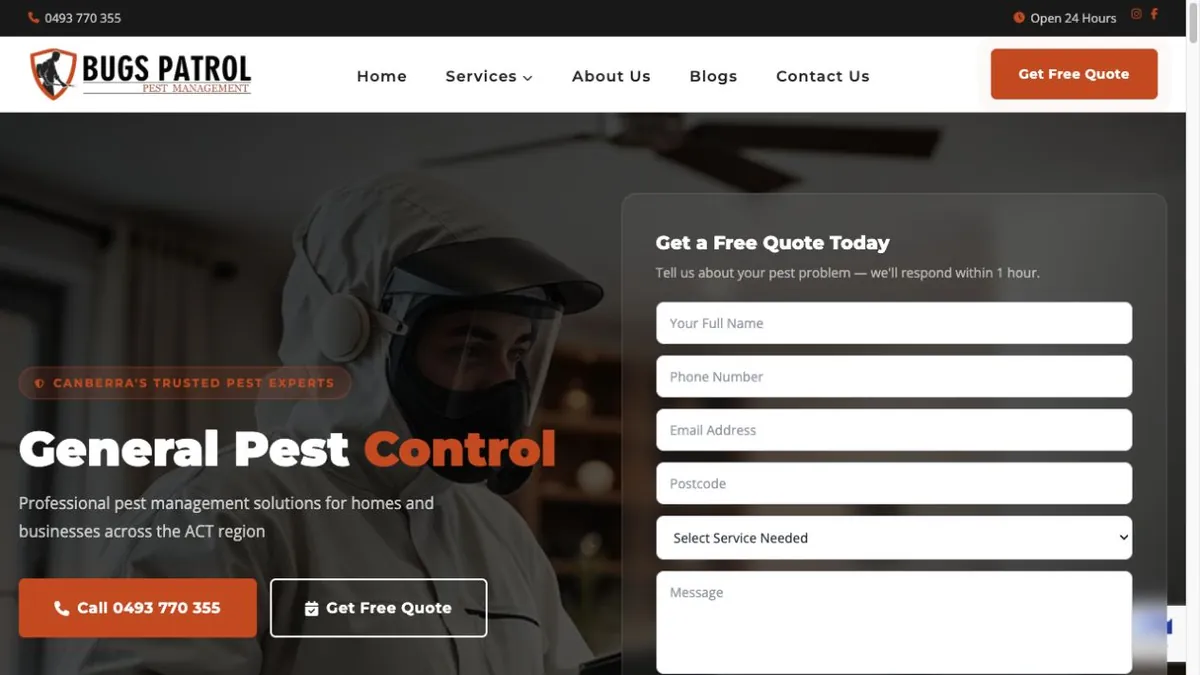
Bugs Patrol
Pest Control
The short version · within 4 weeks
Soudcoh rebuilt Bugs Patrol's website and Google Ads to win local searches in Canberra.
Faster pages, sharper copy, tighter tracking and more bookings at lower cost.
The result.
within 4 weeks
39+
New Leads in 26 Days
within 4 weeks
A$38.72
Cost per Lead
within 4 weeks
181%
Conversion Growth
within 4 weeks
10%
Drop in Average CPC
within 4 weeks
- Industry
- Pest Control
- Discipline
- Pest Control
- Services
- Pest Control · Google Ads · Landing Page Design · Lead Generation
- Measured over
- within 4 weeks
Every figure above was read out of this client's live account and is reproduced exactly as the study publishes it. It is a record of what happened on one account, in one market, at one budget — not a forecast for yours.
What would this look like on your account?
Different market, different budget, different numbers. The first call is where we work out whether the same approach fits yours at all.

The case study
About Bugs Patrol
Bugs Patrol is Canberra's trusted local pest control service, known for fast response times and guaranteed results. They approached SoudCoh to generate more high-intent leads without inflating ad spend. We rebuilt their website, restructured their Google Ads, and sharpened their messaging around trust, speed, and local ownership. The outcome was a cleaner funnel, stronger click-through rates, and conversions that translated directly into booked jobs.
The Challenge
Several issues were blocking qualified traffic from converting into booked inspections and keeping costs higher than necessary.
Scattergun Services
Multiple pest types diluted messaging and budgets. We needed sharper focus without sacrificing service breadth.
Weak Local Proof
Being Canberra-owned was a genuine strength, but it was buried in copy and creatives instead of leading the message.
Generic Headlines
Ads blended in with competitors, hurting quality scores and ad relevance across search campaigns.
Thin Landing Experience
Existing pages lacked social proof, pricing cues, and visible guarantees, causing drop-offs before enquiry.
Patchy Tracking
Leads were tracked loosely, making real optimisation little more than guesswork.
No Clear Offer
Guarantees existed but there was no sharp call to action or urgency driving immediate bookings.
Our Strategic Approach
Strategy
We rebuilt the growth engine from click to call. A fresh website anchored trust, while tightly structured search campaigns captured ready-to-book locals. Every touchpoint emphasised speed, safety, and guaranteed outcomes, backed by crisp tracking and weekly optimisation rhythms.
Service Focus
We organised services by high-intent categories like termites, spiders, and wasps, then aligned ad groups and landing sections to each. Clear pathways meant faster decisions and stronger relevance across the funnel.
Ad Strategy
We launched responsive search ads with headline stacks featuring "pest control Canberra," "guaranteed results," and "one visit" messaging. Tight control over which searches were paid for, so budget went to the ones that convert.
Premium Positioning
We led with "100% Canberra owned," same-day options, and licensed technicians. Trust icons, warranties, and testimonials sat above the fold. This framed Bugs Patrol as the safe, premium choice rather than the cheapest option.
Audience Targeting
We geo-fenced Canberra suburbs and layered urgent intent queries like "pest removal today" and "termite inspection now." Ad schedules prioritised peak home-search hours, while mobile bids pushed calls and form starts.
Conversion-First Website
We designed a swift, modern site with sticky call buttons, short forms, plan cards, and process explainers. Proof blocks and FAQs reduced objections. Page speed and Core Web Vitals scored green across the board.
Measure, Learn, Scale
GA4 and Ads conversion actions captured quotes, calls, and form submissions. Weekly reports highlighted CPA, search terms, and top performers, guiding budget shifts toward the best-performing services.
Services Delivered
Results
within 4 weeks
Traffic quality lifted, forms felt effortless, and the phones started moving. With tighter targeting and a site built to convert, every advertising dollar pulled more weight.
Why This Matters
Local service brands win when trust meets speed. By pairing Canberra-first messaging with precise search intent and a conversion-led website, Bugs Patrol turned ad spend into real bookings. The system is simple to scale across suburbs and services, setting them up for steady, profitable growth.
Tags
- Pest Control
- Google Ads
- Landing Page Design
- Lead Generation
That is one account. Yours is a different one.
We read your ads, your search presence and your tracking the same way this one was read, and tell you what we would change first.
What every number on this page actually means.
Marketing words get used loosely, and a loose word can make a small result look like a big one. Here is exactly what we mean by each of them.
- Conversion
- One real action by one real person: a phone call that lasted long enough to be a conversation, a submitted enquiry form, a booking, or a purchase. Not a page view and not a form that merely loaded.
- Cost per job · cost per lead
- The advertising money spent, divided by the number of those actions. It is the only figure that tells you whether the advertising is worth doing, which is why we publish it next to the count.
- Conversion rate
- The share of people who clicked the ad and then did the thing. A high click count with a low conversion rate usually means the ad and the page are promising different things.
- Ad spend
- Money that went to the advertising platform, not to us. Our management fee is separate and is never included in a cost-per-job figure, because mixing them would flatter the number.
- The measurement window
- The dates the figure covers, named every time. Where a study covers a launch, the clock starts the day campaigns went live — not the day the graph started looking good.
- A starting point
- Where a study knows what a figure was before the work began, that number is printed next to the one it became. Where the account had no history to compare against, the result is printed on its own rather than measured from a number nobody recorded.
- Qualified lead
- An enquiry that matched the service and the service area, so it was worth someone picking up the phone for. Where a study says qualified, somebody checked.
- An anonymised client
- Government, council and cultural-institution engagements are published as sector and jurisdiction only. The work and the measured outcome are described in full; the organisation is not named.
One more, because it matters most: nothing on this page is a guarantee. It is a record of what happened on one account, in one market, at one budget.
What this study cannot tell you is what the same figure looks like on your account — so what a lead costs you at your click price, with your own click price and close rate. It takes about a minute and asks for nothing.
This page exists because of two of the six stages.
Compound is how our team works on any account — six stages every change passes through. Two of them are why there is anything honest to publish.
Meter
If it can't be measured, it doesn't get bought.
Before a dollar moves, every action worth money to the business is tracked as itself — calls, forms, bookings, purchases — with values attached. Without that stage there is no honest number to publish afterwards.
Ledger
Every change we make becomes a record you can open.
Every change lands in a dated record as it happens — what was added, what was stopped, what was rewritten and what it cost. Writing this page afterwards was reading a file, not reconstructing a memory.
What actually happens after the first call.
No mystery and no lock-in before you have seen anything. This is the sequence every account on this site went through.
- The call
Thirty to forty-five minutes, free
What you sell, who buys it, and what one customer is worth to you. No deck. You leave with a real number for your situation rather than a range.
- Week 0
The audit
We open your account — or your competitors' ground, if you do not have one yet — and write down every leak we can find. That list is yours whether or not you work with us.
- Week 1
The build
Everything the account needs before it can spend a dollar: what it will bid on, what it must never pay for, the ad copy, the assets, the landing pages and the tracking. A second person checks all of it before anything is live.
- Day one
You press go
Campaigns are created paused, every time, so you can read the whole build first. You activate when you are ready, not when we are.
- Days 1–14
The clean
The busiest fortnight your account will ever have. Search terms read daily, waste negated, early winners promoted, ad copy iterated against what is actually being served.
- From there
Rhythm
Weekly optimisation, reporting on a fixed cadence whether the news is good or bad, and a proper conversation each quarter about where the next block of budget should go.
Before you ask us anything
Here is what everybody asks first.
The questions this raises.
Whether the figures are real, how they were measured and over what length of window, what it costs, and whether any of it would hold for pest control businesses.
The first call is free and there is no deck.
Book a callAre the figures in this case study real?
Yes. Every number on this page was read out of the client's own advertising account and is printed here exactly as the study publishes it, beside the period it covers. The dashboard and ad images are screen-grabs of that account rather than recreations. If one of these figures matters to your decision, ask about it on the first call and we will walk you through where it came from.
How were these numbers measured, and over what window?
The headline figure covers within 4 weeks, and every other figure on the page is printed beside the period it belongs to. We publish the LENGTH of a measurement window and the year, and withhold the exact dates — when a client advertised, and how their trading calendar looks, is their commercial information rather than ours. A conversion means one real action by one real person: a phone call that lasted long enough to be a conversation, a submitted enquiry form, a booking, or a purchase. Not a page view, and not a form that merely loaded.
Would this work for pest control businesses like mine?
We cannot promise you the same numbers, and nobody honestly can. What this page tells you is what was achievable in that market, at that budget, for that service. Your competition, your service area, your margins and what one customer is worth to you all move the answer. On the first call we build the picture from your figures rather than someone else's, and if the honest answer is that this channel is wrong for you right now, we will say so.
Why does this study show a result but not a starting point?
Because in most of these engagements there was nothing reliable to start from. A brand-new advertising account has no history, and a business that was tracking enquiries on paper or in a spreadsheet has no comparable figure either. Where a real before-number exists we print it next to the after-number, so you can see the movement rather than take our word for it. Where it does not, we print the result on its own. Back-solving a starting point from a percentage would make the page look better and mean less.
Would my business get the same result?
We cannot tell you that, and nobody honestly can. What this page tells you is what was achievable in that market, at that budget, with that service. Your competition, your service area, your margins and what a customer is worth to you all move the answer. On the first call we build the picture from your numbers rather than from someone else's, and if the honest answer is that this channel is wrong for you right now, we will say so.
How much would this cost to run?
Two separate numbers. Your ad spend goes to the platform, and what it needs to be depends on how competitive your market is and how many jobs you want — the smallest companies we work with invest a minimum of A$3,000 a month, and our largest clients run multiple eight figures a month across paid channels. Our management fee is separate and scales with the work. The first call is free and you leave it with a real figure for your situation.
How quickly could we start seeing enquiries?
It depends on the channel. Paid search meets demand that already exists, so calls and forms can arrive within hours of launch, and the first two to four weeks are an optimisation period where waste is cut daily. Most accounts settle into their best rhythm around 60 to 90 days. SEO, content and brand work run on a much longer clock — months rather than weeks — and we will tell you which one your situation actually needs.
Am I locked into a long contract?
No long-term lock-in. We would rather keep the work because it is producing than because a contract says you have to stay. What we do ask for is enough runway to be fair to the account — a campaign judged on its first ten days is being judged during the part where we are still cutting waste out of it. Terms are put in front of you in plain English before anything is signed.
More accounts, same discipline.
Studies from the same kind of work, so you can see how the pattern holds across different businesses.

Waste & Recycling
Scrap metal collection Melbourne: 222 enquiries in a month at $8.91 each
A licensed Melbourne scrap metal dealer took 222 enquiries at $8.91 each in an 18-day period in 2026, with 21.12% of clicks turning into an enquiry. Scrap metal lead generation, Melbourne.
Read case study

Cleaning
Carpet cleaning Melbourne: 136 enquiries in a month at $25.02 each
A Melbourne carpet, upholstery and tile cleaning company booked 136 enquiries at $25.02 each across a 31-day period in 2026, with 22.44% of clicks turning into an enquiry.
Read case study

Home Services
Plumbing leads Sydney: 128 enquiries at $114.39 each
Plumbing leads in Sydney: Champion Plumbing recorded 128 enquiries at $114.39 each across a 27-day period in 2026, with 14.33% of clicks becoming an enquiry.
Read case study
The work that produced this.
Everything above was delivered by one of a handful of things we do. These are the ones this account leant on, written up in full rather than summarised, alongside the page written for pest control businesses generally.
- Pest control campaigns, start to finishTermite inspections, general pest work and emergency callouts are worth very different amounts, and are worth pursuing very differently.
- Getting found in the map results for a calloutMost pest enquiries are urgent and local. The three results on the map take a large share of them before anyone scrolls.
- The website that has to answer the adPaid traffic sent to a homepage asks a worried customer to find their own way. One page, one action, is most of the difference.
The briefing behind the work.
The case study records what happened. These two explain the channel, measurement or operating decision that made the result interpretable in the first place.
Why a clean account can still report the wrong outcome when the conversion definition is wrong. That case is argued in The conversion-tracking errors that duplicate sales and GST.
The repeatable budget, query and tracking checks that sit behind a result like this one. The other half of it is set out in The Google Ads checks worth automating.
The work behind this one is written up in full under pest control campaigns, start to finish, and how the work is sequenced before any of it is published sets out the sequence in order.
Want results like this?
Thirty minutes on your numbers rather than somebody else's, and a written list of what we would change first. Yours to keep either way.
No pitch deck. No upsell. A real conversation and a written list of leaks.