Each result shows its reporting period. Open a tile for the measurement basis.
Headline result
29%
of web-form enquiries from Google Ads became won jobs
First five weeks of Google Ads
How it was measured
Won jobs divided by all web-form enquiries traced to Google Ads over the same days, with test entries and repeat submissions removed. Enquiries with no recorded outcome count as not won. The five weeks start on the first day the ads spent money. Rounded down.
51%
Share of won revenue from bird, possum and dead-animal searches
First five weeks of Google Ads
How it was measured
Won job value from enquiries that came through the bird, possum and dead-animal ad groups, as a share of all won job value from Google Ads enquiries over the same days.
13%
Ad clicks that became a web form or a tracked call of a minute or more
Last 30 days
How it was measured
Web forms plus tracked calls lasting 60 seconds or more, traced to Google Ads, divided by ad clicks over the same days. Test entries removed. Rounded down.
53%
Share of those enquiries that were phone calls
Last 30 days
How it was measured
Tracked calls of 60 seconds or more as a share of all enquiries traced to Google Ads (calls of that length plus web forms) over the same days. Rounded down.
+23%
Rise in ad click-through rate from the first four weeks to the last four
First four weeks vs last four weeks of ads
How it was measured
Clicks divided by impressions across all campaigns over the last 28 days, compared with the first 28 days counted from the first day of spend. Rounded down.
How we measured +
Won-job and value figures cover web-form enquiries only over the first five weeks. Call-inclusive enquiry rates count tracked calls lasting at least 60 seconds. Tests and repeated forms are removed. Won value is the agreed job price before costs; service shares describe an early set of jobs.
In one minute
The 60-second version
Local Pest Control, from the brief to the result in 4 short slides.
01 The business
A Melbourne pest controller for homes and businesses
Local Pest Control treats insects and rodents, and takes on possums, birds, proofing and dead-animal removal across Melbourne, with a short quote form and the phone number on every page.
02 The problem
People search by the pest and by the suburb
Someone with pigeons under the solar panels and someone with bed bugs search in different words, and many add their suburb. One general pest-control ad answers neither of them well.
03 What we built
An ad group for each problem, and a campaign for suburbs
Each pest problem has its own ad group and page, from rats and wasps to pigeons and dead-animal smells. A suburb campaign answers searches naming a suburb. Forms and calls are traced to the ad.
03
04 What happened
Almost 3 in 10 form enquiries became won jobs
In the first five weeks, 29% of web-form enquiries from the ads became won jobs. In the last 30 days, about 1 in 8 ad clicks became a form or a call of a minute or more.
29%of web-form enquiries became won jobs, first five weeks
01 / 04
Insights
What the data showed
Details from the Local Pest Control project. Open a card for the finding and its source.
Service01
51%
Bird, possum and dead-animal searches took about a third of ad spend and brought in 51% of won revenue.
Share of ad spend33%
Share of won revenue51%
Searches about pigeons and other birds, possums in the roof and dead-animal smells took about a third of ad spend in the first five weeks, yet brought in 51% of won revenue. The share rests on a small number of jobs, so one or two jobs can move it, but it is reason enough to give these problems their own ad groups and pages.
Source and basis. Ad spend and won value grouped by ad group theme (birds, possums and dead animals against everything else), first five weeks of ads. Won value comes from web-form enquiries, the ones with recorded outcomes. It rests on a small number of jobs, so one or two jobs can move it.
Device02
60%
Desktop form enquiries became won jobs at more than three times the rate of forms sent from a phone.
Desktop computer60%
Mobile phone18%
60% of web-form enquiries sent from a desktop computer became won jobs, against 18% of those sent from a phone, even though phones brought most of the clicks. The numbers are small, but people who sit down at a computer to fill in the quote form are often closer to booking, so the form stays short and asks for the suburb and the service up front.
Source and basis. Won jobs divided by web-form enquiries traced to Google Ads, split by the device the form was sent from, first five weeks of ads. Forms with no recorded device were left out of both groups. The mobile rate is rounded up, so the gap is not overstated. Treat it as a direction rather than a fixed rate.
Calls03
53%
Just over half of enquiries from the ads were phone calls of a minute or more.
Phone calls of a minute or more53%
Web forms47%
In the last 30 days, 53% of enquiries traced to the ads were tracked calls that lasted a minute or more, and the rest were web forms. A pest problem often feels urgent and many people would rather ring than type, so the phone number sits in the site header, with the quote form close by for everyone else.
Source and basis. Tracked calls of 60 seconds or more and web forms traced to Google Ads, last 30 days, test entries removed. Shorter calls were left out of both the share and the total.
Website development · Local Pest Control
We built their website, too.
Explore the website we designed for Local Pest Control: the pages, the mobile experience and the path to an enquiry.
Explore Local Pest Control’s website, from the first impression to the details.
Use the left and right arrow keys to browse screenshots. Home goes to the first screenshot and End goes to the last.
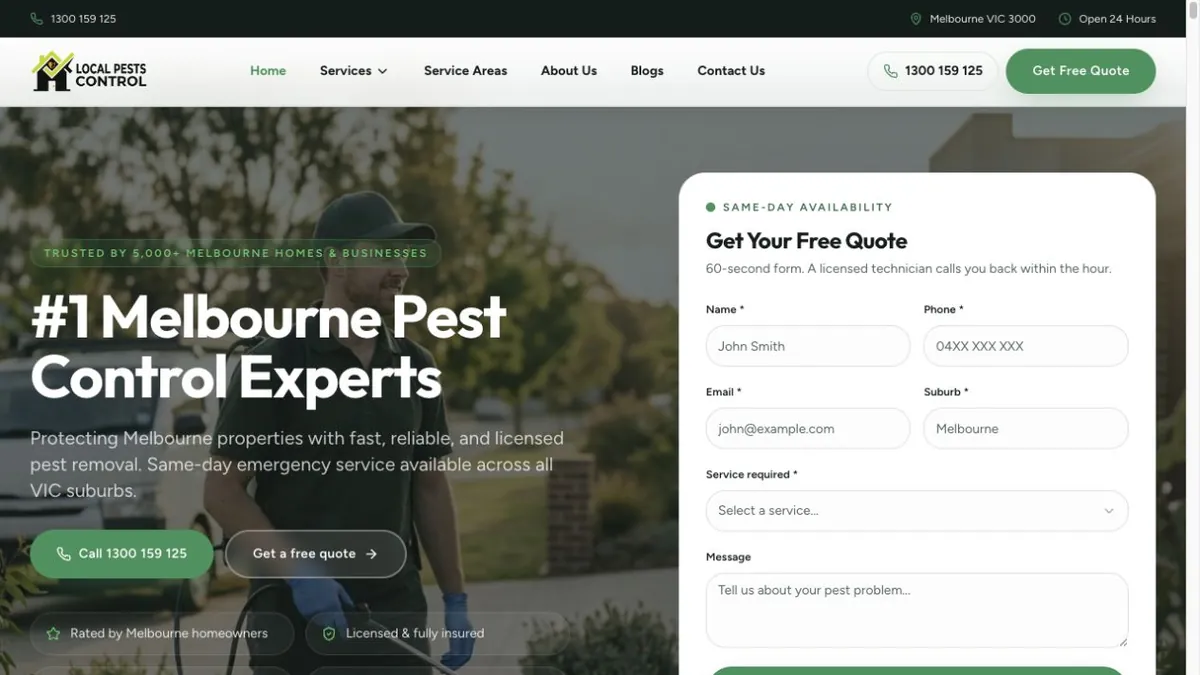
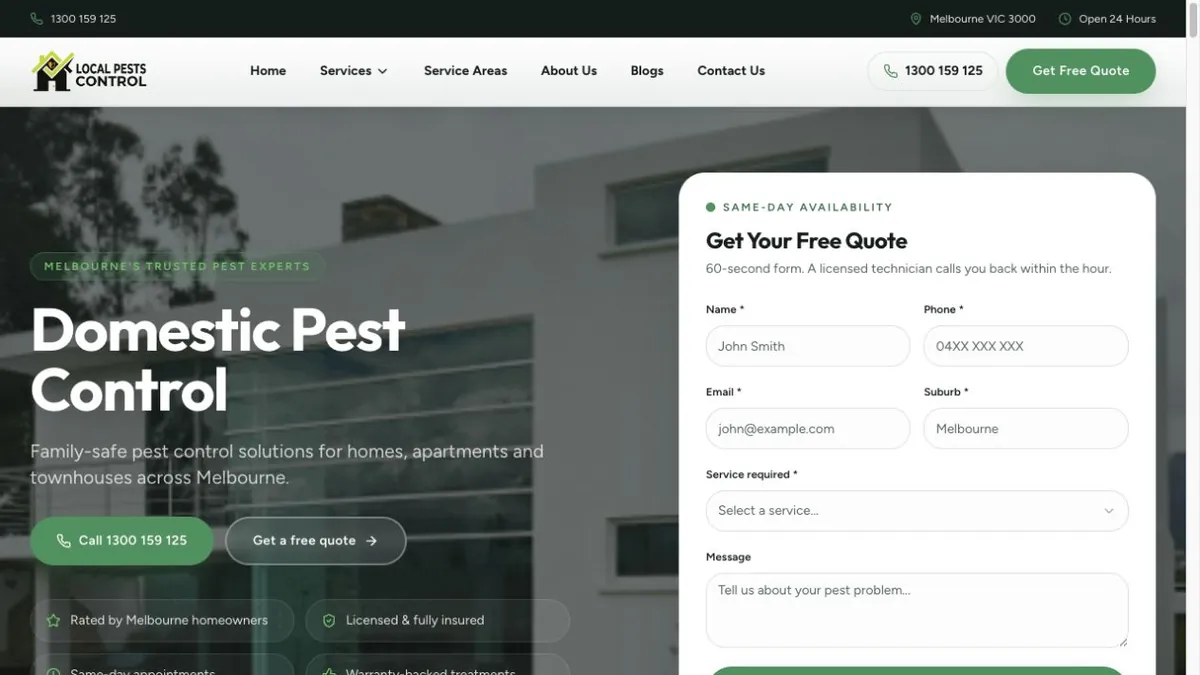
Pair local service copy with a useful job brief — The Melbourne introduction sits over working imagery beside a white quote form. Contact, suburb, service and message fields connect the enquiry to the property and pest problem.
01 / 02 · Pair local service copy with a useful job brief — The Melbourne introduction sits over working imagery beside a white quote form. Contact, suburb, service and message fields connect the enquiry to the property and pest problem.
The case study
The project, connected.
The brief, the work and what it delivered.
The starting point
Local Pest Control
Local Pest Control is a Melbourne pest-control business for homes and businesses, from insects and rodents to possums, birds, proofing and dead-animal removal.
Residential and commercial pest enquiries · Melbourne, VIC
SoudCoh services
Google Ads management
Enquiry tracking and won-job reporting
Website design and landing pages
What we put in place
The campaign work
A main Google Ads campaign with an ad group for each pest problem, from rats and wasps to pigeons, possums and dead-animal smells, each sending people to the page for that problem.
A suburb campaign answering searches that name a Melbourne suburb with an ad that names the same suburb.
Web forms and tracked calls traced from the ad to the enquiry, with won jobs recorded at the agreed price in the client's job records.
A review of won job value by search theme, campaign and device.
What the project delivered
The outcome
29% of web-form enquiries from Google Ads became won jobs in the first five weeks, with bird, possum and dead-animal searches bringing in 51% of won revenue.
Local Pest Control is a Melbourne pest-control business working in homes and businesses. It treats spiders, cockroaches, bed bugs, fleas, flies, wasps, rats and mice, and it takes on the bigger jobs too: possums in the roof, pigeons under solar panels, bird proofing and netting, and dead-animal removal.
Its website, which we also built, gives each problem and many Melbourne suburbs their own page. Every page carries the phone number in the header and a short quote form that asks for the suburb and the service.
What we set out to do
People with a pest problem search for the problem in front of them, or for pest control in their suburb. The account needed ads that matched both. It also needed every enquiry traced from the ad to the job, so the budget could follow the work that was actually won rather than the clicks.
What we built
The main campaign gives each problem its own ad group: rats and mice, possums, pigeons and Indian mynas, bird droppings, wasps, bed bugs, fleas, flies, dead-animal smells, end-of-lease treatments and more. Each one sends people to the page for that problem. A second campaign targeted searches naming a Melbourne suburb, with an ad that names the suburb and, where one exists, the suburb's own page. A separate bee-removal campaign was added later.
The home page: a call button, and a short quote form that asks for the suburb and the service.
Web forms and tracked calls are traced to the ad that produced them. When the client marks a job as won in its own job records, the agreed job price is recorded against the enquiry. Test entries and repeat submissions are removed before anything is counted.
In the first five weeks, counted from the first day the ads spent money, 29% of web-form enquiries from the ads became won jobs. Enquiries without a recorded outcome are counted as not won, so the figure is conservative.
The ads also drew more clicks per view as they ran: click-through rate over the last four weeks was 23% higher than over the first four. In the last 30 days, about 1 in 8 ad clicks became a web form or a tracked call of a minute or more, and just over half of those enquiries were calls.
Birds, possums and dead animals carry the revenue
Searches about birds, possums and dead animals took about a third of ad spend in the first five weeks and brought in 51% of won revenue. The share rests on a small number of jobs, so one or two jobs can move it. These jobs involve proofing, access or removal work, and they earn their own ad groups and pages rather than a line in a general pest-control ad.
Desktop forms were the strongest enquiries
Phones brought 72% of ad clicks, yet web forms sent from a desktop computer became won jobs at more than three times the rate of forms sent from a phone: 60% against 18%. The numbers behind that are small. They still mark the quote form as a serious route to work, not an afterthought behind the phone number.
These figures rest on a small number of jobs from the first weeks of a new account, so a few jobs can move them. The next steps were to give bird, possum and animal work its own budget, keep suburb searches covered and keep the quote form short.
How we measured it
Won value is the agreed job price recorded in the client's job records; no payment amounts are recorded. Won jobs were recorded against web-form enquiries, so the won-job figures cover web forms only. Search themes come from the ad group behind each enquiry, and calls count as enquiries only when they lasted 60 seconds or more.
The definitions behind the campaign results, from enquiries and conversion rates to advertising spend.
Conversion
An action recorded under the account’s conversion setup, such as a tracked call, form submission, booking or purchase. Platform call/form enquiries are described separately in the study; repeat calls can be separate events, so enquiries are not necessarily unique people.
Cost per job · cost per lead
Advertising spend divided by the relevant recorded enquiry or job count. The study identifies the denominator. Enquiry cost is considered alongside lead quality and job value.
Conversion rate
Recorded conversion actions divided by ad interactions, usually clicks. The study identifies which actions count toward its rate.
Ad spend
Money spent on the advertising platform. The enquiry costs and revenue-to-ad-spend figures here exclude agency fees and the cost of delivering the client’s service.
The measurement window
The period covered by the result, with spend and outcomes drawn from the same reporting window.
A starting point
Starting values appear beside the resulting figure when the account history is available.
Qualified lead
An enquiry assessed against the agreed service, service area and customer requirements.
An anonymised client
A project published without the client’s name. The page identifies its sector and explains the scope of the work.
Put your own numbers to work: work out the ROAS your margin needs, with your own click price and close rate. It takes about a minute and asks for nothing.
— 06 · The rules behind it
How we run accounts
How we manage the campaign.
We define the outcomes to track, test the enquiry paths and use what we learn to guide campaign improvements. SoudCoh Compound explains how that work is organised.
We agree which calls, forms, bookings or sales count as a result, and a real test enquiry goes through every tracking path before the campaign goes live.
The number it moves: Waste blocked before the first click
Every change on an account like this one is written to that client's change history, and what it teaches, never the client's numbers, goes into the next account's starting point.
Start with your goals and current setup. We review the opportunity, agree the work and plan the next stage with you.
The call
Thirty to forty-five minutes, free
We discuss your services, customers, website and goals, then identify the most useful next step.
Week 0
The audit
We review your website and advertising, then set out the opportunities, priorities and recommended scope.
Week 1
The build
Everything the account needs before it can spend a dollar: what it will bid on, what it must never pay for, the ad copy, the assets, the landing pages and the tracking. It waits in our approval queue, and a real test enquiry goes through every tracking path before anything is live.
Day one
You press go
Campaigns are created paused, every time, so you can read the whole build first. You activate when you are ready, not when we are.
Days 1–14
The clean
We review search terms, exclude irrelevant searches and refine keywords and ads using the early campaign data.
From there
Rhythm
Regular optimisation and reporting, with reviews of lead quality, customer value and where to focus the next stage of work.
Before you ask us anything
Here is what everybody asks first.
FAQ
The questions this raises.
How the results were measured and how the approach could apply to pest control businesses.
How was the 29% for Local Pest Control worked out?
We took every web-form enquiry traced to Google Ads in the first five weeks of ads, counted from the first day the ads spent money, and divided the jobs the client marked as won by that total. Test entries and repeat submissions were removed, and enquiries with no recorded outcome count as not won. The result is rounded down.
What counts as a bird, possum or dead-animal search?
A search matched by an ad group for birds (pigeons, Indian mynas, starlings and sparrows, bird droppings, proofing and netting), for possums, or for dead animals and carcass removal. Ad spend and won value were grouped by that ad group over the first five weeks of ads.
What is the suburb campaign?
A campaign aimed at searches that name a Melbourne suburb alongside pest control. Each suburb has its own ad group, so the ad names the suburb back. The 1.6 times figure compares its won value per ad dollar with the main campaign over the first five weeks, rounded down.
What did SoudCoh deliver for Local Pest Control?
A main Google Ads campaign with an ad group for each pest problem, from rats and wasps to pigeons, possums and dead-animal smells, each sending people to the page for that problem. A suburb campaign answering searches that name a Melbourne suburb with an ad that names the same suburb. Web forms and tracked calls traced from the ad to the enquiry, with won jobs recorded at the agreed price in the client's job records. A review of won job value by search theme, campaign and device.
What do the results in this Local Pest Control case study measure?
Campaign results describe the enquiries or job outcomes reported for the client. Each figure identifies what it measures.
Which records support these results?
Result basis: First five weeks of Google Ads. The labels distinguish advertising conversions, call/form enquiries and won-job revenue. Enquiry events can include repeat calls; booked jobs are reported separately.
Would this work for pest control businesses like mine?
We assess your service area, competition, margins and customer value, then build a plan around the opportunities in your business. The first call establishes the priorities, budget and tracking for that work.
How would you plan this for my business?
We start with your goals, service area, competition and customer value. From there, we recommend the channels, website improvements and tracking that fit your next stage of growth.
— 09 · Read next
More work for pest control businesses.
Explore the campaigns, websites and customer journeys we have built for more businesses in this industry.
service menus, local pages and a shared quote form
Website delivery
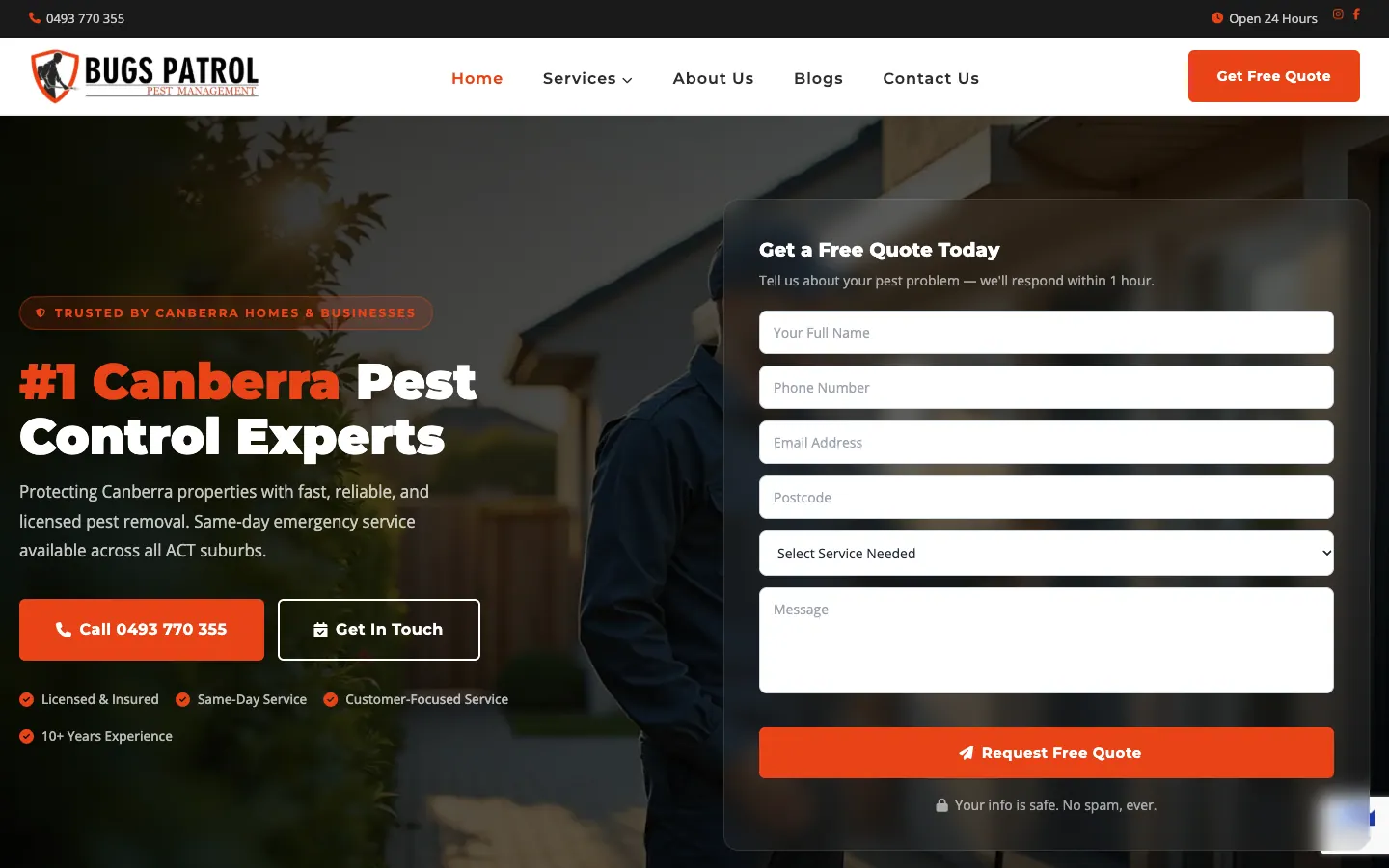
Bugs Patrol: a pest-control website organised by pest, service and suburb. See the design, service pages and enquiry experience.
Bugs Patrol is a locally owned pest control business serving homes and businesses across Canberra and the ACT.
Delivered: 474 pages: 113 service pages, 180 suburb pages, 170 articles and the core pages. A Services menu in five groups and a home page services grid filtered by tab.
Outcome: We built a Services menu in five groups and a home page services grid filtered by tab. We also added nine main services with a page for each of 20 Canberra suburbs.
Local Pests Control: a pest-control website with quotes for homes and businesses. See the design, service pages and enquiry experience.
Local Pests Control is a pest control business serving homes and businesses across Melbourne, VIC.
Delivered: 352 pages: 102 pest and service pages, 160 suburb pages, 78 guides and 12 hub and info pages. A Services menu that sorts 22 services into five groups by pest.
Outcome: We built a Services menu that sorts 22 services into five groups by pest. We also added a clipboard quote form that switches between home and business and arrives with the service chosen.