
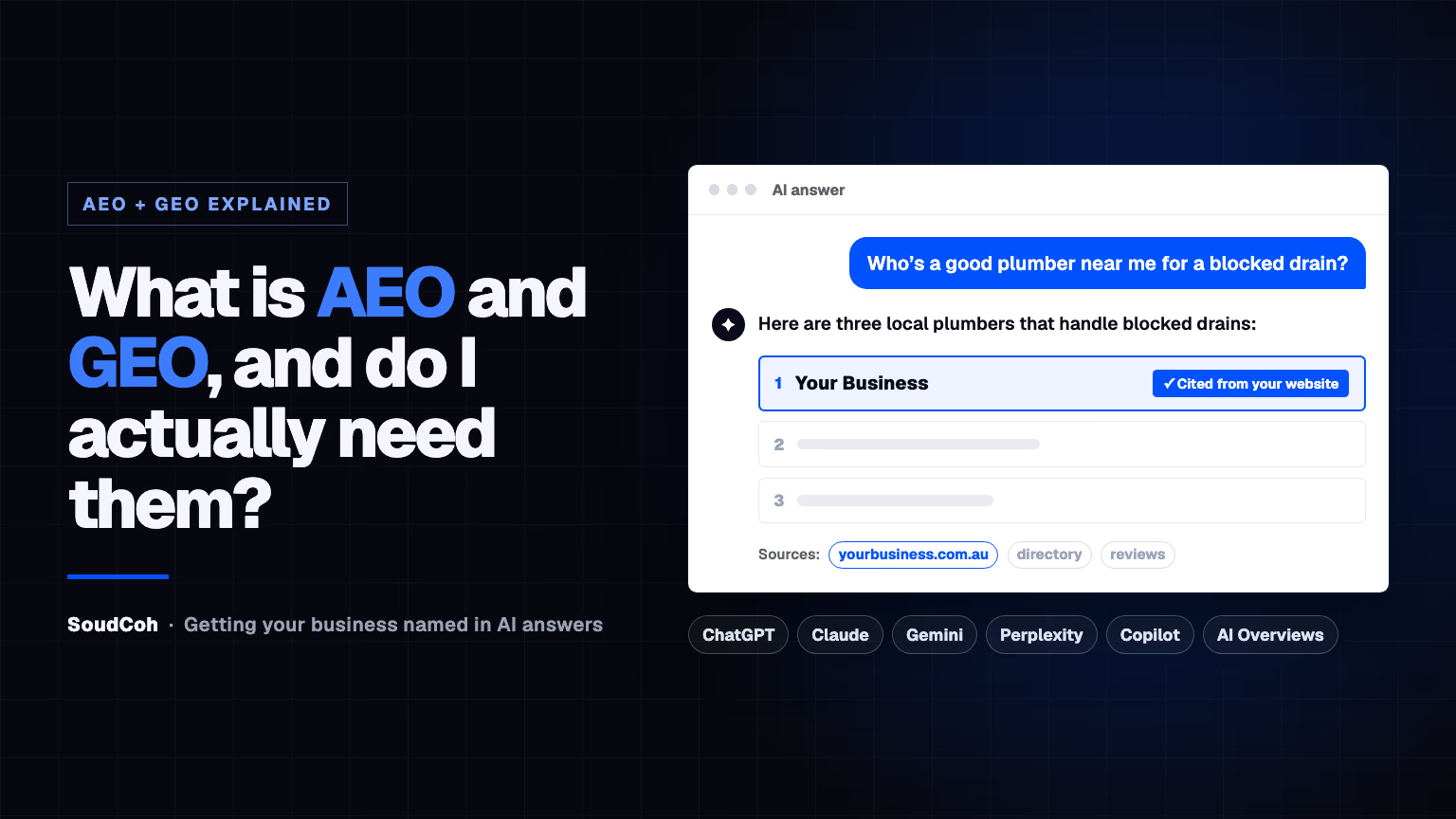
AEO (answer engine optimisation) and GEO (generative engine optimisation) describe the same goal: making your business easy for the AI tools people now ask instead of searching to find, understand and quote. That means ChatGPT, Claude, Google Gemini, Google’s AI Overviews and AI Mode, Perplexity, Microsoft Copilot, Meta AI and Grok. Neither replaces SEO. Both are built on it.
The audience is already there: in July 2025 Google said AI Overviews had more than 2 billion monthly users. Do you actually need AEO and GEO? It depends on how your customers search and whether your SEO basics are in place. Here is how to tell.
What is AEO?
Answer engine optimisation is the work of shaping your pages so that a tool giving one direct answer can use them. The term grew up around featured snippets and voice assistants such as Siri, Alexa and Google Assistant, which read out a single answer instead of a list of links. Today it mostly means pages that answer a real customer question clearly, near the top, in plain words.
In practice, AEO looks like this:
- Headings that match the questions customers actually ask.
- The answer in the first sentence or two under each heading, then the detail.
- A short FAQ written in your customers' words.
- Facts that make sense on their own: prices, service areas, opening hours.
What is GEO?
Generative engine optimisation is the newer term. Researchers introduced it in 2023 to describe getting content cited by AI systems that write their own answers, such as ChatGPT, Claude, Google Gemini, Google’s AI Overviews and AI Mode, Perplexity, Microsoft Copilot, Meta AI and Grok. These tools read several sources, combine them and name a few. GEO is about being one of the names.
It adds two things to AEO. First, the AI has to be able to reach your pages, so your site must not block its search crawler. Second, these systems check whether other sources agree with you, so reviews, directory listings and mentions elsewhere matter as much as your own site. Our generative engine optimisation page explains each part.
AEO vs GEO: what is the difference?
Less than the acronyms suggest. AEO grew up around search features that show one answer; GEO grew up around AI tools that write a new one. The work behind them overlaps almost completely.
| AEO | GEO | |
|---|---|---|
| Where it shows | Google featured snippets, “People also ask”, Siri, Alexa and Google Assistant | ChatGPT, Claude, Gemini, Perplexity, Copilot, Meta AI, Grok, Google’s AI Overviews and AI Mode |
| The aim | Be the direct answer | Be cited when AI writes the answer |
| Built on | SEO | SEO |
Be wary of anyone selling them to you as two separate projects.
AEO and GEO are built on SEO, not instead of it.
What does the data say about AI answers?
Three findings matter for any business deciding whether to invest. The first two come from SoudCoh's tests of AI answers: buyer questions about who does marketing or websites for a named trade, asked repeatedly on more than one model. The third comes from Google.
- 60% of the pages AI assistants cited were pages built for the exact trade asked about.
- 25% of the websites cited appeared in all three answers when the same question was asked three times. There is no fixed AI ranking.
- 2 billion+ people a month used Google's AI Overviews by July 2025, and AI Mode passed 100 million monthly users in the US and India.
| What AI assistants cited | Share of citations |
|---|---|
| A page built for the exact trade asked about | 60% |
| The agency's home page | 23% |
| Another service page | 14% |
| A directory, review site or social profile | 1.8% |
| A blog post or “best of” list | 1.5% |
The lesson is the core of AEO: a specific page that answers a specific question beats a general one. One caution on measurement: on SoudCoh's own website, visits analytics could attribute to AI assistants were just 0.2% of sessions, because most AI-influenced visits arrive with no referrer. Ask every new enquiry how they found you.
Do I actually need AEO and GEO?
It depends. Three questions decide it:
- Do your customers research before they buy? If people compare options or ask about price first, AI answers may already be shaping their shortlist. Someone with a burst pipe wants a phone number fast; someone planning a bathroom renovation is far more likely to ask questions first.
- Are your SEO basics in place? AI tools draw on the same pages search engines index, and Google says no special markup is needed to appear in its AI features. If your site is slow, thin or hard to crawl, fix that first. Good SEO services already cover most of what AEO and GEO need.
- Do your business details agree everywhere? If your name, services, areas and phone number differ between your website, Google Business Profile and directories, an AI tool has less reason to trust any of them.
Three yeses mean AEO and GEO are worth adding now. If your SEO is not in place yet, start there.
The page that ranks, converts and answers a question is the page an AI tool is most likely to quote.
Where AEO and GEO fit in your marketing
They are not a separate channel. They sit on your website and SEO, next to your Google Business Profile and your ads. The page that ranks in Google, turns a paid click into an enquiry and answers a customer's question is the page an AI tool is most likely to quote.
That is why we build answer-first pages, accurate structured data and consistent business details into the SEO work for every client, rather than selling them as an add-on. Across the trade websites we have built, the same answer-ready components recur:
| Component | Share of our website builds |
|---|---|
| Explains what happens after someone enquires | 80% |
| Clear suburb or service-area coverage | 75% |
| Its own page for each service | 66% |
See how search, ads and AI search work together for the full picture, or read how ChatGPT chooses which business to recommend for more from our tests of AI answers. Client examples follow at the end of this article.
Common questions about AEO and GEO
Is AEO the same as GEO?
Mostly. Both aim to get your business used in AI answers. AEO focuses on direct answers in search features and voice assistants; GEO focuses on being cited by AI tools that write their own answers. The work behind them largely overlaps.
Does AEO or GEO replace SEO?
No. AI tools draw on pages that search engines can find and read, so SEO remains the foundation. AEO and GEO shape how those pages answer questions and how consistently your business is described across the web.
How long do AEO and GEO take to work?
It varies. Changes to your own pages can be picked up once they are crawled again, but building reviews and mentions elsewhere takes months. Judge progress by asking the same customer questions regularly, not by a single answer.
Can a small business do AEO and GEO itself?
The basics, yes. Answer common customer questions clearly on your service pages, keep your business details identical everywhere, and check that your website does not block AI search crawlers.
Questions and answers
Do I need an llms.txt file for GEO?
No. An llms.txt file offers a plain-text version of your site's content and can be useful to maintain, but it is not required for Google's AI features and does not guarantee your business appears in AI answers.
Does structured data help with AEO and GEO?
It helps describe information that is already visible on your pages, such as your services, areas and contact details. Keep it accurate and consistent with the page. It supports good content; it does not guarantee inclusion in an AI answer.