
Structured data is code, usually JSON-LD, that states a page's facts in a format machines can read without guessing: who the business is, what it offers, who wrote the article and when. For AI search it does one useful job. It makes your facts unambiguous. It does not get you into AI answers on its own.
Google says no special markup is needed for AI Overviews or AI Mode, and Google stopped showing FAQ rich results in May 2026. Here is what is still worth adding, how to connect it, and what to avoid.
Does structured data help you appear in AI answers?
Indirectly. Google says there are no additional requirements or special optimisations needed to appear in AI Overviews or AI Mode; ordinary SEO best practices apply. Microsoft's Bing team has said schema markup helps its language models, including Copilot, understand content. OpenAI has not published guidance on structured data for ChatGPT search.
So treat structured data as clarity, not a shortcut. It removes doubt about who you are and what a page is about, which helps every system that reads it. But the visible page still has to answer the customer's question; markup cannot stand in for that.
Which schema types matter most for AI search?
Start with the types that describe your business and your expertise, then add the ones for each kind of page you publish.
| Type | Use it for | Where it goes |
|---|---|---|
| Organization | Name, logo, contact details, social profiles | Homepage |
| LocalBusiness | Address, hours, service area | Homepage or contact page, if you serve customers locally |
| Person | Real authors and team: name, job title, photo | About or team page, and article bylines |
| Service | Each service you sell | Each service page |
| Product | Price and availability | Product pages |
| Article or BlogPosting | Headline, author, dates | Articles and guides |
| BreadcrumbList | Where the page sits in the site | Every page |
| FAQPage | Questions and answers shown on the page | Pages with genuine FAQs |
How do you connect schema types together?
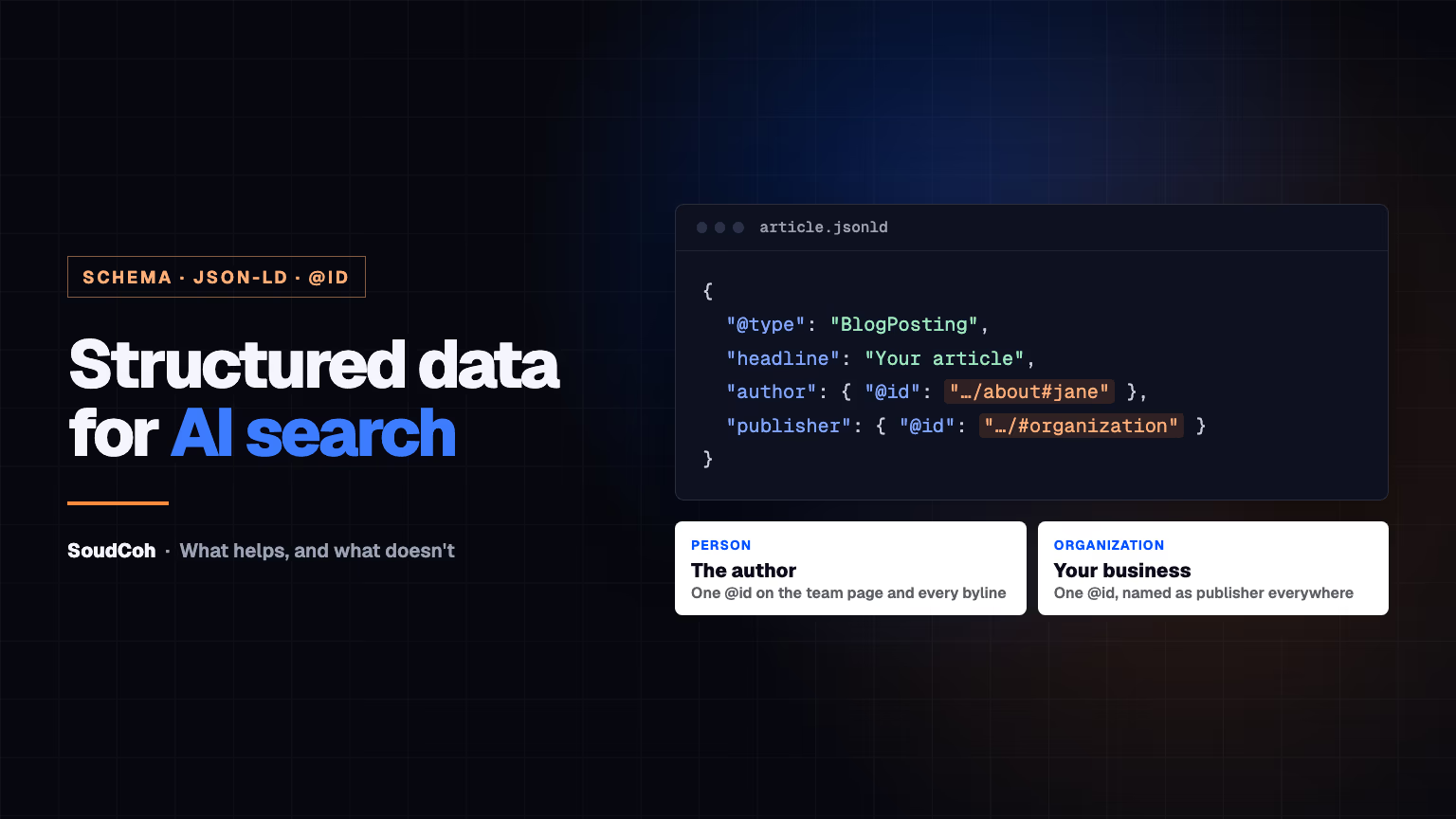
Give each important thing one stable identifier, an @id, and refer to it everywhere instead of describing it again. Your organisation gets one @id on the homepage; each article names it as publisher; each author has one @id that both the byline and the team page use.
{
  "@type": "BlogPosting",
  "headline": "Structured data for AI search",
  "author": { "@id": "https://example.com/about#jane" },
  "publisher": { "@id": "https://example.com/#organization" }
}
We do this on soudcoh.com. The founder named in our Organization markup and his card on the About page share one @id, and article bylines point to the author's About-page entry, so a parser sees one person, not three separate mentions. That consistency is what AI systems need to connect your business, your people and your expertise.
Structured data makes your facts unambiguous. It does not get you into AI answers on its own.
What changed for FAQ markup in 2026?
Google stopped showing FAQ rich results in Search from 7 May 2026, and removed the documentation for the feature in June 2026. The expandable questions under a search result are gone for every site.
FAQPage is still valid schema.org markup, and a clear question-and-answer section is still one of the easiest formats for AI tools to quote. Keep FAQ markup where the questions are real and visible on the page. Just do not add FAQs only to carry markup, and do not build a strategy around a result Google no longer shows.
Which rules keep structured data trustworthy?
Google's structured data guidelines are short, and they apply to every system that reads your markup:
- Describe only what is visible. Structured data must be a true representation of the page; do not mark up content readers cannot see.
- Never invent anything. No made-up authors, no ratings you wrote about yourself, no content unrelated to the page.
- Keep it in step with the page. When a price, phone number or job title changes on the page, change it in the markup too.
Breaking these rules can cost a page its eligibility for rich results through a manual action. More importantly for AI search, markup that contradicts the page undermines the trust that structured data exists to build.
Give each person and business one @id, and use it everywhere.
How do you check your structured data?
Run important pages through Google's Rich Results Test and the Schema.org validator, then read the results against the page itself: does every name, price, date and job title in the markup match what a visitor sees? Recheck after any redesign or template change, because that is when markup quietly breaks. Google's general structured data guidelines are the rulebook to check against.
Structured data is one part of generative engine optimisation, and it sits on ordinary search foundations: good SEO services already include it. To see whether it is working, follow our guide on how to measure AI visibility.
Common questions about structured data and AI search
Is JSON-LD better than microdata for structured data?
For most sites, yes. Google recommends JSON-LD because it sits in one block of code instead of being woven through the page, so it is easier to add, check and keep accurate. Search engines read all three formats.
Does schema markup help ChatGPT recommend a business?
OpenAI has not published guidance on structured data for ChatGPT search. What is clear is that consistent, accurate business facts help every AI tool, and structured data is one tidy place to state them. The visible page still has to answer the question.
Should I remove FAQ schema now that Google has dropped FAQ rich results?
No, as long as the questions and answers are visible on the page and genuinely useful. FAQPage is still valid schema.org markup and still describes the page accurately. Just do not add FAQs only to carry markup.
Do I need special AI schema or an llms.txt file?
No. Google says there are no special requirements or markup needed to appear in AI Overviews or AI Mode. An llms.txt file is optional and is not required for Google's AI features. Be wary of anyone selling a special AI schema as a shortcut.
Questions and answers
Which schema type should a small business add first?
Organization on the homepage, with your exact business name, logo, contact details and social profiles. If you serve customers at a location or in an area, add LocalBusiness with the same details. Everything else builds on those facts.
Can structured data fix a page that does not answer the question?
No. Markup describes the page; it cannot add an answer that is not there. AI tools quote the visible text, so the page still needs a direct answer to the customer's question.