
The best keywords for your website aren't the ones you'd choose. They're the words your customers type, and you can find them for free.
Why your customers' words matter more than yours
Businesses describe their services one way; customers search another. A plumber says "drain remediation"; the customer types "water coming up through shower drain".
Our own data shows how much this matters. Across the Google Ads accounts of plumbing businesses we work with, about 80% of search-traced revenue came from search wording that no other enquiry used, and the 20 most common searches made up under a tenth of it. A short list of popular keywords misses most of what customers really type.
Free ways to find what customers search for
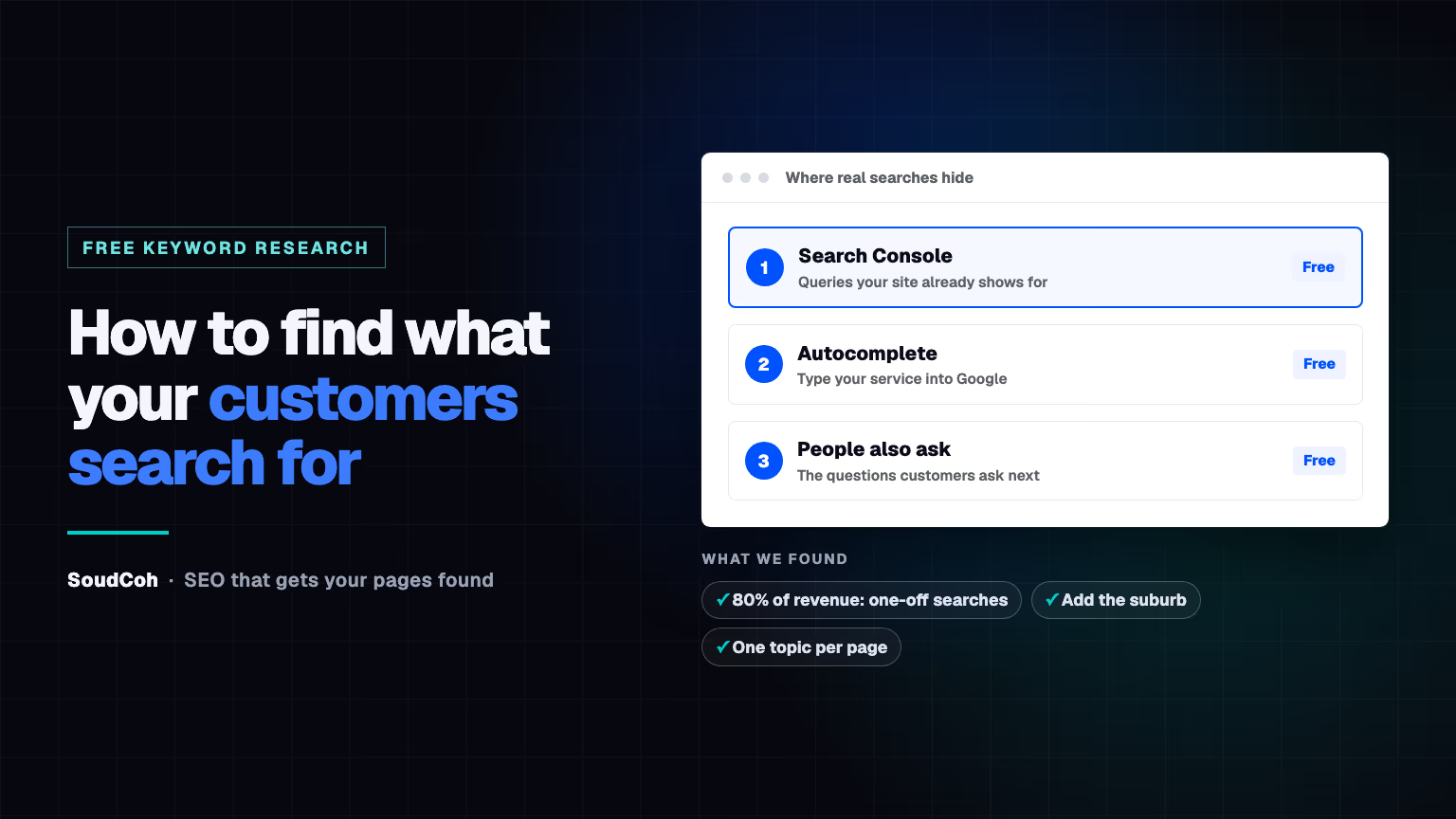
- Google Search Console: open the Performance report and look at Queries. These are real searches your site already appears for.
- Google's autocomplete: start typing your service in Google and note the suggestions.
- "People also ask": the question boxes in Google's results show what people want to know next.
- Your own enquiries: the words customers use in calls, forms and emails are the best keywords you have.
Add the place, not just the service
Local customers search with a place. In our own Search Console data, two in five non-brand searches that showed soudcoh.com named a place. For plumbing, searches that named a specific suburb became paid jobs about 1.5 times as often as other searches; a whole city didn't show the same lift.
So "blocked drains Epping" usually beats "blocked drains Melbourne" for a local plumber.
A short list of popular keywords misses most of what customers really type.
Turn searches into pages
| What you find | What to write |
|---|---|
| A question ("how much does a hot water system cost?") | A post that answers it in the first paragraph |
| Service plus suburb ("emergency plumber Box Hill") | A service page for that area |
| A search an old post nearly matches | Add a section and update the old post |
When the page is live, link it from your related pages so Google finds it. That's how you get more traffic from every post.
How SoudCoh helps
Good SEO services start every page with this research: what customers search for, which pages answer it, and which searches already bring calls. If you're looking for the best marketing agency for your business, book a free marketing audit.
Common questions about keyword research
Do I need a paid keyword tool?
Not to start. Search Console, Google's autocomplete and "People also ask" are free and show real searches. Paid tools add search volumes and competitor data.
Should I target one keyword per page?
Target one main topic per page, written the way customers ask it. Related wording on the same page is fine, because Google matches meaning, not just exact words.
How often should I check what people search for?
Look at Search Console every month or two. New questions appear, and the searches your pages already show for tell you what to add next.
Questions and answers
What if Search Console shows no searches yet?
New sites have little data. Start with autocomplete, People also ask and your customers' own words, then check Search Console again after a month or two.
Are long, specific searches worth targeting?
Yes. In SoudCoh's plumbing data most revenue came from searches only one customer typed, so pages that answer specific problems catch work a short keyword list misses.