
    Proof
    Impress Blinds — cost per recorded Google Ads conversion down 62.63%SLS Solicitors — cost per recorded Google Ads conversion down 58.48%FixCare Property — cost per enquiry down 56.36%Rubbish Removal WA — cost per enquiry down 53.18%Floral Cakery — cost per enquiry down 49.82%ILLUMINATE Laser Emporium — cost per enquiry down 48.54%Aussie Plumbing — cost per enquiry down 41.96%Sydney Fence Painting — cost per enquiry down 33.68%Alliance Plumbing — cost per enquiry down 29.6%Gridless Build Solutions — cost per enquiry down 29.16%FacilityWorx — cost per enquiry down 23.62%Cornerstone Roofing — cost per enquiry down 20.47%Council finance — budgeting and workforce designCouncil planning — clearer approvals and reportingCultural audiences — media strategy and creative conceptsCommunity participation — surveys, maps and project pagesPublic-sector research — survey design and analysisPublic art — site studies and visual conceptsRegional identity — visitor guides and wayfinding conceptsCouncil systems — integration and migration planningA pressure washing business — service-led search campaignsA pressure washing business — a clear enquiry journeyA carpet cleaner — Google Ads built around cleaning servicesA roofing company — campaigns for repairs and restorationA CCTV installer — campaigns for security enquiriesA fence painter — search campaigns for specific surfacesA maintenance business — live in 8 weeks, 3 stacks gone41 numbered clauses, published in full5.0 across every Google review$120M+ in media under management250+ active engagements across five countries
    Small Business

    Review lead quality by service before changing the whole campaign

    When an owner says the leads are poor, the next useful question is what makes them unsuitable. The answer may concern location, service, timing, price expectations or the business's ability to respond. Review those reasons by service before changing the whole campaign, because a combined total can hide where the real problem sits.

    • 23 September 2026
    • 4 min read
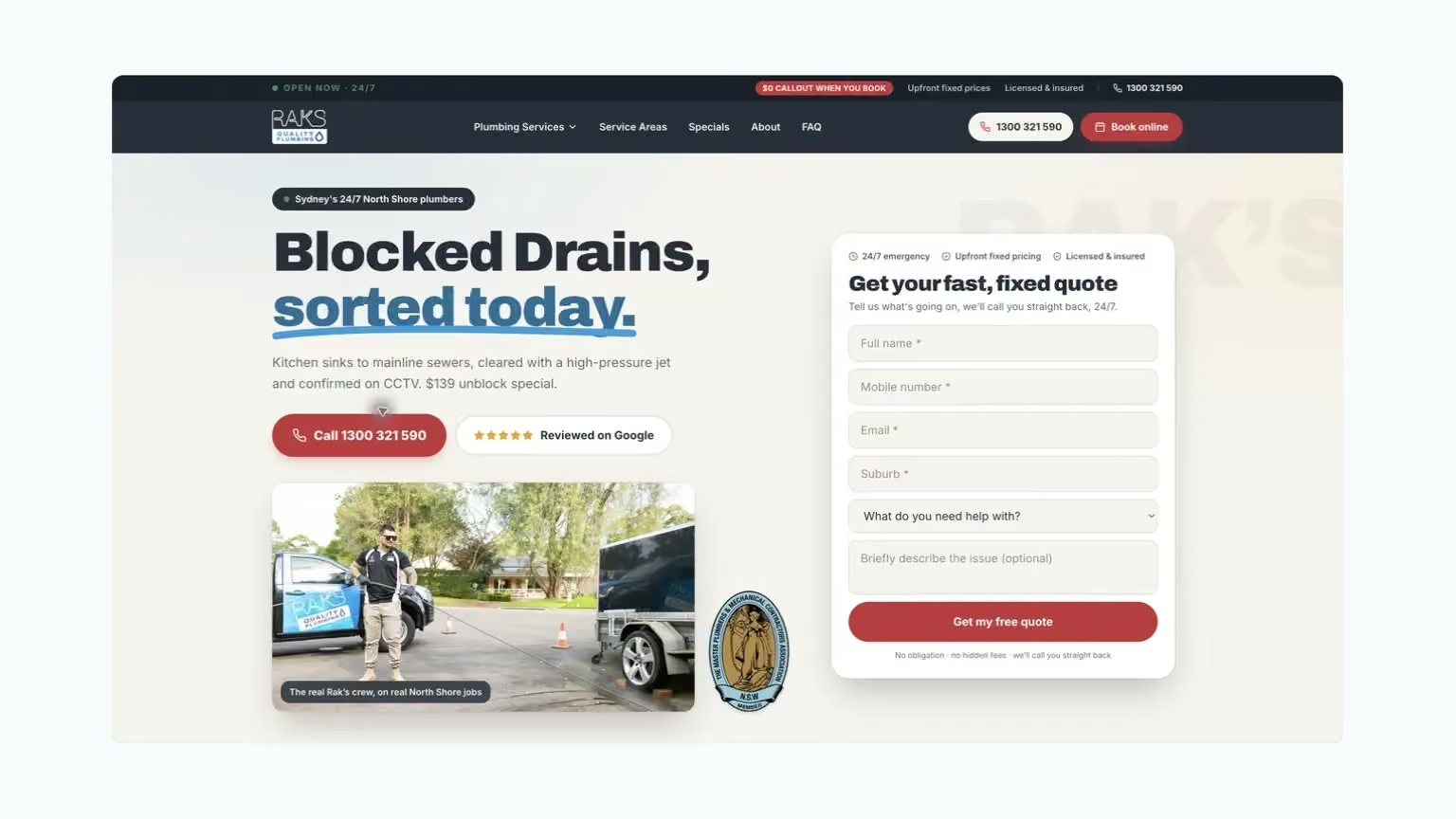
    RAKS Quality Plumbing: a blocked-drain page keeps the enquiry connected to the service.
    RAKS Quality Plumbing: a blocked-drain page keeps the enquiry connected to the service.

    A practical guide

    Turn an unsuitable enquiry into a useful question

    • Wrong service or location

      Review the ad and destination together

      Check whether the message and coverage could have created the wrong expectation.

    • Timing or capacity does not fit

      Review availability and response

      The demand may be relevant even when the team cannot take that work.

    • The scope or price expectation differs

      Review the service explanation

      Look for missing inclusions or qualification before assuming all demand is poor.

    Agree what a suitable enquiry means

    A useful definition begins with the work the business wants and can deliver. Include the service, area and any practical boundaries. An enquiry can match that brief without becoming a job, so keep relevance separate from the later decision to proceed.

    The RAKS campaign case includes specialist plumbing services, while Hi-Tech Deep Cleaning presents carpet and specialist cleaning. Both demonstrate why a broad industry label is insufficient. A relevant enquiry for one service may be unsuitable for another business in the same industry, or for a team not equipped to provide it.

    Use reasons that lead to an action

    Record why requests do not proceed in language the team recognises: outside the area, wrong service, unavailable date, unable to contact, scope not accepted or customer chose another provider. Avoid a single catch-all category that cannot explain what to change.

    Each reason suggests a different investigation. Out-of-area requests call for a coverage review. Wrong-service requests may reveal ambiguous copy. Unavailable dates can indicate a capacity issue rather than bad advertising. The aim is not to create a complicated reporting exercise. It is to make the next decision more specific than lowering every budget or replacing every advertisement.

    Read the enquiry beside the message

    Where possible, review the page and offer associated with a request. Ask whether a reasonable customer could have formed the expectation they expressed. A mismatch may come from a shortened headline, an unclear inclusion or a general page that makes several services appear interchangeable.

    The RAKS website uses separate service pages, and the Hi-Tech website changes the explanation for carpet and leather work. Each page gives the customer a relevant explanation before they enquire. Compare recurring questions with that explanation to identify where the service scope needs to be clearer.

    Distinguish response problems from demand problems

    A relevant request that receives no timely reply should not be interpreted in the same way as an irrelevant request. Review whether the customer could reach the business and whether the team had the information needed to continue the conversation.

    If the business could not answer during a promoted period, revisiting the advertising schedule may be more useful than rewriting the service offer. If the form produces incomplete details, improve the specific question. Keep the diagnosis connected to what happened, rather than assuming the advertising audience is always the cause.

    Compare services on a consistent basis

    Use the same definitions for enquiries, accepted work and cancellations when reviewing periods. Give requests enough time to progress, especially where a quote or site assessment is needed. A report prepared too early can make a service with a longer decision period look weaker than it is.

    At the same time, do not force every service into the same commercial model. An urgent repair, a recurring cleaning arrangement and a planned installation can differ in value, effort and timing. The owner needs to understand those differences before deciding which service deserves more promotion. A cheap enquiry is one input, not the verdict.

    Choose the smallest useful correction

    Once the reason is clear, make a specific change: clarify the area, separate a service, explain the offer or improve the enquiry question. Agree what the team expects to see and when it will review the result. Keep a record of other changes that could influence the comparison.

    Use a small, regularly reviewed sample of enquiry notes to check whether the categories are being applied consistently. One person may label a request outside the area while another calls the same situation a poor lead. Agree the wording and correct the classification before drawing conclusions. Use the review to identify recurring service problems and choose a specific change.

    Improving enquiry quality is an ongoing exercise in matching promises with suitable work. Use the reasons recorded in your enquiries to choose the next change. A service-level review gives the owner a clearer choice and avoids disrupting useful parts of a campaign because one category needs attention.

    What to do next

    Talk to SoudCoh about the services you want to promote and the customer questions your website needs to answer.

    Try the calculation with your own figures: the review-rating calculator.

    Talk to SoudCoh

    Sources and related projects

    1. Client project: https://soudcoh.com/case-study/raks-quality-plumbing-google-ads
    2. Client project: https://soudcoh.com/case-study/hi-tech-deep-cleaning-google-ads
    3. Client project: https://soudcoh.com/case-study/raks-quality-plumbing-website-design
    4. Client project: https://soudcoh.com/case-study/hi-tech-deep-cleaning-website-design
    Read next

    Filed under the same desk first. The full index is searchable and filters by reader.

    If you would rather we just did it.

    The briefing above is the reasoning. These are the pages that describe what it looks like as a piece of paid work, including what it costs and what gets reported.

    Related evidence from live accounts.

    These are individual engagements where the market, system or measurement problem overlaps with the briefing. Each study names its window and the evidence available; none is a forecast for another account.

    Apply it to your account

    Reading it is the easy half. Thirty minutes with someone who runs accounts and you leave with a written list of what is leaking on yours — yours to keep either way.

    No pitch deck. No upsell. A real conversation and a written list of leaks.