
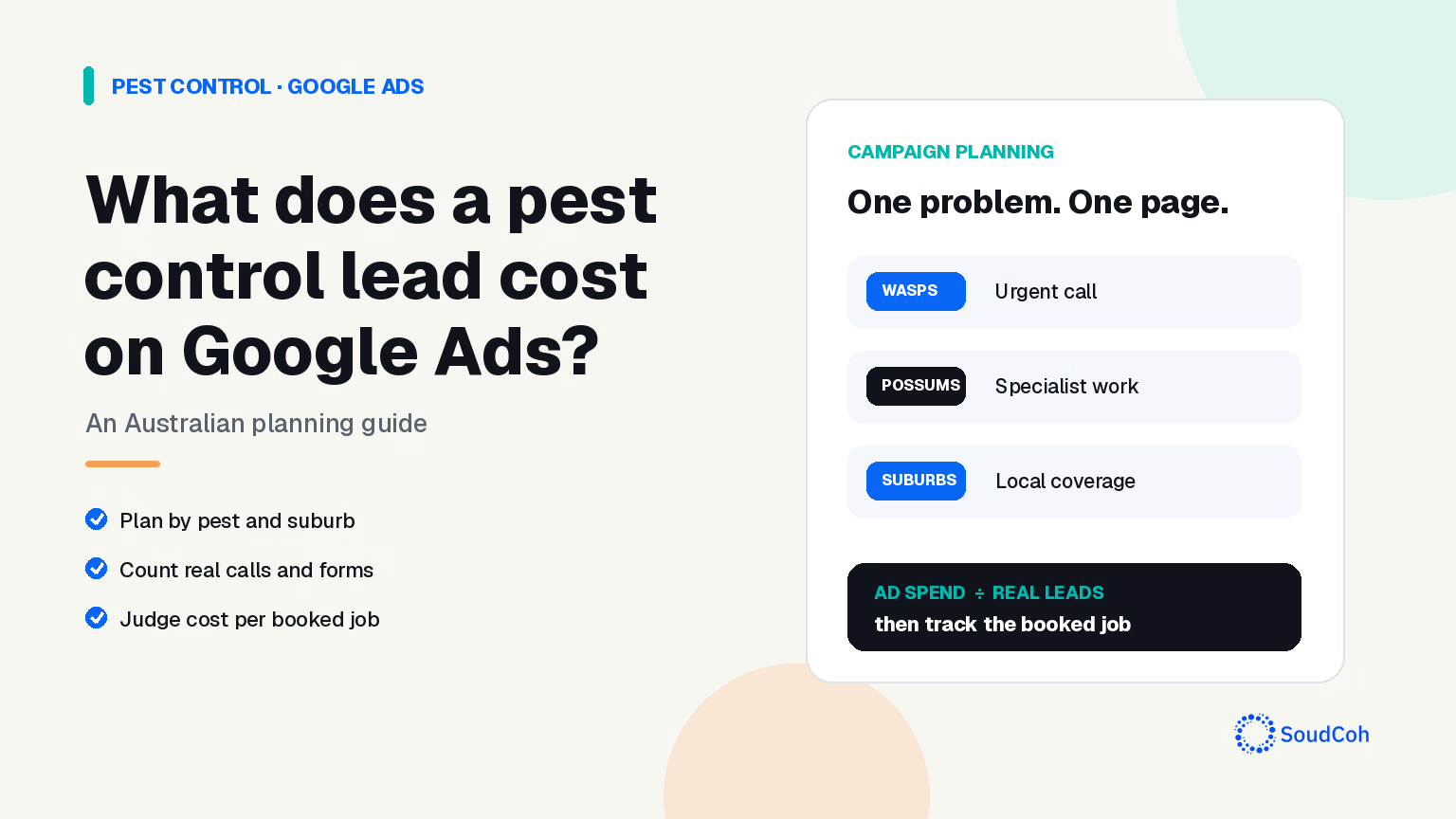
Pest control businesses typically pay A$25–A$30 per lead on Google Ads once campaigns have run three to six months. Figures are ad spend per lead on Google Ads, before GST and our management fee. A lead is a phone call or an enquiry form. What you pay within that range depends on the pest, the suburb, the season and how quickly enquiries are answered.
This guide explains the planning range, what moves a pest control lead cost and how to turn it into the more useful figure: advertising cost per booked job. It also examines the early findings from one Melbourne pest-control campaign, with the small-sample limits kept beside the figures.
The short answer: what does a pest control lead cost?
Pest control businesses typically pay A$25–A$30 per lead on Google Ads once campaigns have run three to six months. Figures are ad spend per lead on Google Ads, before GST and our management fee. A lead is a phone call or an enquiry form.
Use the range to prepare an advertising budget, not as a quote or promised result. A campaign needs three to six months to settle while irrelevant searches are excluded, ads and pages are matched, and the services and suburbs that book become clearer.
| Planning question | What to use |
|---|---|
| What should we allow per lead? | A$25–A$30 in ad spend as a starting range once the campaign has settled. |
| What counts as a lead? | A phone call or an enquiry form. Keep phone-button taps, page views and duplicate submissions out of the count. |
| Are GST and management fees included? | No. Those sit outside this ad-spend calculation. |
| What should we judge next? | Whether the enquiry is for a service and suburb you cover, and whether it becomes a booked job. |
For the service and campaign work around that budget, see our marketing for pest control businesses. For other trades, use the Google Ads cost-per-lead guide by industry rather than assuming one average fits every business.
What makes a pest control lead cost more or less?
The range changes with the work you chase and the way the campaign handles each search.
- Urgent pests versus planned work. Wasps, rats and bees can lead to an immediate call. Inspections, end-of-lease treatments and bird proofing may involve more research, a site assessment or a detailed quote. Keep their budgets and outcomes separate.
- Suburb-level versus city-wide targeting. A tight service area can reduce wasted travel and out-of-area enquiries, but available search volume differs by suburb. City-wide coverage reaches more people and more competitors.
- Season. Pest activity and customer demand change through the year. Review search terms, service mix and capacity rather than expecting every month to produce the same enquiries.
- Answering during ad hours. An unanswered call still costs the click. Match the schedule to real call cover and return missed enquiries promptly.
- A page per pest. An ad about possums should open a possum page, not a general list of services. The Local Pest Control website case study shows how individual pest and suburb pages support that match.
- Metro competition. More businesses bidding on the same urgent searches can raise click costs. Relevant ads, pages and enquiry handling determine whether those clicks become useful leads.
Our guide to pest control marketing by problem explains how to organise the customer journey around what the person has noticed.
What we saw in a Melbourne pest-control campaign
The Local Pest Control Google Ads case study gives one problem its own ad group and page, alongside a suburb campaign and a bee-removal campaign added later. Forms and tracked calls are connected to the advertising, and the client records which jobs were won.
- 29% of web-form enquiries became won jobs in the first five weeks. Enquiries without a recorded outcome counted as not won.
- Bird, possum and dead-animal searches took about a third of spend and 51% of won revenue. These jobs can need proofing, access or removal work, so their value is not visible in lead count alone.
- Phones brought 72% of clicks, but desktop web forms became won jobs at 60%, against 18% for forms sent from a phone.
- Click-through rate over the last four weeks was 23% higher than the first four.
- About one in 8 clicks became a web form or a tracked call of 60 seconds or more in the last 30 days, and just over half of those enquiries were calls.
These findings rest on a small number of jobs from the first weeks of a new advertising programme. One or two jobs can move the shares. They describe this campaign; they are not benchmarks or forecasts for another pest-control business.
Cost per lead versus cost per won job
Cost per lead divides ad spend by calls and forms. Cost per won job divides that spend only by the enquiries that became booked work. The second figure tells you whether the advertising fits the economics of the business.
Illustrative arithmetic, not a benchmark: at the top of the planning range, a lead costs A$30. If one lead in four books, the ad cost per booked job is four times that amount: A$120. If one lead in two books, it is twice the high band: A$60. These examples only show the division; they do not predict your booking rate or lead cost.
| Illustrative booking rate | Arithmetic at the high band | Illustrative ad cost per booked job |
|---|---|---|
| One lead in four | Four times A$30 | A$120 |
| One lead in two | Twice A$30 | A$60 |
Use your own lead cost and lead-to-job rate in the lead-to-job calculator. Include unsuitable areas, duplicate enquiries and jobs that did not proceed in the denominator, then compare the result with job value and delivery costs.
How to bring pest control lead costs down
We review enquiry costs alongside lead quality and booked work, so the campaign reflects the jobs your business wants. Start with the parts of the campaign that determine whether a click becomes suitable work:
- Give each important pest its own ad group and page. Match the words and next step to the problem instead of sending every search to one general page.
- Build useful suburb pages where coverage is real. Let local searches confirm both the service and the area.
- Match the ad schedule to call cover. Pause or adjust advertising when nobody can answer urgent enquiries.
- Count calls only at 60 seconds or more. A consistent minimum call length helps keep accidental and very short calls out of the lead count. Read why we use the 60-second rule for ad calls.
- Review search terms weekly. Exclude job seekers, DIY searches, suppliers and locations the business does not serve.
- Keep the quote form short. Suburb and service give the office a useful starting point; collect the remaining detail during follow-up.
- Give high-value work its own budget. Birds, possums and dead-animal removal can disappear inside general pest reporting. Separate budgets make their lead quality and won work visible.
Do not pursue a cheaper lead by broadening the definition of a lead. Clean measurement usually makes the reported figure look worse before the campaign decisions make the booked-job economics better.
How pest control compares with other trades
These owner-set planning ranges belong to different kinds of work. They are useful for preparing a budget within an industry, not for declaring one trade's leads better value than another's.
| Industry | Typical Google Ads cost per lead | Planning note |
|---|---|---|
| Pest control | A$25–A$30 | Once campaigns have run three to six months |
| Plumbing | A$40–A$120 | Across the main services, from urgent repairs to planned work |
| Electrical | A$30–A$60, A$40–A$70 in Melbourne and Sydney | The metropolitan range reflects Melbourne and Sydney |
| Cleaning | A$12–A$25 residential, A$80–A$120 or more commercial | Residential and commercial work have different ranges and buying processes |
| Heating and cooling | A$20–A$60 | Demand and service mix move with the season |
There is no single cost per lead across industries. A removalist lead and a commercial cleaning lead are different jobs with different values, so the figures are given industry by industry. See the full industry-by-industry guide for the other trades and the definitions behind the figures.
Common questions about pest control lead costs
How much does a pest control lead cost on Google Ads in Australia?
Pest control businesses typically pay A$25–A$30 per lead on Google Ads once campaigns have run three to six months. Figures are ad spend per lead on Google Ads, before GST and our management fee. A lead is a phone call or an enquiry form. The pest, suburb, season, competition and enquiry handling affect where a campaign sits within that range.
Is Google Ads worth it for a pest control business?
It can be when the campaign reaches services and suburbs the business wants, calls and forms are tracked, and enough enquiries become profitable jobs. Judge it on advertising cost per booked job and job value, not clicks or lead volume alone. A small early campaign sample is not enough to promise a long-term result.
How long before pest control lead costs settle?
Allow three to six months, as the planning range in our lead-cost data specifies. Early work includes filtering search terms, improving service and suburb matching, and learning which enquiries become jobs. Compare later performance with the early period rather than treating the first weeks as the settled rate.
Are phone calls or web forms better pest control leads?
Both matter. In the Local Pest Control case study, phones brought 72% of clicks, while desktop forms became won jobs at 60% and phone forms at 18%. Those form figures come from a small number of jobs in the first weeks of a new advertising programme, so treat them as a reason to keep both routes easy to use, not a universal conversion rate.
Which pest control jobs are worth a separate budget?
In the case study, bird, possum and dead-animal searches took about a third of spend and produced 51% of won revenue in the first five weeks. That small early sample supports giving those services their own budget and reporting, alongside distinct ad groups and pages. It does not establish the same revenue share for another business.
Questions and answers
Should every pest control service have its own campaign?
Give separate budgets to services that need independent spending control or have different job values. Smaller services can share a campaign while retaining distinct ad groups, pages and outcome reporting.
What should I bring to a pest control lead-cost review?
Bring your services, suburbs, recent call and form records, and which enquiries became jobs. Include the hours somebody answers and any seasonal changes so the review reflects how the business actually operates.