
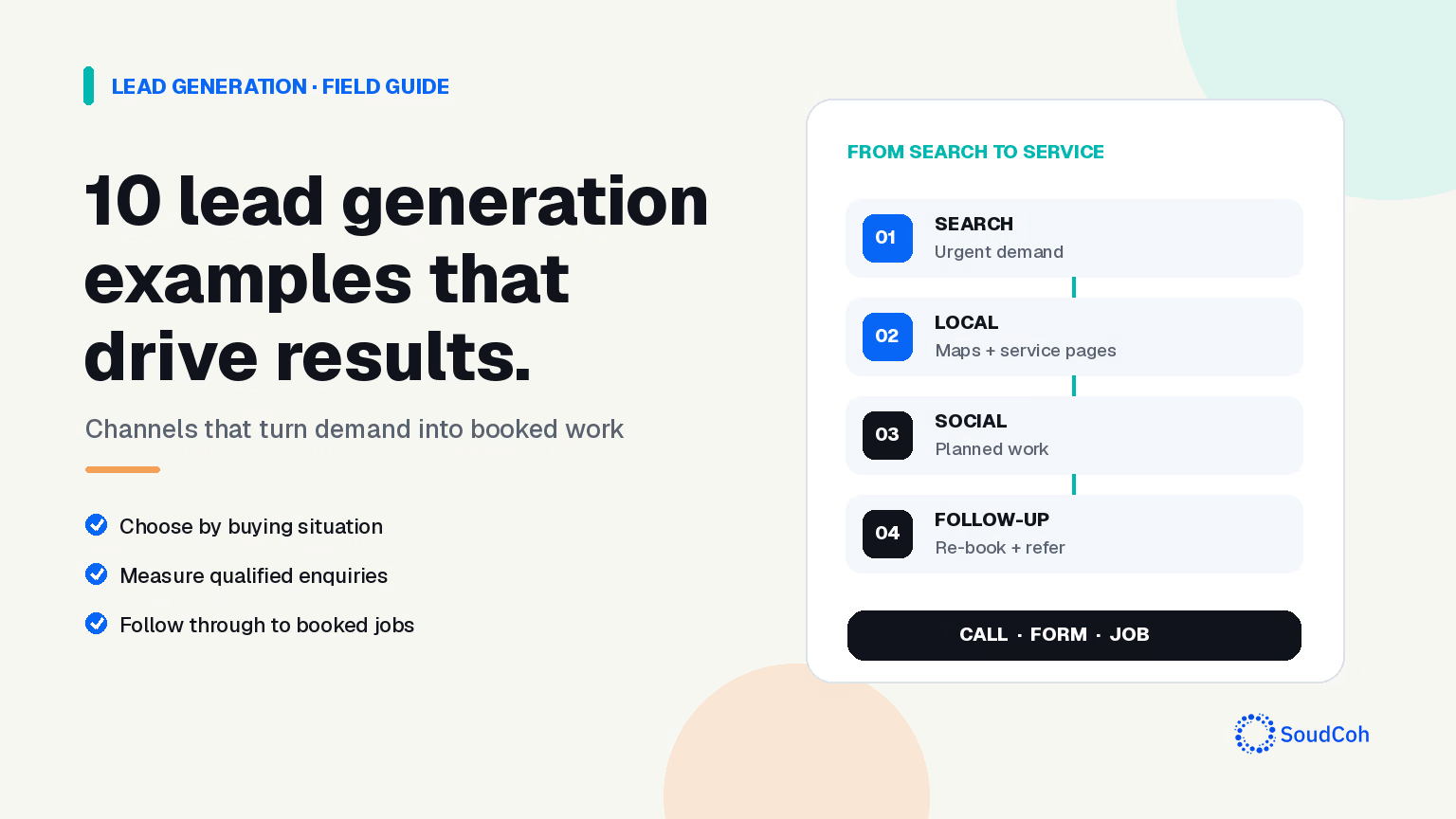
Lead generation is any way of turning someone who needs your service into a call, form or booking. For trade and service businesses, the examples below are the ones we see produce real enquiries, each with when it works, what it needs and how to measure it. Most businesses need two or three of them working together, not all ten.
Use these as channel and tactic examples rather than a checklist to complete. The right starting point depends on whether the work is urgent or planned, how customers choose a provider and whether your team can follow up promptly.
1. Google search ads for urgent jobs
What it is: paid search ads that appear when someone looks for immediate help, such as a burst pipe, no power or a wasp nest. The visitor calls or submits a short enquiry form.
When it works best: when the problem is urgent, the service area is clear and somebody can answer while the ads run. It suits businesses that need enquiries now rather than waiting for organic visibility to grow.
What it needs: call tracking, ad hours that match when you answer, negative keywords and a page for each service. Send an emergency plumbing search to an emergency plumbing page, not the home page.
How to measure it: divide ad spend by booked jobs, not by clicks. Keep cost per lead as a diagnostic, then record which enquiries were suitable and became work. This is the measurement approach behind our lead generation service.
2. Google Business Profile and the map pack
What it is: your business listing in Google Maps and local search results, where customers can call, request directions or visit your website.
When it works best: for local services with a defined coverage area, especially when customers compare nearby providers before making a call.
What it needs: the right primary category, accurate service areas, useful photos, current business information and a steady flow of genuine reviews. The website should reinforce the same services and locations.
How to measure it: review calls and direction requests in the profile's Performance view, then compare website enquiries from organic search. Keep profile interactions separate from booked jobs so an increase in calls is not mistaken for an increase in revenue.
3. Service and suburb pages for organic search
What it is: a useful page for each service and area you genuinely cover, written to answer the searcher's problem and make the next step clear.
When it works best: when there is consistent search demand and the business can build visibility over months. It suits services customers research before contacting several providers, as well as recurring local work.
What it needs: accurate service information, real coverage, clear internal links, original local detail and a direct call or quote route. Do not publish near-identical pages for places the team does not serve.
How to measure it: track organic enquiries by landing page and follow them through to booked work. Search visibility is an input; qualified enquiries and jobs are the outcome. These pages take months to establish, but can produce a lower cost per lead once they work.
4. Problem-led ad groups and landing pages
What it is: campaign structure based on the problem in front of the customer, such as rats, possums, a blocked drain or mould, rather than one broad advertisement for the whole business.
When it works best: when customers describe distinct problems that need different answers, appointment arrangements or job values. It also helps a business learn which services produce suitable work.
What it needs: an ad group and matching page for each important problem, search-term reviews and outcome tracking by service. Keep the page language close to the words customers use.
How to measure it: compare qualified enquiries, booked jobs and job value by problem. In the Local Pest Control Google Ads case study, each problem had its own ad group and page; in the first five weeks, 29% of web-form enquiries from the ads became won jobs, with enquiries lacking a recorded outcome counted as not won. That is a small, early sample from one new account, not a forecast for another business.
5. Quote calculators and useful online tools
What it is: an estimator, calculator or planning tool that helps a visitor understand a cost, budget or likely outcome before they speak to you.
When it works best: for considered purchases where uncertainty stops people enquiring. A useful tool can also help existing visitors return when they are ready.
What it needs: sensible inputs, transparent assumptions and a result shown on screen first. Offer to email the result or discuss it rather than hiding the answer behind a contact form.
How to measure it: count completed calculations separately from enquiries, then measure how many users choose to call, submit details or book. Our lead-to-job calculator is an example of a useful-first tool: it estimates the advertising cost of a booked job from the visitor's own figures.
Most service businesses need two or three lead sources working together, not ten competing for attention.
6. Meta lead ads for planned work
What it is: Facebook or Instagram advertising with an instant form that lets someone enquire without leaving the platform.
When it works best: for planned or visually understandable work such as hot water upgrades, switchboards, solar or regular cleaning. It reaches people before they type a search, so the offer needs a clear reason to act.
What it needs: relevant creative, a defined service area and one qualifying question such as suburb, job type or timeframe. Send submissions into the follow-up process immediately.
How to measure it: review the cost of qualified enquiries and booked jobs by audience, creative and offer. A low platform cost per form can still be expensive if the requests are outside your area or never become work.
7. LinkedIn Lead Gen Forms for B2B work
What it is: LinkedIn advertising with a form pre-filled from the member's profile, used to request a consultation, assessment or useful business resource.
When it works best: for commercial cleaning contracts, facilities work and other services bought by a person in a recognisable role or organisation.
What it needs: precise targeting, an offer relevant to that role and a follow-up process suited to a longer buying decision. Ask only for details the first conversation needs.
How to measure it: track accepted meetings, proposals and won contracts rather than celebrating form volume. Attribute later outcomes to the original campaign so a slow sales cycle does not make a useful channel look unproductive.
8. Remarketing to previous website visitors
What it is: ads shown to people who visited your website but did not enquire, reminding them of the service, offer or customer proof they have already seen.
When it works best: for higher-value or planned work where customers compare options over days or weeks. It supports a main acquisition channel rather than replacing it.
What it needs: consent and platform setup appropriate to your business, audience exclusions for existing enquiries, relevant creative and a frequency cap so the message does not become intrusive.
How to measure it: compare qualified enquiries and booked jobs from returning visitors with the remarketing spend. Check assisted outcomes as well as last-click conversions, without counting the same enquiry twice.
9. Free audit, inspection or assessment offers
What it is: a defined first step that helps the customer understand their situation before committing to the full service.
When it works best: when expertise is hard to judge from an advertisement and an initial review can uncover the right scope. It can suit websites, marketing, property assessments and specialist services.
What it needs: a precise explanation of what the person receives, what it does not include, how long it takes and what happens afterwards. Avoid a vague free-consultation promise that could mean anything.
How to measure it: track completed assessments, suitable opportunities and booked work. If many people accept the free step but few fit the service, revise the qualifying information and the audience.
A click is a visit, not a lead. A lead is not yet a booked job.
10. Re-booking and referral follow-up
What it is: email or SMS follow-up to your own customer list, including seasonal service reminders, review requests and a clear invitation to refer someone.
When it works best: for services with repeat cycles, maintenance needs or customers who know others with the same problem. It uses relationships the business has already earned.
What it needs: accurate customer records, appropriate consent, useful timing and a simple way to book or refer. Connect the CRM message to the right person and service rather than sending every customer the same promotion.
How to measure it: record re-bookings, referred enquiries and won jobs by message or segment. Include the cost of the follow-up activity, and keep unsubscribes and complaints visible alongside the results.
How to choose which examples to start with
Start with the buying situation, not the longest list of channels:
- Urgent work: begin with search ads and a well-maintained Google Business Profile. Match ad hours to call cover and send each problem to its matching page.
- Planned or high-value work: build useful SEO pages, test Meta where the audience and creative fit, and use follow-up to stay visible while customers decide.
- B2B work: consider LinkedIn and a clearly defined audit or assessment, then measure meetings, proposals and contracts.
Two or three connected tactics are easier to measure and improve than ten disconnected ones. Judge each on cost per booked job, using your own enquiry-to-booking rate in the lead-to-job calculator. If you are comparing outside help, our guide to choosing a lead generation company explains what to check before signing.
Common lead generation mistakes
- Running every channel at once with a small budget. None gathers enough useful evidence, and follow-up becomes inconsistent.
- Not tracking calls. The campaign appears to produce fewer leads than it does, while reporting favours forms over the channel customers actually use.
- Sending every ad to the home page. The visitor has to work out whether the business handles their particular problem.
- Following up slowly. An urgent customer rings somebody else, and a planned quote request loses momentum.
- Counting clicks as leads. A click is a visit, not a call, form or booking. Measure the complete path to a won job.
- Optimising the form without fixing the channel. Form design matters, but it cannot rescue poor targeting. For the form-specific side, see our 22 lead generation form examples and tips.
Common questions about lead generation examples
What is an example of lead generation?
A person searching for an emergency plumber, clicking a relevant ad and calling the business is lead generation. So is a customer requesting a quote from a service page, submitting a LinkedIn form or booking after a seasonal reminder. The shared outcome is an identifiable enquiry the business can follow up.
What is the best lead generation method for tradies?
For urgent local work, search ads and Google Business Profile are often the most direct starting points. Planned work may benefit more from service pages, social advertising and follow-up. The best method is the one that produces suitable booked jobs at a sustainable cost in your area.
Our guide to efficient lead generation for trades compares the decision in more detail.
How much does lead generation cost?
It depends on the channel, industry, location, competition and how well enquiries are handled. Compare advertising cost per lead and cost per booked job, with management and other delivery costs kept clear.
See our Google Ads cost-per-lead guide by industry for the owner-set planning ranges.
How long does lead generation take to work?
Search and social ads can produce enquiries within days once tracking and follow-up work correctly, although a new campaign still needs refinement. SEO usually takes months because pages need to be discovered, evaluated and earn visibility. Referral and re-booking programmes depend on the customer cycle.
What's the difference between lead generation and marketing?
Marketing covers the broader work of understanding customers, positioning the business, building demand and supporting retention. Lead generation focuses specifically on creating enquiries that can become customers. The two overlap, but more attention is not automatically more leads, and more leads are not automatically more booked jobs.
Questions and answers
How many lead generation channels should a small business use?
Start with two or three that fit the buying situation and the team's capacity. Add another only when tracking, follow-up and booked-job reporting are reliable enough to judge it.
What should I review before increasing lead generation spend?
Review suitable enquiries, response time, booked jobs and job value by source. Check whether the extra budget would reach more of the right customers or simply buy broader, less useful demand.