
Your email sequence has a 38% open rate and the phone is not ringing — that number is lying to you.
Open rates measure curiosity; the only metric that pays the mortgage is a booked job on your calendar.
Fix three trigger points tonight — copy-paste the exact subject lines and CTA below — and watch the difference within two weeks.
Open rate is the wrong scoreboard for a service business
Pull up your email sequence stats right now. If you see a number between 36% and 42%, you are looking at exactly what the HubSpot 2024 Email Marketing Benchmarks report describes as average for SMB automated sequences — and that number tells you almost nothing useful. According to HubSpot's 2024 benchmarks (hubspot.com/marketing-statistics), conversion-to-meeting rate for automated sequences without behavioural triggers sits below 2%. Your open rate is not a problem. Your trigger logic is.
A 38% open rate with zero booked jobs means your sequence is entertaining prospects, not closing them.

The gap between 38% opens and 2% meetings is not a copywriting problem
The open rate gap is seductive. You see it sitting above industry average and assume the sequence is working. It is not. Opening an email is a passive action — the equivalent of glancing at a shop window. Booking a job requires a decision. Those two behaviours are separated by friction, timing, and the presence or absence of a single clear next step. The HubSpot data makes this explicit: the sequences that convert are not better-written, they are better-timed and behaviourally triggered.
In a sub-$5M Australian service business, one booked job is worth somewhere between $800 and $8,000 depending on whether you run a one-person carpet-cleaning round or a boutique physio practice. Celebrating a 38% open rate when no jobs are booking is exactly like celebrating foot traffic in a shop while the register stays empty. The visitors came in. They looked around. They left. The metric looked great. Revenue did not move.
You do not need a new platform to fix this
The most common response when sequences underperform is to look at a new tool. That is the wrong move, and it is expensive in time and money. GoHighLevel and HubSpot Starter both support behavioural triggers natively. The trigger logic exists inside the platform you are already paying for. Most owners have never turned it on because the default templates do not use it, and the onboarding flow does not explain why they should. The fix is a configuration change, not a subscription change.
- GoHighLevel: Workflow triggers include Contact Replied, Appointment No Show, and Pipeline Stage Duration — all available on the base plan.
- HubSpot Starter: Workflow triggers include Email replied, Meeting outcome equals no-show, and Last activity date is more than X days ago — all available without upgrading to Pro.
Why off-the-shelf templates fail Australian service contexts specifically
GoHighLevel and HubSpot Starter are built in the United States. Their default templates are designed for US SaaS funnels — software companies nurturing a free-trial user toward a paid subscription over weeks of educational drip content. That funnel logic has almost nothing in common with what a Melbourne electrician or a Sydney physio clinic needs. The intent gap is enormous.
Educational drip content is the wrong medicine for a trade or clinic lead
A prospect who just asked for a quote on a bathroom renovation does not need three blog posts about bathroom design trends. They need a reason to say yes and a way to act on it before they call the next person on their shortlist. Off-the-shelf sequences send information on a calendar schedule — Day 1, Day 3, Day 7 — regardless of whether the prospect has already booked with someone else, replied to your quote, or gone cold. The timing is arbitrary. The content is generic. The outcome is predictable: low conversion, high unsubscribes.
The correct model for a service business sequence is decision-prompt architecture. Every email exists to answer one question: Is now the right time to book? If the answer is yes, make booking frictionless. If the answer is not yet, re-ask the question at the next logical behavioural moment — not on a calendar schedule.
Australian leads contact outside the US-optimised send windows
Template sequences in GoHighLevel and HubSpot default to US Eastern Time send logic. When you install a template and do not adjust the send-time settings, your Day 1 follow-up fires at 9am EST — which is midnight or 1am AEST depending on daylight saving. The sequence then reschedules to the next send window, which may be the following day in Australian time. Meanwhile, the lead who enquired on Saturday morning at 9am AEST gets their first follow-up on Monday afternoon — 30 hours later.
Australian service leads are most active on weekday evenings (6pm–9pm AEST) and Saturday mornings (8am–11am AEST). A sequence that fires at 9am Tuesday AEST because a US template scheduled it that way is hitting an inbox at a moment when the prospect has mentally moved to the next item on their list.
Spam Act 2003 compliance is not optional and US templates frequently miss it
Every automated commercial email sent to an Australian contact must comply with the Spam Act 2003, administered by the Australian Communications and Media Authority (ACMA — acma.gov.au/spam). The three requirements are non-negotiable:
- Consent — you must have express or inferred consent to contact the recipient.
- Identify — the message must clearly identify your business.
- Unsubscribe — every message must contain a functional, easy-to-use unsubscribe mechanism.
US-built GoHighLevel and HubSpot templates regularly omit the unsubscribe footer or embed it in a font size that fails ACMA's functional accessibility standard. Before you activate any sequence, check that each email in the chain contains a visible unsubscribe link and your registered Australian business name — not just a trading name or a first name from the sender field.
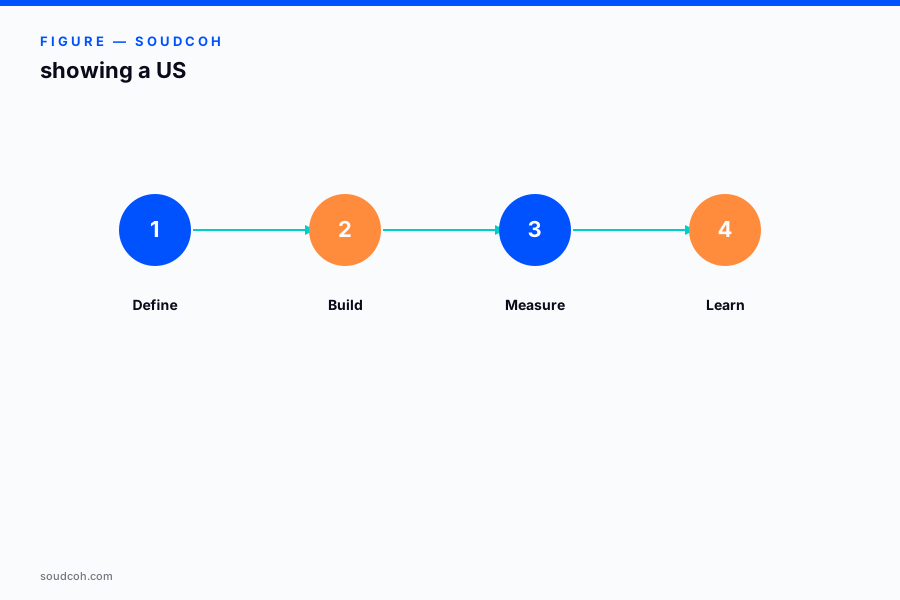
Trigger Point 1: The first-reply window is shorter than you think
When a prospect replies to your quote email or your initial enquiry response, that is the highest-intent moment in your entire sequence. They are in their inbox, they are thinking about your business, and they have just taken a deliberate action. Most templates respond to this moment with silence — because the next scheduled send is tomorrow, or Day 3, or whenever the calendar timer fires next. By then, the window has closed.
What the data says about reply-window timing
The HubSpot 2024 benchmarks make clear that sequences with behavioural triggers — specifically reply-triggered follow-ups — significantly outperform calendar-time equivalents on conversion-to-meeting rate. Waiting 24 hours after a reply is not a conservative strategy; it is a conversion leak. The reply is a signal. Your sequence needs to treat it as one.
The rewrite is straightforward. In GoHighLevel, open your workflow, remove the calendar-delay step on your first follow-up, and replace the trigger with Contact Replied to Email. Set the action delay to 10 minutes — long enough to feel human, short enough to catch the lead while they are still in their inbox.
The exact configuration and subject line
Here is the GoHighLevel workflow configuration for Trigger Point 1:
- Trigger: Contact Replied to Email (any email in the sequence)
- Action 1 — Wait: 10 minutes
- Action 2 — Send SMS: "Hey [first name] — quick one, does [day] at [time] suit for a quick chat? [booking link]"
- Action 3 — Send Email: Subject and body below
- Action 4 — Remove from nurture sequence: so they do not receive the next calendar-time email while you are already in conversation
The email for Action 3:
| Element | Copy |
|---|---|
| Subject line | Quick one — does [day] at [time] suit? |
| Body line 1 | Thanks for getting back to me. |
| Body line 2 | Does [specific day] at [specific time] work for a quick call to sort out the details? |
| CTA | [Book that time — one-click link to a live calendar slot] |
| Sign-off | First name only. No title. No company boilerplate in the body. |
No preamble. No company history. No "as per my previous email". One question, one link. The subject line uses a specific day — not "this week" — because specificity forces a real decision. "Does Thursday at 2pm suit?" is answerable. "Let me know when you're free" is not.
A 38% open rate with zero booked jobs means your sequence is entertaining prospects, not closing them.
Trigger Point 2: The no-show follow-up must fire within 60 minutes, not next day
Someone booked a call with you and did not show up. This is not a lost lead. This is a lead who had enough intent to put time in their calendar — and then something interrupted them. The difference between recovering that lead and losing them permanently comes down to when your follow-up lands.
The no-show follow-up that fires next day loses 7x the bookings of one that fires within the hour.
What Klenty's cadence data shows about the no-show window
According to Klenty's 2023 Sales Cadence Study (klenty.com/blog/sales-cadence-study), follow-up emails sent within one hour of a missed call or no-show convert at 7x the rate of next-day sends. The mechanism is straightforward: in the 60 minutes after missing an appointment, the lead is still aware they missed it. They feel mild guilt or mild inconvenience. They are mentally available. By the next morning, other priorities have filled that mental space and your missed call is a vague memory.
Most service business sequences either have no no-show branch at all, or they include one scheduled for the following morning at 9am. Both approaches discard the conversion window entirely.
The HubSpot Starter configuration and the exact two-line template
In HubSpot Starter, create a new workflow with the following settings:
- Trigger: Meeting outcome is equal to No-show
- Delay: 45 minutes (close enough to fire in the window; far enough to feel considered, not automated)
- Send email: Subject and body below
- Branch: If contact books within 24 hours → remove from sequence. If not → add to 14-day stale-lead trigger (Trigger Point 3).
The email:
| Element | Copy |
|---|---|
| Subject line | Missed you — grab another time here |
| Body line 1 | No stress at all. |
| Body line 2 | Here's a link to pick a time that works better: [direct booking link]. Takes 30 seconds. |
| Sign-off | First name. Nothing else. |
That is the entire email. No guilt. No "I noticed you didn't show up for our scheduled call". No lecture about the value of your time. The phrase "No stress at all" removes the embarrassment barrier — the most common reason a no-show lead does not rebook is that they feel awkward about having missed. Remove the awkwardness and the friction drops.
Trigger Point 3: The 14-day stale lead is not dead — it's just waiting for a reason
A lead who enquired 14 days ago and has not booked is not lost. They are suspended. Something interrupted their decision — a cash-flow concern, a family schedule conflict, a competing quote they are still considering, or simple inertia. The question is whether your sequence gives them a way back in, or whether it sends them a PDF they did not ask for and calls that nurturing.
What the GoHighLevel community data shows about stale-lead recovery
Data from the GoHighLevel community forum (2024) shows that pipeline-stale automations triggered at 14–21 days recover 11–18% of leads marked as lost — but only when the call-to-action is a direct booking link. When the CTA is a content asset (a PDF guide, a blog post, a case study), recovery rates drop to near zero. The lead does not need more information at day 14. They already know what you do. They need permission to restart the conversation without it feeling awkward, and a clear, frictionless way to act on that permission immediately.
The one-question rewrite that recovers 11–18% of stale leads
Delete your existing day-14 nurture email. Replace it with this:
| Element | Copy |
|---|---|
| Subject line | Still looking for [service] in [suburb]? |
| Body line 1 | We keep a spot open each week for jobs like yours — if you're still keen, grab it here: [direct booking link]. |
| Body line 2 | If the timing's wrong, no worries at all. |
| CTA | [direct booking link — live calendar slot, not a contact form] |
Two sentences. Zero content assets. One link. The subject line uses the actual suburb from their enquiry record — both GoHighLevel and HubSpot support this via custom fields pulled from the contact record. "Still looking for electrician in Parramatta?" is specific to them. It signals you remember who they are. That specificity is doing more conversion work than any amount of drip content.
The phrase "no worries at all" matters. It lowers the cost of not responding. Paradoxically, reducing the pressure to act increases the rate of acting — because the lead no longer feels they are committing to something large by clicking the link.
The single-CTA rule that ties all three trigger points together
Look at the three rewritten emails above. Each one contains exactly one call-to-action. One link. One destination. One action available to the reader. This is not minimalism for aesthetic reasons — it is conversion architecture. When you give a prospect two options, they face a decision. When they face a decision at 9pm after a long day, the default choice is to do nothing and come back to it later. They do not come back.
Why a direct calendar link outperforms every other CTA in a service sequence
A contact form adds a step. A phone number requires them to switch apps, consider what to say, and commit to a conversation they may not feel ready for. "Reply to this email" is open-ended and puts the scheduling burden back on them. A direct link to a live calendar slot with one available time visible removes all of those friction points. The action is: click, see a real time, confirm. Three taps. Under 30 seconds.
| CTA type | Steps required | Decision burden | Conversion in service context |
|---|---|---|---|
| Contact form | 4–6 | Medium | Low |
| Phone number | 2–3 + mental preparation | High | Low at 9pm |
| Reply to email | 2–3 + drafting response | Medium-high | Low — scheduling loop created |
| Direct booking link (live slot) | 2–3 | Low | Highest — decision is pre-made |
How to connect your calendar in under 20 minutes
In GoHighLevel:
- Go to Calendars → Calendar Settings → create or select your booking calendar.
- Copy the Booking Link from the calendar overview page.
- In each workflow email action, paste the booking link as the single hyperlink in the body. Do not add any other links — not your website, not your social profiles, not an unsubscribe link in the body (the footer handles that).
- Test by opening the link in a private browser window to confirm it shows live availability.
In HubSpot Starter:
- Go to Sales → Meetings → Create meeting link.
- Set availability to reflect your actual working hours in AEST — do not leave the default US Eastern Time setting.
- Copy the personal meeting link and paste it as the single CTA in each workflow email.
- Set the meeting type to One-on-one and limit the advance booking window to 7 days so the lead sees near-term availability, not a calendar two months out.
The no-show follow-up that fires next day loses 7x the bookings of one that fires within the hour.
How to rebuild these three triggers tonight without breaking what's already running
The fastest way to undo weeks of work is to edit a live sequence that has active contacts moving through it. Do not do that. The correct process is to clone first, edit the clone, test on yourself, then swap.
Step-by-step: clone, audit, test before going live
- Clone your existing sequence. In GoHighLevel: open the Workflow, click the three-dot menu, select Duplicate. Name the duplicate "[Original name] — trigger rebuild". In HubSpot: open the Workflow, click Actions → Copy. Your live contacts remain in the original. The clone is safe to edit.
- Audit the clone in this order:
- Find the first-reply step. Check the delay setting. If it says anything other than "immediately" or "10 minutes", change it.
- Find your no-show branch. If it does not exist, create it now using the configuration from Trigger Point 2 above.
- Find your last nurture email (the one that fires around day 7–14). Count the CTAs in the body. If there is more than one link, apply the single-CTA rewrite.
- Test each trigger on yourself. Enrol your own email address as a test contact. Manually trigger each branch — reply to the first email yourself, mark a test meeting as no-show, manually advance the contact to day 14 in the pipeline. Time how long each email takes to land in your inbox. If any email takes more than 15 minutes to arrive, you have a delay step buried in the workflow you have not noticed. Find it and remove it.
- Check ACMA compliance on every email in the clone before activating it. Each email must show your business name, include an unsubscribe link in the footer, and be sent only to contacts who have given consent. In GoHighLevel, the unsubscribe footer token is
{{contact.unsubscribe_url}}. In HubSpot, it is added automatically via the email template footer — confirm it is visible, not hidden by CSS. - Deactivate the original sequence for new contacts only (do not remove existing contacts mid-sequence). Set the clone as the active sequence for all new leads coming in from your lead source — whether that is your Google Ads landing page, a Meta Ads form, or organic enquiry.
The 15-minute timing test explained
GoHighLevel and HubSpot both allow you to add delay steps anywhere in a workflow — and it is easy to accumulate them without realising it. A common mistake is a sequence that has a 10-minute delay before the trigger action, then a 1-hour delay before the email action, making the total delay 70 minutes instead of 10. The only way to find these hidden delays is to test with a real email address and a stopwatch. If the email lands outside your expected window, open the workflow and look at every step between the trigger and the send action — the delay is in there somewhere.
What SoudCoh found when auditing real Australian service-business sequences
The three faults described in this article are not theoretical. They appear in almost every GoHighLevel and HubSpot Starter sequence that SoudCoh audits across Australian service businesses. The pattern is consistent regardless of industry: a trades business, a physiotherapy clinic, a cleaning company, and a financial advice practice all running the same structural errors — calendar-time delays on reply triggers, no no-show branch, and multi-CTA stale-lead emails.
A real result from fixing all three in one session
One of the case studies from SoudCoh's CRM automation work involves a Sydney-based trades client who came in with a GoHighLevel sequence showing strong open rates and a booking rate of 4 jobs per month from roughly 120 monthly enquiries. The audit found all three faults: the reply trigger had a 24-hour calendar delay, there was no no-show branch at all, and the day-14 email contained four links — a PDF download, a testimonials page, a contact form, and a phone number. Fixing all three took one working afternoon. Within the first full month of the rebuilt sequence running on the same lead volume, booked jobs moved from 4 to 11. No new ads spend. No platform change. No new copy beyond the three template rewrites described in this article.
What the SoudCoh audit process actually involves
The CRM and automation audit at SoudCoh involves three steps:
- Workflow export and mapping. Every trigger, delay, condition branch, and action in your current sequence is mapped against your actual contact behaviour data — reply rates, no-show rates, and pipeline age — to identify where leads are dropping off.
- Trigger fault identification. Each delay setting is checked against the behavioural window it is supposed to serve. Missing branches are identified. CTA count per email is logged.
- Configuration fix delivery. The rebuilt workflow logic is delivered as a GoHighLevel shareable snapshot or a HubSpot workflow export — ready to import into your account without manual rebuilding.
SoudCoh works exclusively with Australian service businesses under $5M revenue. That means every sequence configuration accounts for AEST send-time logic, ACMA compliance requirements under the Spam Act 2003, and the specific decision behaviour of Australian service leads — not US SaaS users. The ACMA-compliant footer tokens and Australian business identification requirements are built into the delivery templates by default, not added as an afterthought.
If you run SEO or paid traffic and your lead volume is healthy but booking conversion is not, the sequence is almost certainly where the revenue is leaking. The ads are working. The enquiries are coming in. The triggers are dropping them.
Questions and answers
How often should a sequence send messages?
Choose timing that fits the service, customer expectation and decision involved. Start with the purpose of each contact and review replies or complaints rather than copying a fixed schedule across every service.
Who should take over when someone replies?
Assign the response to a named role with access to the relevant context. The customer should not have to repeat information because a sequence and the office operate separately.