

Your Snowflake clean room is live, your LiveRamp Habu contract is signed, and your CFO is twelve months into asking why the $800K investment has produced exactly zero incremental revenue signal.
The failure is not in the technology layer — it is one layer upstream, in the unresolved gap between your CDP's data governance posture and the publisher contract clauses your legal team never flagged as a commercial blocker.
This piece delivers a three-tier readiness matrix that tells you precisely which layer is stalling your clean room value realisation and the specific remediation actions — contractual, organisational, and technical — required to unblock each one.
The clean room stall is a governance failure, not a platform failure
Across Fortune 500 retail and CPG verticals, clean rooms have become the most expensive shelf-ware in the modern martech stack. The Snowflake Data Cloud Summit 2024 case study series documented a median time-to-first-insight exceeding eleven months from deployment go-live — a figure that cannot be attributed to implementation complexity when the underlying infrastructure is a managed cloud service with documented API connectors to every major publisher. Eleven months is not an engineering problem. It is an operating model problem wearing an engineering disguise.
"The clean room stall is not a signal that the platform was the wrong choice. It is a signal that the organisation deployed infrastructure into a governance vacuum and then waited for the infrastructure to govern itself."
The LiveRamp 2024 State of Data Connectivity Report sharpens the diagnosis further: 61% of enterprise clean room deployments identify 'data quality and completeness' as the primary barrier to activation, ranking it ahead of every technical integration challenge on the list. That is not a close result. Technical integration — the layer where platform vendors compete on features and where martech architects spend the majority of their implementation budget — is not even the primary problem in the majority of failing deployments.
Why upgrading the platform tier compounds the problem
The operational consequence of misdiagnosing a governance failure as a platform failure is that the remediation response moves in the wrong direction. When a clean room deployment stalls at eleven months with no usable attribution signal, the instinctive escalation path is a platform review: moving from AWS Clean Rooms to LiveRamp Habu Premium, adding a Snowflake Horizon governance layer, or opening a procurement conversation with Infosum or Optable. Each of these decisions adds six-figure annual contract value to the martech budget while doing nothing to address the upstream constraints that caused the stall.
The sunk-cost pressure this creates on the martech team is commercially damaging in a specific way: it forces the marketing operations director to defend a platform investment by demonstrating use cases the data quality layer cannot yet support, which produces optimistic match rate reporting that further delays the honest governance conversation the CFO's attribution process actually needs. The clean room stall, left undiagnosed at the governance layer, becomes self-reinforcing.

Why the CDP-to-clean-room handoff breaks before the first query runs
The architectural assumption embedded in every clean room vendor's onboarding documentation is that the brand arrives with a clean, complete, consistently formatted first-party identity graph. In practice, the CRM layer feeding Adobe AEP or Treasure Data into the clean room carries a 30–60% email address incompleteness rate that was never remediated before ingestion. A match rate calculated against a 40% complete email universe is not a match rate — it is a noise floor. Publishers reporting back a 12% overlap against what the brand believes is its full customer file are almost always reporting against a file that was already 50% empty before the query ran.
Hashing standard conflicts and data freshness failures
Two technical failure modes account for the majority of CDP-to-clean-room join failures that are not caused by completeness gaps. The first is hashing standard misalignment: Adobe AEP's default PII normalisation pipeline and the hashing standard expected by a given publisher's matching layer are frequently incompatible. SHA-256 versus MD5 conflicts are the most common manifestation, but inconsistent phone number formatting — specifically, whether the E.164 standard is enforced before hashing, or whether local formats are hashed directly — produces silent match failures that are difficult to diagnose because the query executes without errors and returns a result that appears plausible.
The second failure mode is data freshness. Adobe AEP segments fed into a clean room on a 72-hour batch cadence cannot support real-time suppression or the audience refresh cadence that a performance media partnership requires. When a suppression list is 72 hours stale, brands are serving paid media to customers who converted, churned, or opted out within the last three days. The match rate that surfaces in the attribution layer is not just low — it is structurally misleading, because the segment composition has shifted between the time the query was written and the time the result is consumed by the media planning team.
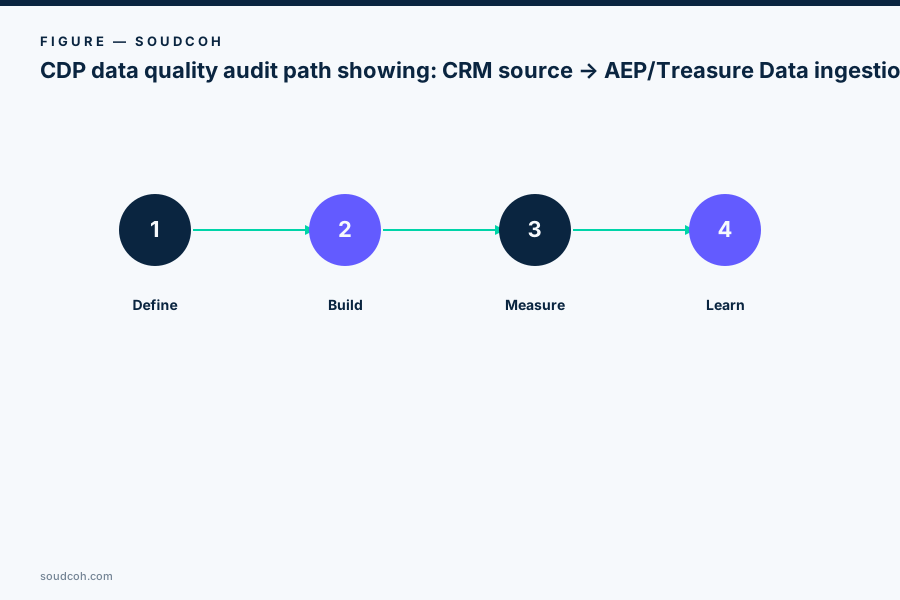
These are not edge cases in exotic deployment configurations. They are the default state of enterprise CRM data in organisations that have not run a dedicated data quality remediation sprint against the specific requirements of their publisher matching layers. The clean rooms are not broken. The data arriving at the clean rooms is broken, and the clean rooms are accurately reporting that breakage as a low match rate.
Publisher contract terms are the invisible ceiling on identity resolution depth
Assume for a moment that the data quality layer is resolved: email completeness above 70%, hashing standards aligned, freshness SLA met. The clean room query runs and returns an overlap count that the commercial team finds credible. What happens next is where the second failure mode asserts itself — and it has nothing to do with the technology stack.
The IAB Tech Lab Clean Room Standards Working Group, in its 2023–2024 draft framework, identified publisher contract interoperability as an unresolved governance gap in multi-party clean room agreements. The specific mechanism is straightforward: most DSP and walled-garden agreements signed before 2023 contain data-use clauses drafted for a measurement-only use case. When those clauses limit permitted data use to 'campaign measurement only,' they legally bar the brand from executing the commercial use cases the clean room was procured to support — lookalike expansion, cross-publisher frequency capping, and incremental reach attribution across the open web.
The specific clause to audit and the addendum structure that resolves it
The audit target is the 'permitted data use' or 'audience enrichment' provision in the master services agreement with each publisher and DSP. When this clause contains 'campaign measurement only' language, the following clean room use cases are contractually prohibited regardless of what the platform technically supports:
- Lookalike audience modelling against publisher first-party data
- Cross-publisher frequency cap enforcement using identity-resolved user segments
- Incremental reach attribution that requires user-level join across publisher environments
- Suppression list application derived from clean room overlap analysis
Brands that have resolved this ceiling did not renegotiate their master services agreements in full — a process that routinely takes six to twelve months and requires procurement, legal, and executive sponsorship that the marketing team cannot unilaterally mobilise. Instead, they appended a targeted data collaboration addendum containing three specific provisions: a defined permissioned identity resolution scope (which use cases are authorised, expressed as a named list), a query output aggregation threshold (accepting the publisher's k-anonymity floor, typically 1,000 to 5,000 records, as a boundary condition rather than a point of contention), and a mutual data deletion SLA specifying that both parties purge matched records within a defined window post-campaign.
This negotiation pattern takes six to ten weeks when driven by a counterparty who has authority to redline commercial terms. It takes six to twelve months when routed through general counsel without a commercial owner. The difference is organisational, not legal.
| Contract Clause | Blocking Language | Use Cases Blocked | Addendum Resolution |
|---|---|---|---|
| Permitted Data Use | "Campaign measurement only" | Lookalike expansion, suppression, frequency capping | Named use-case list with explicit permissions per case |
| Query Output Aggregation | k-anonymity floor ≥ 5,000 | User-level enrichment, small-segment targeting | Agree floor as a boundary condition; scope use cases within it |
| Audience Enrichment | Prohibits third-party identity join | Cross-publisher identity resolution | Define permitted identity resolution scope by named provider |
| Data Deletion Obligation | Absent or undefined timeline | Creates legal exposure on retained matched records | Mutual deletion SLA: 30 days post-campaign flight end |
The clean room st
The MMM cold-start problem: why clean room outputs never reach the attribution model
Even where match rates are commercially acceptable and contract terms permit the required use cases, a third failure mode reliably prevents clean room investment from producing a revenue signal: the output of a clean room query is structurally incompatible with the input format required by the marketing mix model.
Clean room outputs are typically produced as ad-hoc queries at campaign flight level — an aggregated overlap count, a modelled reach metric, or a frequency distribution table. Marketing mix models running on Databricks or in a Snowflake-hosted MMM environment require a consistent, longitudinal exposure signal at geography-channel-week granularity. These are not the same data shape. The translation between them is not trivial, and it is never operationalised because no one owns the bridge between the clean room analyst and the data science team running the MMM.
Building the permanent operational pipe, not the one-off project deliverable
The failure pattern here is architectural but its root cause is organisational. The clean room analyst produces a query result. The data science team needs a weekly time-series table. Between them sits a manual export, a Slack message, a spreadsheet, and a six-week lag that makes the signal useless for the quarterly CAC payback calculation the CFO is running. The signal does not die because the data is wrong. It dies because the operational pipe was never built.
The remediation is a scheduled Snowflake task or Databricks job that transforms clean room aggregate outputs into a standardised MMM input schema on a weekly cadence. This is not a significant engineering investment — it is typically two to four weeks of a senior data engineer's time to build and one to two hours per week to maintain. The organisational requirement is that it is owned by a named individual with a service-level agreement to the media finance team, not assigned as a project deliverable that expires when the project closes.
The MMM input schema should specify, at minimum: publisher identifier, channel, geography (at the DMA or postcode level appropriate to the model), week-ending date, impressions (clean room-qualified reach), and an incremental reach flag distinguishing net-new reach from frequency on known audiences. This schema should be documented in the data catalogue — in Snowflake's information schema or in a Databricks Unity Catalog entry — and version-controlled. When the MMM vendor updates their input specification, the pipe owner is responsible for the schema update. This is infrastructure, not a one-time deliverable.
Fewer than 20% of enterprises have the operating model that makes clean rooms work
The Gartner Marketing Data and Analytics Summit 2024 finding is the single most operationally important data point in this analysis: fewer than one in five enterprises with an active clean room deployment has a defined data stewardship role with contractual authority over publisher matching agreements. This is not an observation about technology maturity. It is an observation about organisational design — and it is the variable most correlated with value realisation across the deployment base Gartner surveyed.
"Fewer than one in five enterprises with an active clean room deployment has a defined data stewardship role with contractual authority over publisher matching agreements. Platform capability is not the binding constraint. Organisational authority is."
The failure pattern and the specific role that resolves it
The failure pattern across stalled deployments follows a consistent organisational logic. The clean room programme is owned by the martech architect or marketing operations director. That individual has implementation authority — they can configure Adobe AEP segments, build Snowflake data shares, and manage the LiveRamp Habu workspace. What they do not have is the mandate to renegotiate publisher contracts, the budget line to fund a data quality remediation sprint in the CDP, or a standing reporting line into the CFO's attribution governance process. They have been given the tool and denied the authority required to use it commercially.
The resolution is not a steering committee, a centre of excellence, or an expanded RACI matrix. Those are organisational responses that distribute responsibility without concentrating authority, which is precisely the opposite of what is required. The resolution is a single Data Partnership Manager role defined with three explicit and non-delegable authorities:
- Data quality remediation authority: the right to trigger and prioritise data quality sprints within Adobe AEP or Treasure Data, with a direct reporting line to the CDP product owner and a defined SLA for remediation completion.
- Commercial redline authority: the authority to draft and redline publisher data collaboration addenda without routing every clause through general counsel — with legal review scoped to novel provisions only, not standard addendum language.
- Attribution governance access: a standing agenda item in the quarterly CAC payback review with the CFO or VP of Finance, where clean room match rate, incremental reach, and MMM contribution are reported as named line items, not appended to a marketing operations update.
This role does not need to be a new headcount. In several enterprises that have successfully operationalised clean room value realisation, the function was absorbed by a senior marketing operations director whose role description was rewritten to include the three authorities above. The headcount question is secondary. The authority question is primary.
The three-tier clean room readiness matrix: diagnosing which layer is blocking you
The following matrix provides a diagnostic framework for identifying which of the three tiers is the binding constraint on your clean room value realisation. Score each tier independently before drawing conclusions about remediation sequencing — it is common for enterprises to score red on all three simultaneously, and the sequencing of remediation across tiers matters as much as the remediation actions themselves.
Tier One — Data Quality
Score your CDP against four binary criteria. A green score requires a definitive yes on each item:
| Criterion | Threshold | How to Measure | Score |
|---|---|---|---|
| Email completeness | ≥ 70% of CRM records carry a valid, hashed email | AEP profile completeness report or Treasure Data audience quality dashboard | Green / Red |
| Hashing standard | Single documented standard (SHA-256 preferred) enforced at ingestion for all publisher-bound segments | AEP data prep policy or Treasure Data workflow audit | Green / Red |
| Data freshness SLA | CRM segments feeding clean room refresh within 24 hours of source update | Segment scheduler configuration in AEP or Treasure Data | Green / Red |
| Identity resolution conflict log | Documented log of known conflicts between CDP identity graph and top three publisher matching layers, with resolution status | Manual audit against publisher onboarding documentation | Green / Red |
Fewer than three green scores means the clean room will not produce a commercially usable match rate regardless of platform tier. Remediate Tier One before any further investment in Tier Two or Tier Three activity.
Tier Two — Commercial Terms
Audit every active publisher and walled-garden agreement against three specific clause categories. A Priority 1 flag on any item means the agreement is a binding commercial constraint that must be addressed before the next media planning cycle:
| Clause Category | Blocking Condition | Priority Flag |
|---|---|---|
| Permitted data use scope | "Campaign measurement only" or equivalent language present | Priority 1 — renegotiate addendum before next planning cycle |
| Query output aggregation floor | k-anonymity requirement of 5,000 or higher, making user-level enrichment operationally impossible | Priority 2 — scope use cases within the floor; flag for renegotiation in annual review |
| Data deletion obligations | Absent, undefined, or unilateral deletion terms | Priority 1 — legal exposure; resolve in addendum alongside use-case expansion |
Tier Three — Operating Model
Assess against three organisational gates. A 'no' on any single gate predicts continued stall irrespective of Tier One and Tier Two remediation status:
| Gate | Assessment Question | Pass Condition |
|---|---|---|
| Named authority | Is there a named individual with contractual authority over publisher data collaboration agreements? | Named role exists with authority documented in job description and acknowledged by legal and procurement |
| MMM pipeline | Does a documented, scheduled data pipeline exist between clean room aggregate outputs and the MMM input schema? | Snowflake task or Databricks job in production, version-controlled, with named owner and SLA |
| CFO visibility | Has clean room match rate or incremental reach appeared as a line item in a CFO-level attribution review in the past 90 days? | Yes — with a defined cadence for future reviews |
Build vs. buy vs. federate: the platform decision that should come last, not first
The enterprise instinct when a technology investment stalls is to diagnose a technology problem and respond with a technology decision. For clean rooms, this produces a specific and expensive error: opening a platform review before the governance constraints have been resolved, then selecting a higher-tier platform that is equally unable to produce revenue signal because the data quality and commercial terms layers remain unaddressed.
When the build case is genuinely defensible
The genuine build-versus-buy decision in clean room infrastructure is not about which managed service to procure. It is about whether to build a proprietary identity resolution graph on Snowflake or Databricks rather than licensing a third-party identity spine. The case for building is defensible under specific conditions: the brand processes more than 50 million addressable profiles, maintains more than eight active publisher partnerships requiring identity resolution, and has scored green across all four Tier One data quality criteria. Under those conditions, the per-thousand-record cost of licensing LiveRamp's RampID or an equivalent identity solution begins to exceed the total cost of ownership for an in-house graph built and maintained on Snowflake's native data sharing infrastructure.
The case does not hold below that threshold. For enterprises processing fewer than 50 million profiles or managing fewer than eight publisher relationships, the operational overhead of maintaining a proprietary identity graph — model governance, MLOps pipeline for the matching model, prompt vault management for any LLM-assisted entity resolution layer — exceeds the licensing cost differential by a margin that makes the build case indefensible on a three-year TCO basis.
The federated architecture as the regulatory default
The architecture most consistent with both emerging IAB Tech Lab standards and the regulatory trajectory in the EU and California is the federated model: the brand operates a Snowflake Data Clean Room instance, each publisher operates their own, and queries execute at the intersection of the two environments without raw data egress from either party. No PII crosses the boundary. The output is an aggregate result computed inside the intersection, not a record-level file passed between parties.
This architecture is not a future upgrade path. It is the architecture that publisher contracts should be written to assume today, because retrofitting federated-query assumptions into agreements drafted for a centralised clean room model requires exactly the kind of addendum renegotiation described in the Tier Two audit above. Enterprises that negotiate federated-query architecture as the contractual default in new publisher agreements signed from 2024 onward are positioning themselves to absorb regulatory tightening without a contract renegotiation cycle. Enterprises that do not are accumulating a legal and operational liability that will surface at the worst possible time — typically during a platform migration or a regulatory audit.
| Architecture | Best-Fit Profile | Key Constraint | Regulatory Posture |
|---|---|---|---|
| AWS Clean Rooms (managed) | < 5 publisher relationships, measurement-only use cases | Limited query flexibility; no native identity graph | Adequate for current CCPA/GDPR requirements |
| LiveRamp Habu | 5–15 publisher relationships, identity-resolved activation | RampID licensing cost scales with profile volume | Adequate; dependent on LiveRamp's regulatory posture |
| Snowflake Data Clean Room (native) | > 10 publisher relationships, in-house data science team | Requires internal identity resolution infrastructure | Strong; data never leaves Snowflake environment |
| Federated (Snowflake + publisher-side) | Enterprises with regulatory exposure or EU operations | Requires publisher adoption of compatible architecture | Strongest; no raw data egress by design |
The 90-day unblock plan: sequencing remediation across all three tiers
The sequencing of remediation matters as much as the remediation actions themselves. Tier Two and Tier Three work executed before Tier One is resolved produces contracts and operating model decisions that are premised on data capabilities the organisation does not yet possess. The 90-day plan below is sequenced to respect this dependency structure while compressing the timeline to a point where clean room outputs can feed a Q4 media plan with commercially usable audience data.
Days 1–30: The data quality sprint
The first 30 days are exclusively a data quality sprint. No new platform decisions, no publisher negotiations, no operating model redesigns. The deliverables for this period are:
- Pull the CRM completeness report from Adobe AEP's profile completeness dashboard or Treasure Data's audience quality module. Document the email completeness rate against the 70% threshold. If the rate is below 70%, identify the source systems contributing the highest volume of incomplete records and initiate a data remediation request with the CRM team — this is the authority the Data Partnership Manager role must be empowered to exercise.
- Enforce a single hashing standard across all publisher-bound segments. The standard should be SHA-256 with E.164 phone number normalisation applied before hashing. Document the standard in the AEP data prep policy or the equivalent Treasure Data workflow configuration. Publish the standard to all publisher onboarding contacts as a standing requirement for new data collaboration agreements.
- Document every known identity resolution conflict between the CDP and the top three publisher matching layers. The conflict log should capture: conflict type (hashing standard, normalisation format, identifier type), publisher, estimated match rate impact, and resolution status. This document is the input to the publisher addendum negotiations in Days 31–60.
- Audit data freshness SLAs for all AEP or Treasure Data segments currently feeding clean room instances. For any segment on a cadence longer than 24 hours, submit a scheduler reconfiguration request with a target completion date within the 30-day window.
This sprint requires no new budget. It requires authority and prioritisation. If the sprint cannot be completed in 30 days without new headcount or budget, that is diagnostic information: the organisation does not currently have the operating model to support clean room value realisation, and the Tier Three operating model work should be initiated in parallel rather than deferred.
Days 31–60: Legal and commercial sequencing
With Tier One remediation underway, Days 31–60 focus on the publisher contract addendum work. The objective is counter-signature on two or three targeted addenda by day 60, enabling clean room-qualified audiences to feed the Q4 media planning cycle.
- Identify the two or three publisher and walled-garden agreements where 'campaign measurement only' language is the binding constraint, using the Tier Two audit output from the readiness matrix. Prioritise by media spend concentration — the agreements where resolving the constraint produces the highest incremental reach or frequency efficiency gain should be addressed first.
- Draft the data collaboration addendum using the IAB Tech Lab Clean Room Standards Working Group interoperability framework as the base document. The addendum should contain the three provisions described in the commercial terms section above: permissioned use-case list, agreed aggregation floor, and mutual deletion SLA. Route for legal review with a scope-limited brief — novel provisions only, not standard addendum language — to compress the review cycle.
- Target counter-signature by day 60. Agreements signed in this window can be operationalised in the clean room environment in time to produce audience segments for Q4 campaign planning. Agreements that slip past day 60 represent a missed media planning cycle and should be rescheduled for Q1.
Days 61–90: Operating model lock-in
The final 30 days convert the remediated data quality and commercial terms position into a permanent operational capability rather than a project-phase deliverable.
- Publish the MMM input schema as a documented data contract in the Snowflake information schema or Databricks Unity Catalog. Build the scheduled Snowflake task or Databricks job that populates the schema weekly from clean room aggregate outputs. Assign named ownership to a data engineer with a defined SLA to the media finance team.
- Schedule the first CFO-level attribution review where clean room match rate and incremental reach appear as named line items. The agenda item should be positioned alongside CAC payback and media efficiency metrics, not within a martech programme update. This positioning signals that clean room outputs are an attribution input, not a technology metric.
- Publish the Data Partnership Manager role description with the three contractual authorities defined above. If the role is being absorbed into an existing position rather than created as new headcount, update the role description formally and communicate the authority expansion to legal, procurement, and the CDP product owner. The role's existence as a permanent organisational function — not a project-phase appointment — is the single decision most predictive of sustained value realisation beyond the 90-day window.
Enterprises that complete this sequencing within 90 days consistently report first-insight timelines measured in weeks rather than the eleven-month median documented at Snowflake Data Cloud Summit 2024. The technology was never the constraint. For paid media programmes running eight and nine-figure annual spend, the cost of the eleven-month delay is not an implementation cost — it is a competitive positioning cost that compounds quarterly. The governance work described here is the only remediation that addresses it at the source.
If your organisation is working through a clean room readiness assessment or needs an independent audit of your CDP-to-publisher data pipeline, the SoudCoh advisory team works with marketing operations and martech architecture teams at the intersection of data governance, paid media strategy, and attribution infrastructure. You can also review relevant case studies or explore how our organic and paid channel work integrates with first-party data programmes.
Questions and answers
Can we begin by testing a smaller use case?
A narrower decision with well-understood information can expose practical issues earlier. Scope the test and its permissions carefully rather than treating a pilot as an exemption from normal obligations.
What should a business owner ask before approving the project?
Ask what decision will change, who can use the information, what the output will contain and who is responsible for operation and exit. Request specialist review of the relevant risks.