Msaha - Two-Sided Commercial Kitchen Marketplace for Saudi Arabia
Food & Hospitality
The short version
How SoudCoh built Msaha, Saudi Arabia's first commercial kitchen rental marketplace - a two-sided web app with dashboards, messaging, listings, and WhatsApp integration for kitchen owners and food entrepreneurs.
The record.
- Industry
- Food & Hospitality
- Discipline
- Custom Web Apps
- Services
- SaaS · Web App Development · Marketplace Platform · UI/UX Design
This study is a record of one engagement, in one market, at one budget. The full account of the work, and any figures it produced, is written up below — not a forecast for yours.
What would this look like on your account?
Different market, different budget, different numbers. The first call is where we work out whether the same approach fits yours at all.

The case study
The Problem - Idle Kitchens, Growing Demand, and Messy Coordination
Across Saudi Arabia, hundreds of restaurants have commercial kitchens sitting idle for long stretches of the day. Meanwhile, a growing wave of food entrepreneurs and cloud-kitchen operators are actively searching for licensed, ready-to-use kitchen spaces - without the risk and capital outlay of building a full facility from scratch.
Before Msaha, this market was fragmented and inefficient. Transactions relied on WhatsApp chats, phone calls, and scattered spreadsheets. Pricing and availability were unclear. The same questions about equipment, licences, location, and operating hours had to be repeated for every enquiry. And trust was a constant friction point - is the kitchen real? Is the listing up to date? Who bears responsibility?
Msaha needed a platform that could standardise supply and demand, eliminate friction, and make leasing a commercial kitchen feel as seamless as booking a hotel room - while still aligning with how people in the region actually operate: fast conversations, WhatsApp-first, and mobile browsing.
The Solution - A Full Product, Not Just a Website
SoudCoh built Msaha as a complete, integrated system with two connected experiences working in tandem:
- A marketing website designed to explain the value proposition, drive sign-ups from both sides of the marketplace, and build immediate trust with new visitors.
- A logged-in web application where kitchen owners publish and manage listings, tenants post their specific requirements, and both sides handle enquiries, conversations, and bookings from a single dashboard.
This dual approach matters because marketplace businesses do not succeed on brochures alone. They win on workflow: discovery, trust-building, enquiry, decision-making, and follow-up. Every screen in the Msaha platform was designed to move both sides closer to a completed transaction.
How the Platform Works
Msaha operates like an Airbnb for commercial kitchens. The concept is simple, but the execution required careful product thinking to serve two distinct user groups with different goals:
- Kitchen owners list their kitchens with detailed information including equipment inventories, location, availability windows, pricing in SAR, and compliance certifications.
- Tenants and entrepreneurs browse available kitchens by city, equipment type, and budget - or post their own requirements specifying what they need, when they need it, and how much they can pay.
- Both sides can message each other directly inside the platform, receive real-time notifications, and move rapidly from initial interest to agreement.
- For users who prefer it, enquiries can also be routed via WhatsApp directly from any listing page - a critical conversion path for the Saudi market.
Key Features SoudCoh Delivered
1. SEO-First Marketing Website for Trust and Acquisition
The public-facing website was engineered to convert three distinct audiences: entrepreneurs actively searching for kitchen space, restaurant owners looking to monetise idle capacity, and partners or stakeholders who need confidence in the platform's legitimacy. It features clear value propositions, step-by-step process explanations, social proof, and strong calls to action that funnel visitors directly into the web application.
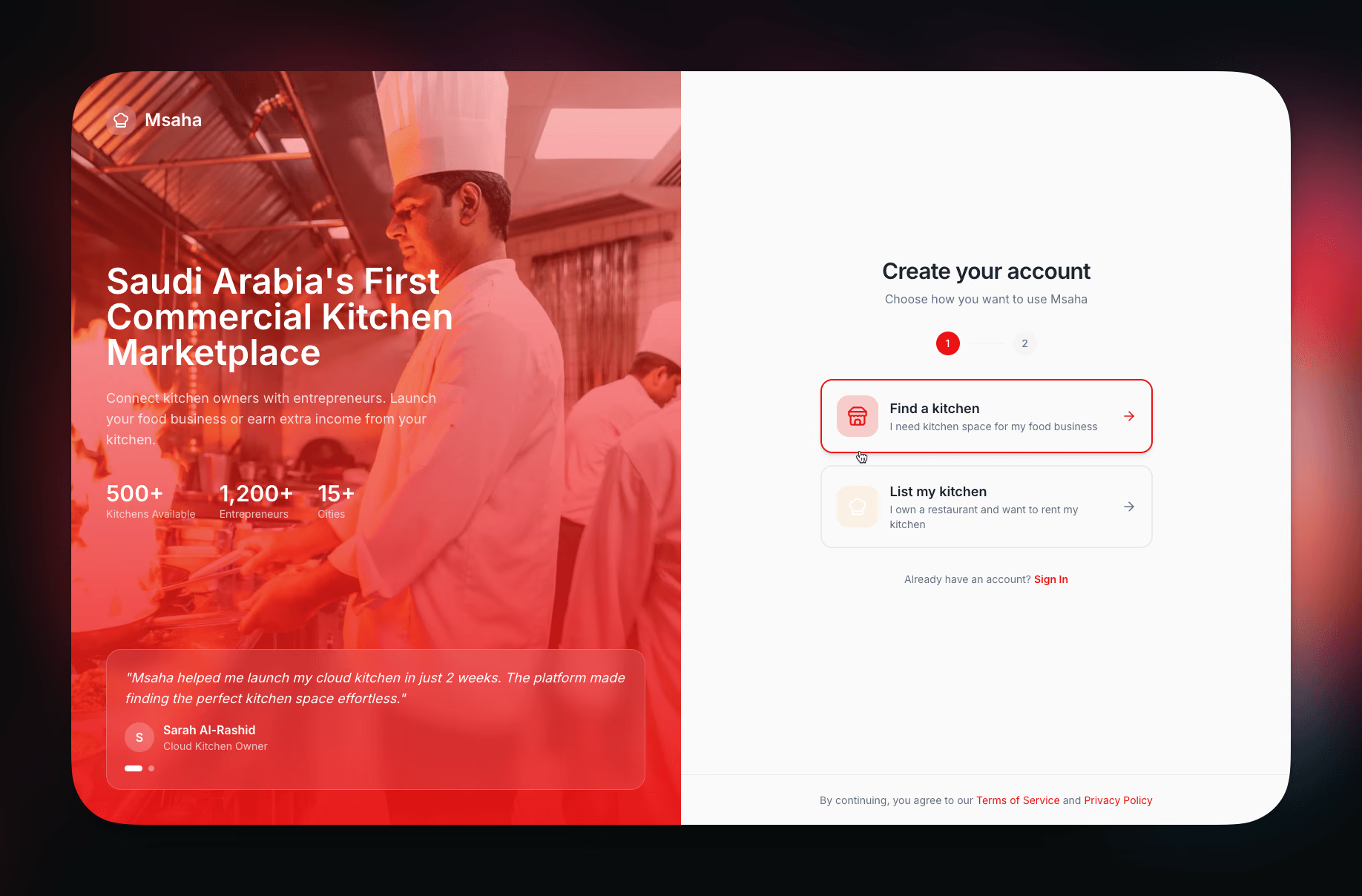
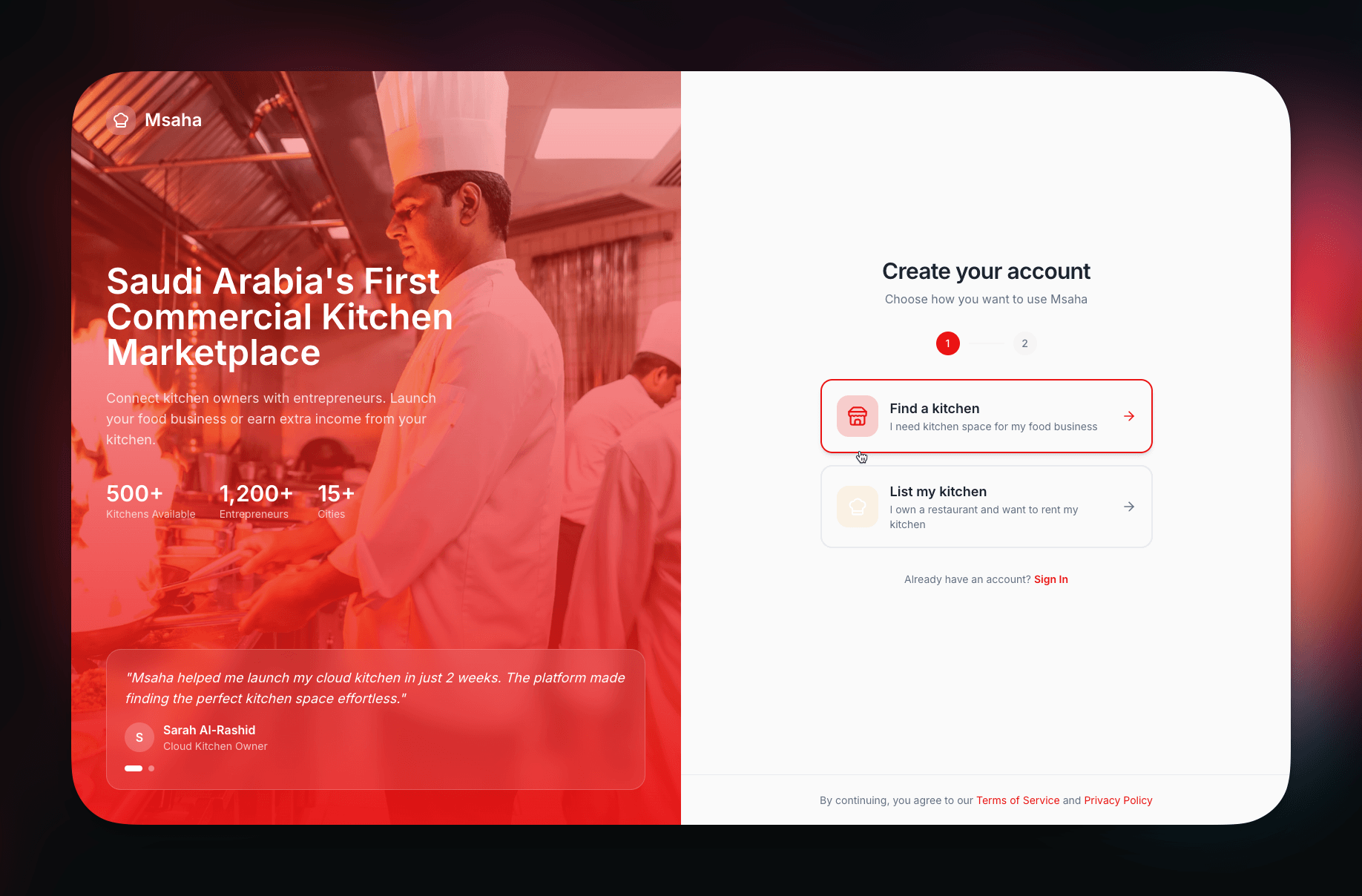
2. Two-Sided Onboarding with Role-Based User Journeys
Msaha supports different user intents from the very first interaction. Tenants are guided towards searching kitchens and posting requirements. Owners are directed to list their kitchens and respond to incoming enquiries. This role-based UX design reduces confusion and accelerates each user's path to their first meaningful action on the platform.
3. Action-Oriented Dashboard
The dashboard was designed around what users need to do next, not vanity metrics. Quick actions let owners list a kitchen or browse tenant requirements in a single click. Management modules provide centralised access to bookings, messages, listings, and lease requests. A recent activity feed keeps users engaged and returning regularly. The result is a dashboard that feels like a working tool, not a passive catalogue.
4. In-Platform Messaging to Close Deals Faster
Marketplace transactions fail when communication gets fragmented across channels. Msaha includes an integrated messaging system that keeps every conversation tied to a specific kitchen or lease request. This contextual threading reduces missed messages, eliminates confusion about which listing is being discussed, and supports a clear enquiry-to-response workflow that drives conversions.
5. Notifications That Pull Users Back
Msaha includes a comprehensive notification centre so users never miss a critical update. New messages, lease enquiries, and interest signals in their listings all appear as real-time alerts. This notification system dramatically improves response times - a major lever in marketplace conversion rates where speed of reply directly correlates with deal completion.
6. Requirements Marketplace for Tenant-Led Demand
Tenants can post structured requirements specifying their city, monthly budget in SAR, usage type, team size, and equipment needs. Kitchen owners can browse these requirements and make targeted offers. This feature solves a critical cold-start marketplace problem: sometimes demand exists before the perfect listing does. The requirements system captures that demand as structured, actionable data that owners can respond to proactively.
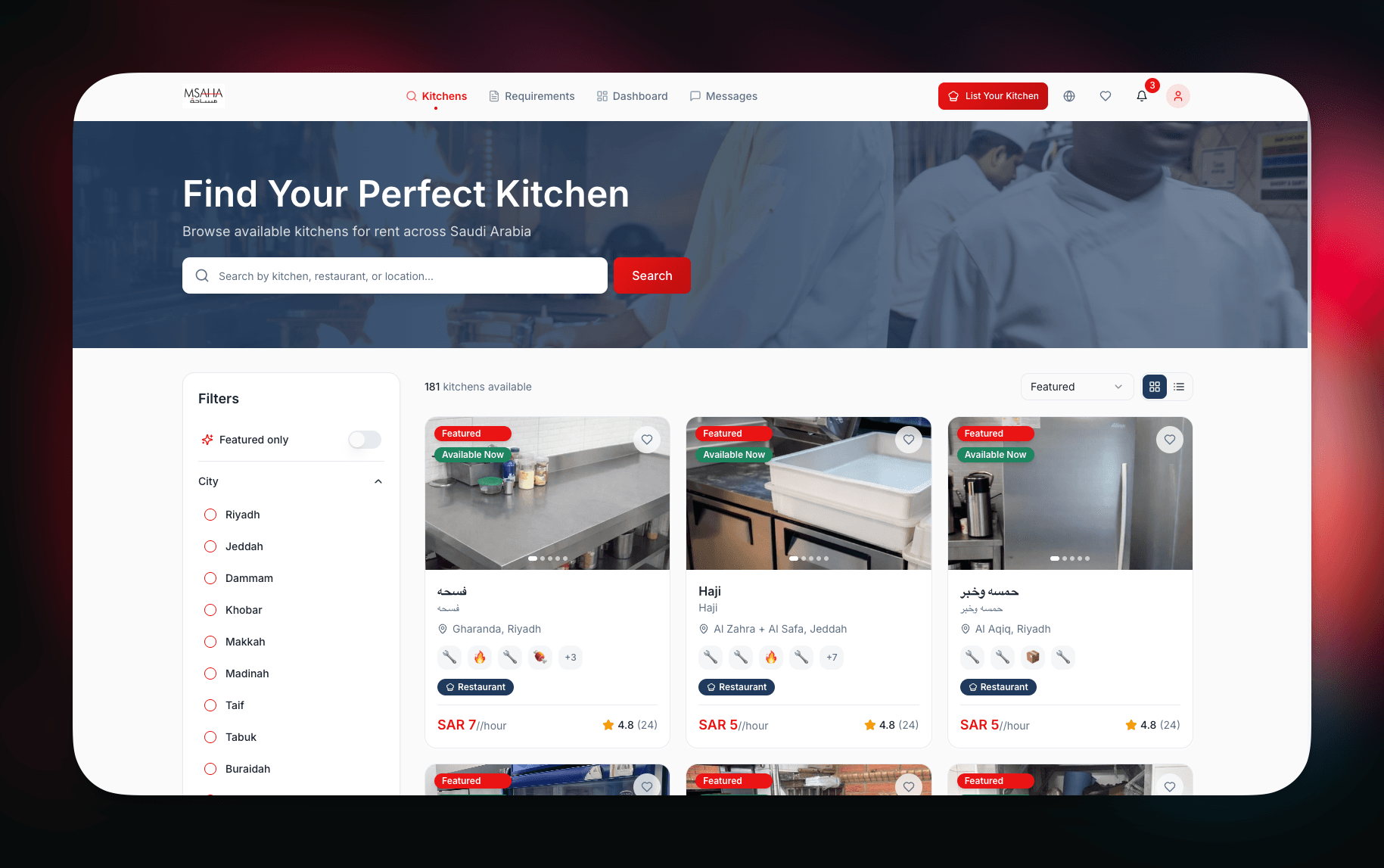
7. Listings Marketplace with Advanced Filtering
Kitchen owners publish detailed listings that are easy to compare and filter. The marketplace supports filtering by city (Riyadh, Jeddah, Dammam, Khobar, Makkah, and more), equipment availability, pricing, availability status, and kitchen type. Each listing card shows key information at a glance - location, hourly or monthly rate, equipment icons, ratings, and availability badges - enabling tenants to make fast, informed decisions.
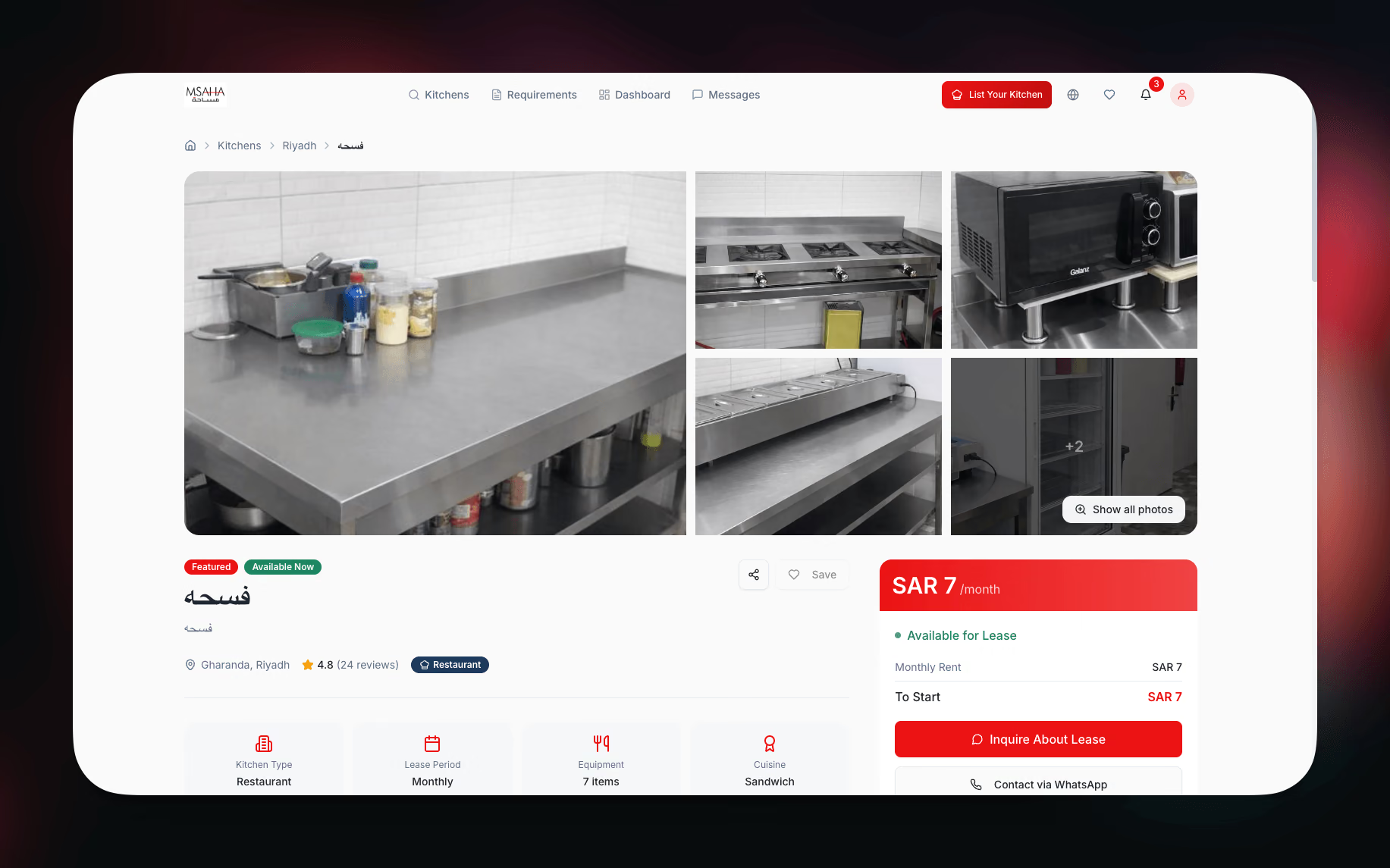
8. High-Conversion Listing Detail Pages
Every listing detail page was designed to answer a tenant's questions before they need to ask. It includes a multi-image gallery, clear monthly and hourly pricing displayed in SAR, a full equipment inventory, available services, and licence and compliance badges (Municipality Licence, Commercial Registration, Verified Platform). Two prominent conversion paths - an in-platform lease enquiry button and a direct WhatsApp contact option - ensure tenants can take action immediately through whichever channel they prefer.
Why a Platform Was Necessary
A standard marketing website could explain what Msaha does. But it could never run Msaha. The business required a structured catalogue of kitchens with consistent, searchable fields. It needed user accounts to manage listings, enquiries, and ongoing conversations. It required messaging and notifications to minimise response delays. It demanded two-sided workflows where tenant requirements and owner listings work together to increase matching density. And it needed to fit real user behaviour in Saudi Arabia: browse on mobile, decide quickly, and jump to WhatsApp when ready.
That is exactly what the Msaha web application enables - repeatable, scalable transactions rather than one-off lead collection.
The Outcome - A Scalable Foundation for Marketplace Growth
Msaha now operates as a single, unified system where kitchen owners can monetise their idle capacity, food entrepreneurs can discover compliant kitchens faster than ever before, and all enquiries, conversations, and actions live in one centralised platform. The marketplace is designed to scale city by city across Saudi Arabia without reinventing operations each time a new region is added.
What SoudCoh Delivered
- Full-stack two-sided marketplace web application
- SEO-optimised marketing website with conversion funnels
- Role-based onboarding and user journeys
- Action-oriented dashboards for owners and tenants
- In-platform messaging with contextual threading
- Real-time notification system
- Requirements marketplace for demand capture
- Advanced listing search with multi-filter support
- High-conversion listing pages with WhatsApp integration
- Licence and compliance badge verification system
- Mobile-first, region-aware UX design
Tags
- SaaS
- Web App Development
- Marketplace Platform
- UI/UX Design
That is one account. Yours is a different one.
We read your ads, your search presence and your tracking the same way this one was read, and tell you what we would change first.
What every number on this page actually means.
Marketing words get used loosely, and a loose word can make a small result look like a big one. Here is exactly what we mean by each of them.
- Conversion
- One real action by one real person: a phone call that lasted long enough to be a conversation, a submitted enquiry form, a booking, or a purchase. Not a page view and not a form that merely loaded.
- Cost per job · cost per lead
- The advertising money spent, divided by the number of those actions. It is the only figure that tells you whether the advertising is worth doing, which is why we publish it next to the count.
- Conversion rate
- The share of people who clicked the ad and then did the thing. A high click count with a low conversion rate usually means the ad and the page are promising different things.
- Ad spend
- Money that went to the advertising platform, not to us. Our management fee is separate and is never included in a cost-per-job figure, because mixing them would flatter the number.
- The measurement window
- The dates the figure covers, named every time. Where a study covers a launch, the clock starts the day campaigns went live — not the day the graph started looking good.
- A starting point
- Where a study knows what a figure was before the work began, that number is printed next to the one it became. Where the account had no history to compare against, the result is printed on its own rather than measured from a number nobody recorded.
- Qualified lead
- An enquiry that matched the service and the service area, so it was worth someone picking up the phone for. Where a study says qualified, somebody checked.
- An anonymised client
- Government, council and cultural-institution engagements are published as sector and jurisdiction only. The work and the measured outcome are described in full; the organisation is not named.
One more, because it matters most: nothing on this page is a guarantee. It is a record of what happened on one account, in one market, at one budget.
This page exists because of two of the six stages.
Compound is how our team works on any account — six stages every change passes through. Two of them are why there is anything honest to publish.
Meter
If it can't be measured, it doesn't get bought.
Before a dollar moves, every action worth money to the business is tracked as itself — calls, forms, bookings, purchases — with values attached. Without that stage there is no honest number to publish afterwards.
Ledger
Every change we make becomes a record you can open.
Every change lands in a dated record as it happens — what was added, what was stopped, what was rewritten and what it cost. Writing this page afterwards was reading a file, not reconstructing a memory.
What actually happens after the first call.
No mystery and no lock-in before you have seen anything. This is the sequence every account on this site went through.
- The call
Thirty to forty-five minutes, free
What you sell, who buys it, and what one customer is worth to you. No deck. You leave with a real number for your situation rather than a range.
- Week 0
The audit
We open your account — or your competitors' ground, if you do not have one yet — and write down every leak we can find. That list is yours whether or not you work with us.
- Week 1
The build
Everything the account needs before it can spend a dollar: what it will bid on, what it must never pay for, the ad copy, the assets, the landing pages and the tracking. A second person checks all of it before anything is live.
- Day one
You press go
Campaigns are created paused, every time, so you can read the whole build first. You activate when you are ready, not when we are.
- Days 1–14
The clean
The busiest fortnight your account will ever have. Search terms read daily, waste negated, early winners promoted, ad copy iterated against what is actually being served.
- From there
Rhythm
Weekly optimisation, reporting on a fixed cadence whether the news is good or bad, and a proper conversation each quarter about where the next block of budget should go.
Before you ask us anything
Here is what everybody asks first.
The questions this raises.
Whether the figures are real, how they were measured and over what length of window, what it costs, and whether any of it would hold for your business.
The first call is free and there is no deck.
Book a callAre the figures in this case study real?
Yes. Every number on this page was read out of the client's own advertising account and is printed here exactly as the study publishes it, beside the period it covers. The dashboard and ad images are screen-grabs of that account rather than recreations. If one of these figures matters to your decision, ask about it on the first call and we will walk you through where it came from.
How were these numbers measured, and over what window?
Every figure on the page is printed beside the period it belongs to. We publish the LENGTH of a measurement window and the year, and withhold the exact dates — when a client advertised, and how their trading calendar looks, is their commercial information rather than ours. A conversion means one real action by one real person: a phone call that lasted long enough to be a conversation, a submitted enquiry form, a booking, or a purchase. Not a page view, and not a form that merely loaded.
Would this work for my business?
We cannot promise you the same numbers, and nobody honestly can. What this page tells you is what was achievable in that market, at that budget, for that service. Your competition, your service area, your margins and what one customer is worth to you all move the answer. On the first call we build the picture from your figures rather than someone else's, and if the honest answer is that this channel is wrong for you right now, we will say so.
Why does this study show a result but not a starting point?
Because in most of these engagements there was nothing reliable to start from. A brand-new advertising account has no history, and a business that was tracking enquiries on paper or in a spreadsheet has no comparable figure either. Where a real before-number exists we print it next to the after-number, so you can see the movement rather than take our word for it. Where it does not, we print the result on its own. Back-solving a starting point from a percentage would make the page look better and mean less.
Would my business get the same result?
We cannot tell you that, and nobody honestly can. What this page tells you is what was achievable in that market, at that budget, with that service. Your competition, your service area, your margins and what a customer is worth to you all move the answer. On the first call we build the picture from your numbers rather than from someone else's, and if the honest answer is that this channel is wrong for you right now, we will say so.
How much would this cost to run?
Two separate numbers. Your ad spend goes to the platform, and what it needs to be depends on how competitive your market is and how many jobs you want — the smallest companies we work with invest a minimum of A$3,000 a month, and our largest clients run multiple eight figures a month across paid channels. Our management fee is separate and scales with the work. The first call is free and you leave it with a real figure for your situation.
How quickly could we start seeing enquiries?
It depends on the channel. Paid search meets demand that already exists, so calls and forms can arrive within hours of launch, and the first two to four weeks are an optimisation period where waste is cut daily. Most accounts settle into their best rhythm around 60 to 90 days. SEO, content and brand work run on a much longer clock — months rather than weeks — and we will tell you which one your situation actually needs.
Am I locked into a long contract?
No long-term lock-in. We would rather keep the work because it is producing than because a contract says you have to stay. What we do ask for is enough runway to be fair to the account — a campaign judged on its first ten days is being judged during the part where we are still cutting waste out of it. Terms are put in front of you in plain English before anything is signed.
More accounts, same discipline.
Studies from the same kind of work, so you can see how the pattern holds across different businesses.

Plumbing
Plumbing leads Adelaide: 46 enquiries in a 12-day period
Plumb SA generated 46 plumbing enquiries at $71.91 per lead across greater Adelaide in 2026, from just 12 days of spend.
Read case study

Cleaning
End of lease cleaning Sydney: lead cost down 26.51%
End of lease cleaning leads in Sydney: cost per lead fell from $41.84 in one measured period in 2026 to $30.75 over the first three days of the next.
Read case study

Electrical
Electrician leads Sydney: 35 enquiries in a 13-day period
SK Electrical took 35 electrical enquiries across Sydney in a 13-day period in 2026 at $96.99 per lead, converting 18.13% of clicks.
Read case study
The work that produced this.
Everything above was delivered by one of a handful of things we do. These are the ones this account leant on, written up in full rather than summarised.
- How we scope and build custom softwareDiscovery, build, handover and what the code and hosting arrangement look like when it is finished.
- The front end this platform sits behindAn internal tool still needs a public site that explains it. This is the design and build side of the same engagement.
- The technology division that delivered itEnterprise and government software builds, hosting arrangements, escrow and the support model behind a project of this size.
The briefing behind the work.
The case study records what happened. These two explain the channel, measurement or operating decision that made the result interpretable in the first place.
The ownership, governance and operating constraints behind an internal data product. That case is argued in Why first-party data projects stall outside tier one.
A practical accountability question for any workflow that places a model between an operator and an output. The other half of it is set out in When AI drafts the brief, who owns the message?.
The work behind this one is written up in full under how we scope and build custom software, and how the work is sequenced before any of it is published sets out the sequence in order.
Want results like this?
Thirty minutes on your numbers rather than somebody else's, and a written list of what we would change first. Yours to keep either way.
No pitch deck. No upsell. A real conversation and a written list of leaks.