Snug Nest Designs · Interior design for custom homes · Melbourne, VIC
Snug Nest Designs: Meta ads with a 25% lower cost per website lead
Snug Nest Designs cut its cost per website lead from Meta ads by 25% over the full run of the campaign we rebuilt, against the earlier website lead campaigns. Most of the saving came early and faded as the films wore out. It came from more people clicking the films rather than more clicks becoming leads, so the next version sends every ad to book.snugnestdesigns.com and is judged on booked calls.
Services
Facebook and Instagram advertising · Campaign structure and audience targeting · Landing page and call booking · Lead and booking measurement
Each figure names the window it covers. Use the info button on a tile to see how it was measured.
Headline result
−25%
Cost per website lead against the earlier website lead campaigns
Rebuilt Meta campaign, full run
How it was measured
Ad cost divided by website leads for the rebuilt campaign over its full run of about four and a half months, compared with the same for the account's earlier website lead campaigns over the seven or so months before the rebuild began. Both optimised for the same website lead. Rounded toward the smaller change.
−38%
Cost per website lead in the first 60 days, against the 60 days before
First 60 days of the rebuilt campaign
How it was measured
Ad cost per website lead in the rebuilt campaign's first 60 days, compared with the earlier website lead campaigns over the 60 days just before the rebuild began. This was the strongest stretch of the run. Rounded toward the smaller change.
+26%
Higher link click-through rate than the earlier website lead campaigns
Rebuilt Meta campaign, full run
How it was measured
Link clicks divided by impressions, rebuilt campaign over its full run against the earlier website lead campaigns before the rebuild began. Rounded down.
1 in 25
Link clicks that became a website lead, about the same rate as before
Rebuilt Meta campaign, full run
How it was measured
Website leads divided by link clicks. The rebuilt campaign and the earlier website lead campaigns both came to about one lead for every 25 link clicks.
99%
Website leads from people on a mobile device
Rebuilt Meta campaign, full run
How it was measured
Website leads by device as Meta reports them, as a share of all website leads from the campaign. Rounded down. The earlier website lead campaigns showed the same pattern.
9 in 10
Earlier website leads that came from video ads rather than image ads
Earlier website lead campaigns, whole run
How it was measured
Website leads from ads built on video, as a share of all website leads from the earlier website lead campaigns over their whole run. Video ads also carried most of the impressions.
How we measured +
Figures come from the ad account's own reporting, read without changes, and are published as ratios and changes only. A website lead is a lead recorded on the studio's pages and credited to the ad by Meta's standard reporting. The earlier website lead campaigns are the two design-consultation campaigns that were told to find that same website lead; they are measured over the seven or so months before the rebuild began, except the video share, which covers their whole run. A short furniture-package test with a different offer is left out. Campaigns that used Meta's in-app lead forms are left out, because they count a different step. The rebuilt campaign is measured over its full run of about four and a half months; its first and last 30 days, its first 60 days and its two halves are counted by day of delivery. Cost per lead compares ad cost per website lead; no amounts are published. Link click-through rate is link clicks divided by impressions. Frequency is impressions divided by people reached. The booked-call campaign had run for under two weeks when the figures were taken, with too few bookings to publish a rate. Changes are rounded toward the smaller figure, and nothing resting on a small number of results is shown.
In one minute
The 60-second version
Snug Nest Designs, from the brief to the result in 5 short slides.
01 The business
A Melbourne studio for custom and boutique homes
Snug Nest Designs creates interiors for custom and boutique homes, from the first floor plan to the final piece of furniture. Its clients are planning or building a home in and around Melbourne.
02 The problem
Website leads were coming in, at a cost worth bringing down
Earlier campaigns already sent people to the studio's pages and counted a website lead. The question was whether better films, aimed better, could win more of the clicks and bring the cost of each lead down.
03 What we built
A video-only campaign, built from the films that worked
We rebuilt the campaign around films: the proven ones first, then new builds, client stories, transformations, pieces on show and sourcing trips, all aimed at people in and around Melbourne.
04 What happened
A 25% lower cost per website lead over the full run
Cost per website lead came in 25% below the earlier campaigns over the full run, and 38% below in the first 60 days. 99% of leads came from someone on a mobile device.
−25%cost per website lead, rebuilt campaign, full run
05 What we learned
More clicks, same conversion: the next step is booked calls
About 1 in 25 link clicks became a lead before and after the rebuild. So the next version sends every ad to book.snugnestdesigns.com and is judged on calls booked.
1 in 25link clicks that became a website lead
01 / 05
Insights
What the data showed
What Snug Nest Designs’ own records showed once the work was live. Open a card for the full finding and how it was measured.
The build01
+26%
The lower cost per lead came from more people clicking the films, not more clicks becoming leads.
Earlier website lead campaigns1.5%
Rebuilt campaign1.9%
The rebuilt campaign's link click-through rate was 26% higher than the earlier website lead campaigns'. About 1 in 25 link clicks became a lead in both, so the saving came from the ads earning the click. For a studio selling a long, considered project, it showed that the films were doing the persuading and the page after the click was where the next gain sat.
How it was measured. Link click-through rate is link clicks divided by impressions, rounded down to one decimal place in the chart. Rebuilt campaign over its full run; earlier website lead campaigns over the months before the rebuild began.
Timing02
−36%
In a fixed Melbourne audience the films wore out: link click-through fell by more than a third.
Link click-through, first 30 days2.5%
Link click-through, last 30 days1.6%
Over the run, the average person reached in and around Melbourne saw the ads about five times, and link click-through in the last 30 days was 36% below the first 30. Cost per lead in the second half was nearly double the first half, which took it back to slightly above the earlier campaigns' level even with new films added. That is why the next version changed what the campaign is judged on and which films each person sees.
How it was measured. Link clicks divided by impressions in the rebuilt campaign's first 30 days and its last 30 days, rounded down to one decimal place in the chart. The second-half comparison splits the full run into two equal halves by day, and compares each half's ad cost per website lead with the earlier website lead campaigns. Frequency is impressions divided by people reached over the full run.
Device03
1.5×
Facebook turned link clicks into website leads 1.5 times as often as Instagram did.
Facebook72%
Instagram and other placements27%
Instagram carried about a third of the impressions but under a quarter of the website leads, while Facebook brought in close to three in four. The earlier website lead campaigns leaned the same way. Instagram still earns attention for an interior studio, so both stay on, and each is judged on the leads and booked calls it brings in.
How it was measured. Website leads by placement as Meta reports them, rebuilt campaign over its full run, as shares of all its website leads, rounded down. The 1.5 times compares leads per link click on Facebook with the same on Instagram, rounded down.
The build04
9 in 10
Video ads brought in 9 in 10 of the earlier website leads, so every ad since has been a film.
Video ads, share of impressions89%
Video ads, share of website leads91%
In the earlier website lead campaigns, ads built on video produced 91% of website leads from 89% of impressions. Video was what the audience saw most and answered most, so the rebuilt campaign and the booked-call campaign run on video alone.
How it was measured. Ad-level results for the earlier website lead campaigns over their whole run. An ad counts as video when its creative is built on a video. Shares of all impressions and all website leads from those campaigns.
Website development · Snug Nest Designs
We built their website, too.
Explore the website we designed for Snug Nest Designs: the pages, the mobile experience and the path to an enquiry.
Explore Snug Nest Designs’ website, from the first impression to the details.
Use the left and right arrow keys to browse screenshots. Home goes to the first screenshot and End goes to the last.
The landing page every active ad sends people to: book.snugnestdesigns.com.
01 / 03 · The landing page every active ad sends people to: book.snugnestdesigns.com.
The case study
The project, connected.
The brief, the work and what it delivered.
The starting point
Snug Nest Designs
Snug Nest Designs is a Melbourne interior design studio for custom and boutique homes, advertising on Facebook and Instagram to people planning or building a home.
Interior design for custom homes · Melbourne, VIC
SoudCoh services
Facebook and Instagram advertising
Campaign structure and audience targeting
Landing page and call booking
Lead and booking measurement
What we put in place
The campaign work
A rebuilt, video-only Meta campaign that opened with the films already bringing in leads and grouped the rest by theme.
Sets aimed at people within about 44 kilometres of Melbourne, with new films and sets added during the run, including sets that bring back people who had already watched or visited.
A booked-call campaign that sends every active ad to book.snugnestdesigns.com, is judged on completed bookings tracked as their own result, and follows people through the booking page with follow-up and final-step films.
A review of cost per lead, click-through, placement and device against the account's earlier website lead campaigns.
What the project delivered
The outcome
Website leads at a 25% lower cost than the earlier website lead campaigns over the rebuilt campaign's full run, and a booked-call campaign now running every ad to book.snugnestdesigns.com.
Snug Nest Designs cut its cost per website lead from Meta ads by 25% over the full run of the campaign we rebuilt, about four and a half months, against the earlier website lead campaigns. In its first 60 days, cost per lead was 38% below the 60 days before the rebuild. By the second half it had drifted back to slightly above the earlier campaigns' level as the films wore out. The films did the work: more people clicked, while about 1 in 25 clicks became a lead, as before. So the next version sends every ad to one landing page, book.snugnestdesigns.com, and is judged on booked calls.
The studio
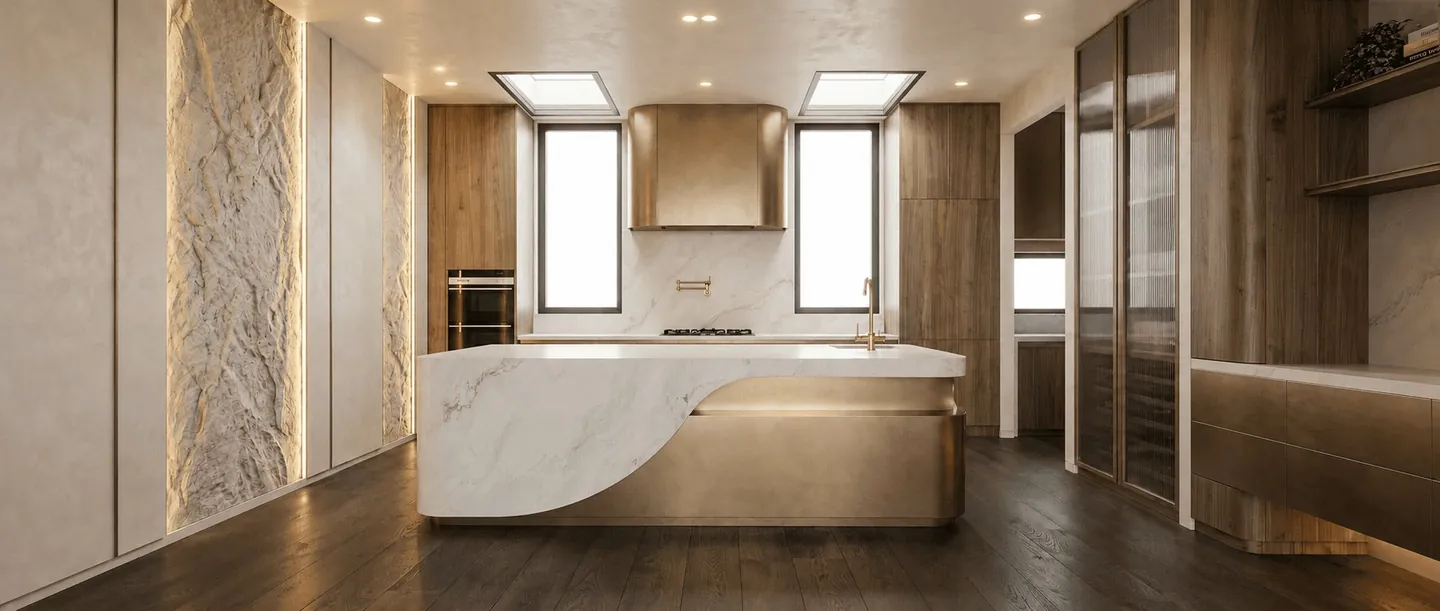
Snug Nest Designs is a Melbourne interior design studio for custom and boutique homes. The work runs from the first floor plan to the final piece of furniture: layouts, finishes, joinery and lighting, with materials and custom pieces sourced from international makers. Its clients are people planning or building a home, and the first step is a conversation with the design team.
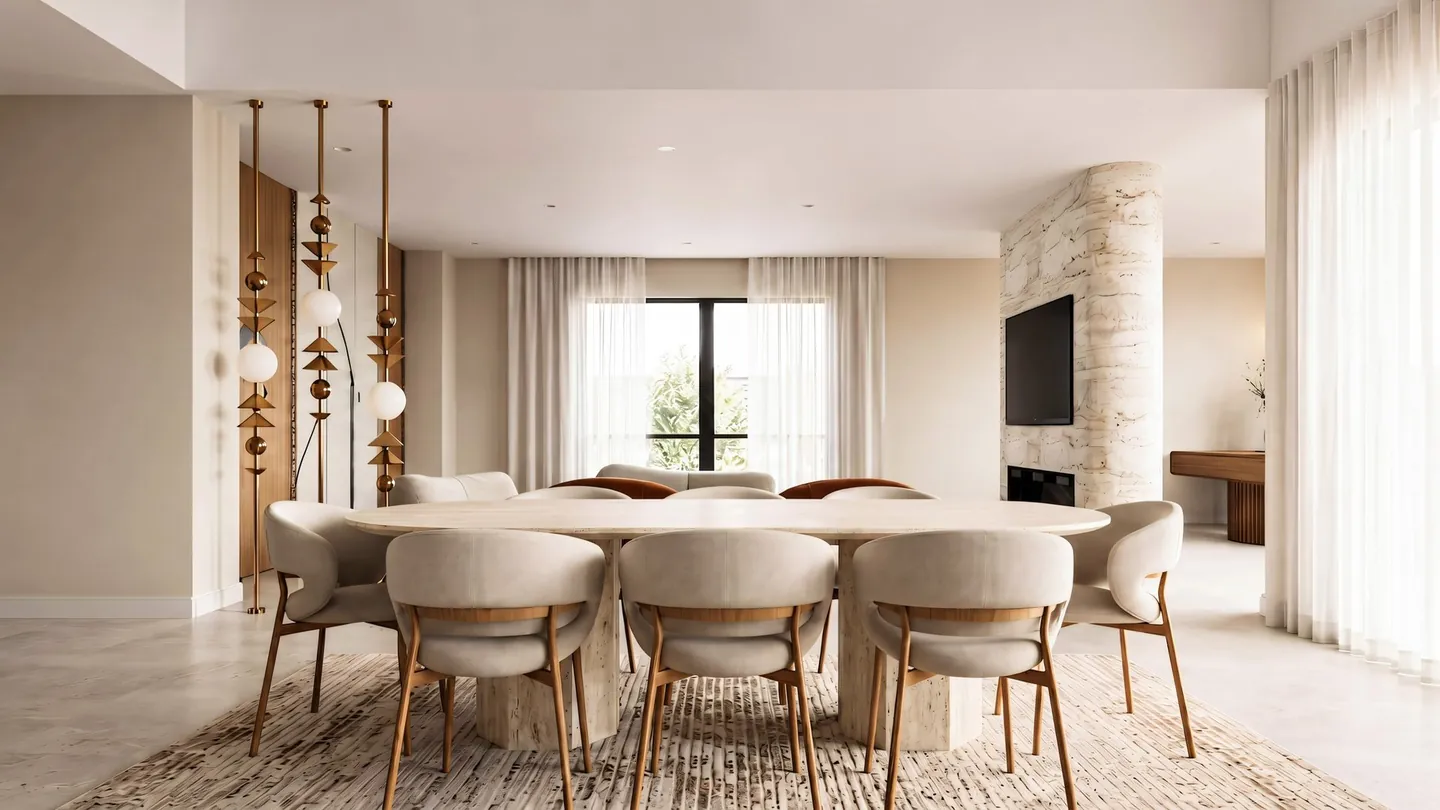
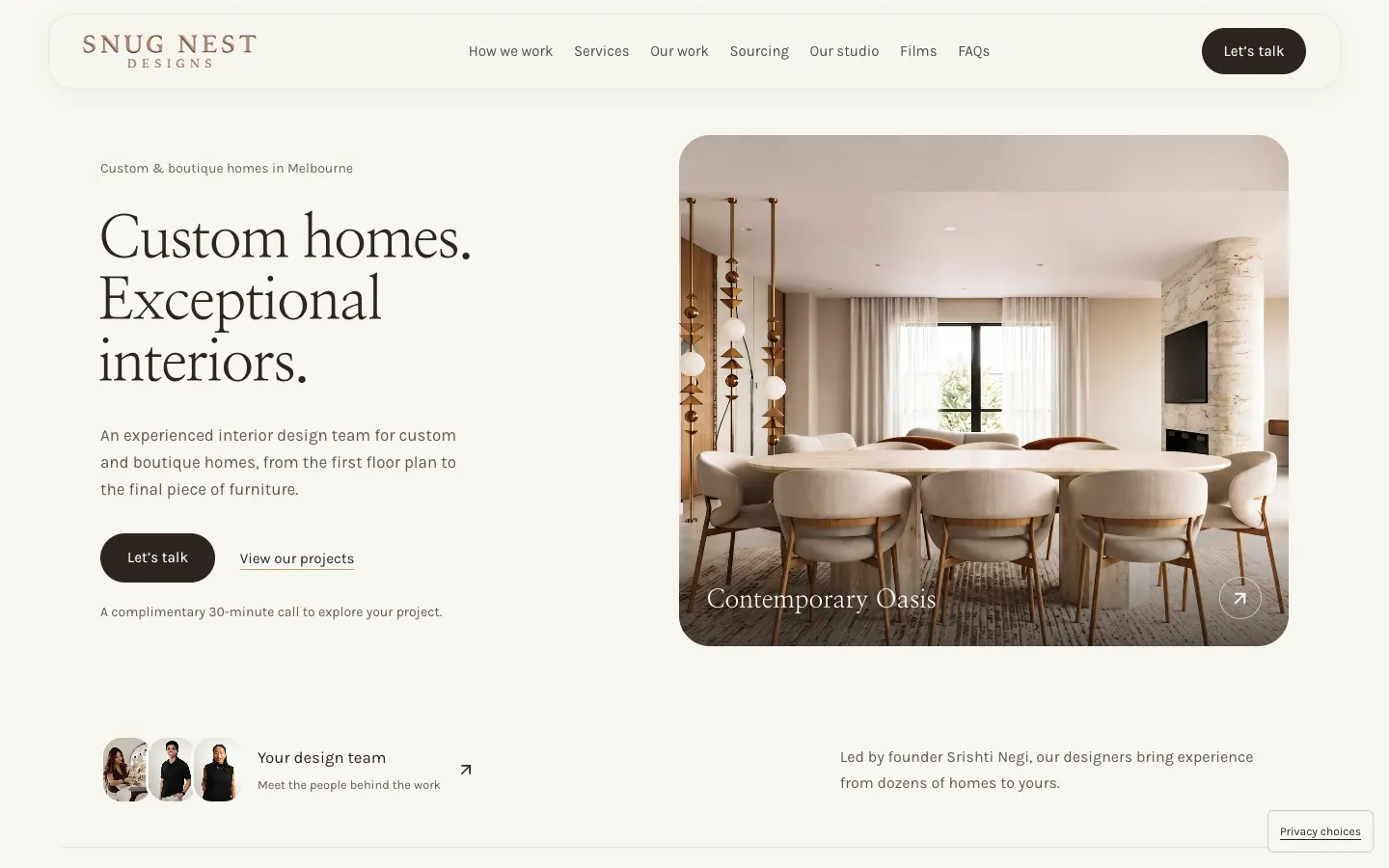
Contemporary Oasis, a design visualisation. The studio's work is visual, which is why the ads are films.
That makes Facebook and Instagram a natural place to advertise. The homes photograph and film well, and a custom home is a long decision, so the ads have to earn attention well before anyone is ready to talk.
Where the account started
The ad account had run lead campaigns before. The earliest collected details on Meta's own in-app lead forms. Two later campaigns offered a design consultation, sent people to the studio's pages and counted a website lead there. Those two are the fair comparison for the rebuilt campaign, because they were told to find the same website lead.
They brought in leads. The question for the rebuild was whether better films, organised better and aimed at the right part of Melbourne, could win more of the clicks. Video was already doing nearly all the work: across their whole run, ads built on video brought in 91% of their website leads from 89% of the impressions.
What we built
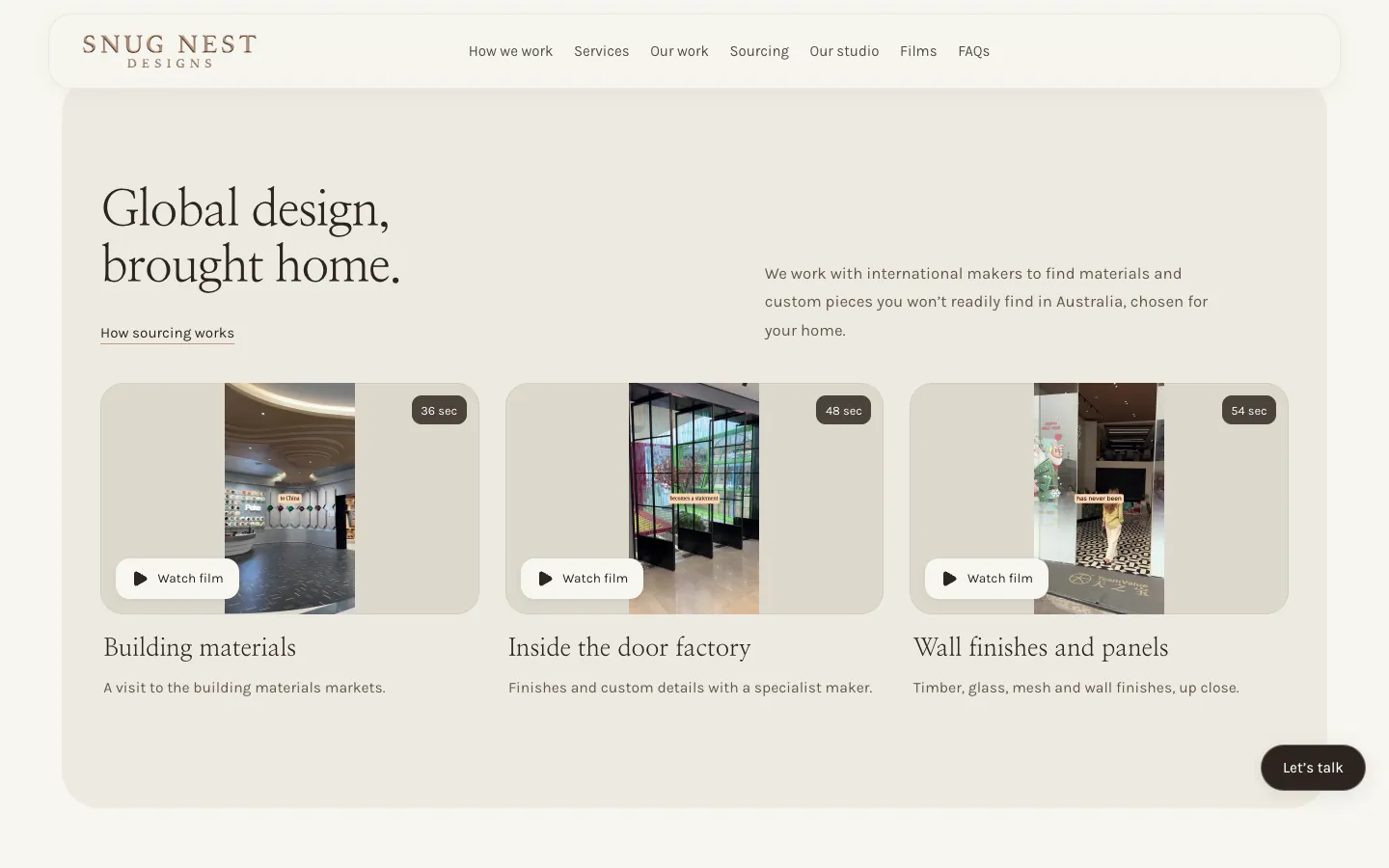
We rebuilt the campaign around video. It opened with the films that had already brought in leads, then grouped the rest by theme: designing a new build, client stories and transformations, pieces on show, and sourcing trips through the building materials markets. Every ad was a film.
The audience is people who live in, or have recently been in, the area within about 44 kilometres of Melbourne, where the studio works. New films and new sets were added during the run, including first-look sets for people new to the studio and sets that bring back people who had already watched the films or visited the studio's pages.
Sourcing films on the landing page. The ads draw on the same material: the homes, the studio at work and the trips to source pieces.
What happened
Over its full run, the rebuilt campaign brought in website leads at a cost 25% below the earlier website lead campaigns. The start was stronger still: in its first 60 days, cost per lead was 38% below those campaigns' last 60 days before the rebuild.
The link click-through rate was 26% higher than before. The share of link clicks that turned into a lead did not move: about 1 in 25, the same as the earlier campaigns. Almost every lead came from a mobile device: 99% of website leads, as Meta reports them, the same as in the earlier campaigns. That is why the page after the click has to work on a phone.
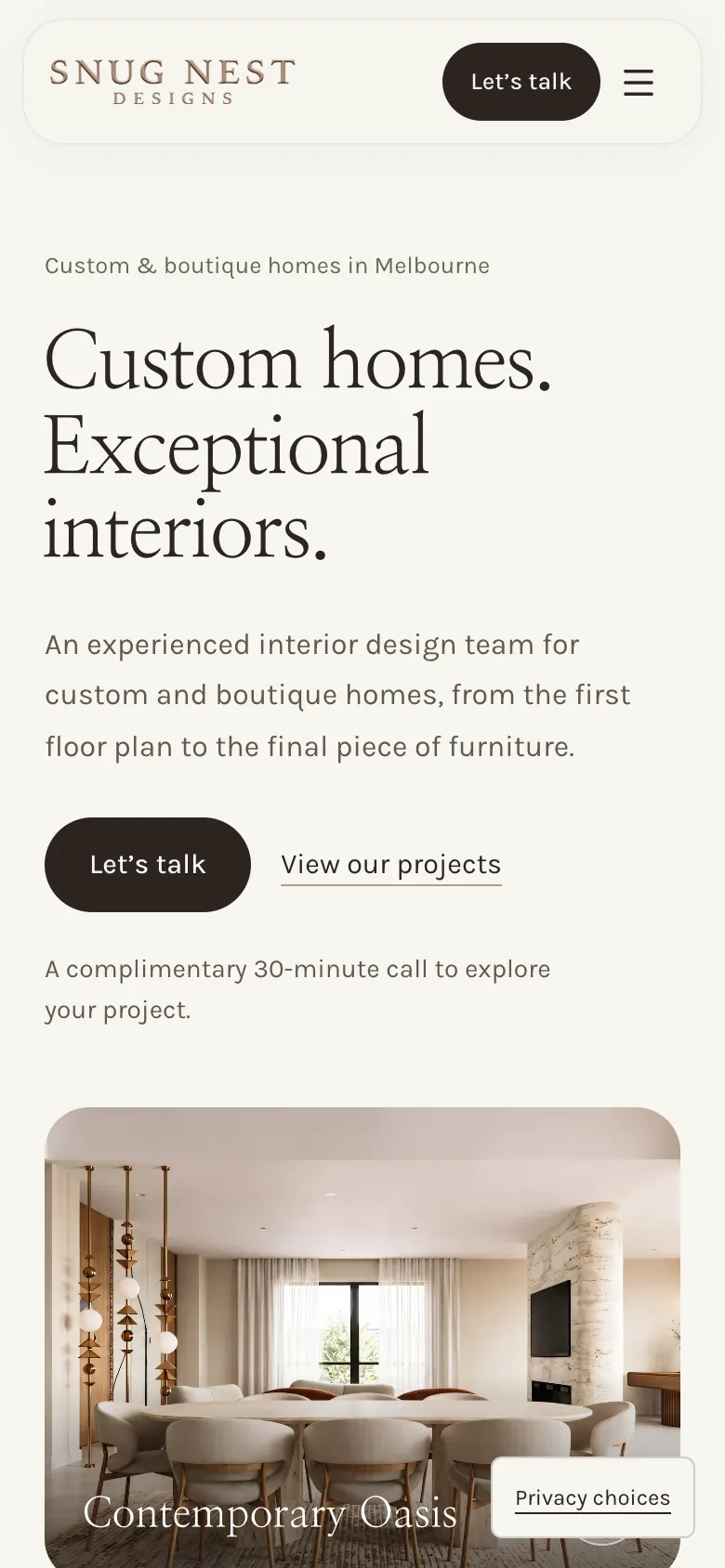
The landing page on a phone, where every active ad now sends people. In the rebuilt campaign, nearly every website lead came from someone on a mobile device.
What the numbers taught us
The films did the persuading
The saving came from the ads earning the click, not from the page converting better. That is useful to know. It suggests the films were working, and that the next gain sits after the click: in what the visitor sees, and in what the campaign is asked to find.
Films wear out in a fixed audience
A studio that works in one city shows its ads to the same people again and again. Over the run, the average person reached saw the ads about five times. Link click-through in the last 30 days was 36% below the first 30, and cost per lead in the second half of the run was nearly double the first half, even with new films added along the way. That took it back to slightly above the earlier campaigns' level, so the full-run saving was won in the first months. A campaign like this needs fresh films on a schedule, and a clear view of when the old ones have run their course.
Facebook turned clicks into leads
Instagram carried about a third of the impressions but under a quarter of the website leads. Facebook brought in close to three in four of them, and turned link clicks into leads 1.5 times as often as Instagram. The earlier campaigns leaned the same way. Both placements stay on, but each is judged on what it brings in.
The next version: booked calls
A website lead is a step toward a project, not a project. What the studio wants is a conversation with a homeowner who is ready to talk. So the booked-call version keeps the films and the Melbourne audience, and changes three things.
First, every active ad now sends people to one landing page, book.snugnestdesigns.com. The page walks visitors through the studio's homes, offers advice for each stage of a build and ends in a booking window for a complimentary 30-minute call. Second, the campaign is judged on a completed booking on that page, tracked as its own result, rather than on a website lead.
Third, the sets now follow people through the booking page itself. First-look films reach people who have not yet engaged with the studio. Follow-up films reach people who have visited the booking page or watched at least half of a build film. Final-step films reach people who started a booking in the last two weeks and did not finish it. Anyone who has already booked a call is left out for six months, so the films go to people who still need them.
The booking window on book.snugnestdesigns.com. A completed booking here is the result the booked-call campaign is judged on.
When these figures were taken, the booked-call campaign had run for under two weeks, with too few bookings yet to publish a rate. We will add it here once it rests on enough bookings to mean something. The page itself is covered in the Snug Nest Designs landing page case study.
How we measured it
Every figure is a ratio or a change, taken from the ad account's own reporting. Cost per lead compares ad cost per website lead between campaigns that were told to find the same website lead; no amounts are published. Link click-through rate is link clicks divided by impressions. The earlier campaigns are measured over the seven or so months before the rebuild began, and the rebuilt campaign over its full run of about four and a half months. Each change is rounded toward the smaller figure. Lead-form campaigns are left out of the comparison because a form filled inside the app is a different step from a visit and an enquiry on the studio's own page, and so is a short furniture-package test with a different offer.
For an interior or custom-home business that wants the same approach, see how we run Facebook ads and Instagram ads.
Key campaign decisions+
Over its full run, the rebuilt campaign brought in website leads at a 25% lower cost than the earlier website lead campaigns, and 38% lower in its first 60 days.
The gain came from the films earning more clicks: link click-through was 26% higher, while about 1 in 25 clicks became a lead, as before.
In a fixed Melbourne audience the films wore out, with link click-through 36% lower in the last 30 days than the first 30, and cost per lead back to slightly above the earlier campaigns' level by the second half.
Facebook turned link clicks into leads 1.5 times as often as Instagram, and 99% of leads came from someone on a mobile device.
Every active ad now runs to book.snugnestdesigns.com, and the campaign is judged on booked calls rather than website leads.
Tags
Facebook and Instagram ads
Interior design
Melbourne, VIC
That is one account. Yours is a different one.
We read your ads, your search presence and your tracking the same way this one was read, and tell you what we would change first.
The definitions behind the campaign results, from enquiries and conversion rates to advertising spend.
Conversion
An action recorded under the account’s conversion setup, such as a tracked call, form submission, booking or purchase. Platform call/form enquiries are described separately in the study; repeat calls can be separate events, so enquiries are not necessarily unique people.
Cost per job · cost per lead
Advertising spend divided by the relevant recorded enquiry or job count. The study identifies the denominator. Enquiry cost is considered alongside lead quality and job value.
Conversion rate
The share of people who clicked the ad and then did the thing. A high click count with a low conversion rate usually means the ad and the page are promising different things.
Ad spend
Money spent on the advertising platform. The enquiry costs and revenue-to-ad-spend figures here exclude agency fees and the cost of delivering the client’s service.
The measurement window
The period covered by the result, with spend and outcomes drawn from the same reporting window.
A starting point
Starting values appear beside the resulting figure when the account history is available.
Qualified lead
An enquiry that matched the service and the service area, so it was worth someone picking up the phone for. Where a study says qualified, somebody checked.
An anonymised client
A project published without the client’s name. The page identifies its sector and explains the scope of the work.
Put your own numbers to work: work out your own cost per lead, with your own click price and close rate. It takes about a minute and asks for nothing.
— 06 · The rules behind it
How we run accounts
The two numbers behind this result.
Every account we run follows the same written rules, published on the SoudCoh Compound page. This result rests on two of them: deciding what counts as a real enquiry, and starting each account with what the others learned.
We agree which calls, forms, bookings or sales count as a result, and a real test enquiry goes through every tracking path before the campaign goes live.
The number it moves: Waste blocked before the first click
Every change on an account like this one is written to that client's change history, and what it teaches, never the client's numbers, goes into the next account's starting point.
Start with your goals and current setup. We review the opportunity, agree the work and plan the next stage with you.
The call
Thirty to forty-five minutes, free
What you sell, who buys it, and what one customer is worth to you. No deck. You leave with a real number for your situation rather than a range.
Week 0
The audit
We open your account — or your competitors' ground, if you do not have one yet — and write down every leak we can find. That list is yours whether or not you work with us.
Week 1
The build
Everything the account needs before it can spend a dollar: what it will bid on, what it must never pay for, the ad copy, the assets, the landing pages and the tracking. It waits in our approval queue, and a real test enquiry goes through every tracking path before anything is live.
Day one
You press go
Campaigns are created paused, every time, so you can read the whole build first. You activate when you are ready, not when we are.
Days 1–14
The clean
The busiest fortnight your account will ever have. Search terms read daily, waste negated, early winners promoted, ad copy iterated against what is actually being served.
From there
Rhythm
Weekly optimisation, reporting on a fixed cadence whether the news is good or bad, and a proper conversation each quarter about where the next block of budget should go.
Before you ask us anything
Here is what everybody asks first.
FAQ
The questions this raises.
How the results were measured and how the approach could apply to your business.
We divided ad cost by website leads for the rebuilt campaign over its full run, and did the same for the account's earlier website lead campaigns over the months before the rebuild began. The rebuilt campaign's figure was 25% lower, rounded toward the smaller change. Both sets of campaigns were told to find the same website lead, so the comparison is like for like.
Why leave the lead-form campaigns out of the comparison?
Meta's in-app lead forms collect details without the person leaving Facebook or Instagram. That is a different, lighter step from visiting the studio's page and enquiring there, so comparing the two would flatter whichever counts the easier step. The largest of those campaigns did come in at a lower cost per lead than either set of website lead campaigns, as the lighter step would lead you to expect.
Why did cost per lead rise later in the run?
The campaign shows its films to people in and around Melbourne, so the same people see them again and again. Over the run, link click-through in the last 30 days was 36% below the first 30, and cost per lead in the second half was nearly double the first half, back to slightly above the earlier campaigns' level. The answer is fresh films and sets matched to how far each person has come, which is why new ones were added during the run and the booked-call version leaves out anyone who has already booked.
Why move from website leads to booked calls?
Because the rebuild improved the click, not what happened after it: about 1 in 25 link clicks became a lead before and after. A booked call is closer to what the studio actually wants, so the next version sends every ad to book.snugnestdesigns.com and is judged on completed bookings.
What do the results in this Snug Nest Designs case study measure?
Campaign results describe the enquiries or job outcomes reported for the client. Each figure identifies what it measures.
Which records support these results?
Result basis: Rebuilt Meta campaign, full run. The labels distinguish advertising conversions, call/form enquiries and won-job revenue. Enquiry events can include repeat calls; booked jobs are reported separately.
Would this work for my business?
We assess your service area, competition, margins and customer value, then build a plan around the opportunities in your business. The first call establishes the priorities, budget and tracking for that work.
Why does this study show a result but not a starting point?
Where a comparable earlier result is available, the study shows both values. New accounts report their launch result, with the tracking basis explained alongside it.
— 09 · Read next
There are dozens more of these.
Every study we have published sits in the library, filterable by industry and by the work involved.