

You signed up for HubSpot because Google said it was the best small business CRM — six months later you're paying for three tools that don't talk to each other. For a plumber, physio, or bookkeeper under $5M, the CRM decision isn't about features: it's about which platform your one-person ops team will actually use at 9pm after a full day on the tools. This article breaks down the real AUD cost comparison, shows you the automation each platform can run tonight, and tells you exactly when to switch — and what you'll lose if you do it mid-quarter.
The hidden third-tool problem is why your HubSpot pipeline went stale
HubSpot Starter looks cheap in AUD. At roughly $27 per seat per month, it's easy to justify. The problem shows up about three weeks after signup when you realise the thing you actually needed — SMS follow-up — isn't included. It requires a third-party integration, either MessageBird or Twilio, billed separately, configured separately, and maintained separately from your CRM.

The SMS gap that HubSpot Starter doesn't advertise
Per HubSpot's public pricing page (hubspot.com/pricing), SMS capability in the Australian market is not bundled into the Starter CRM Suite. You connect a Twilio or MessageBird account, pay their per-message rates on top of your HubSpot subscription, and hope the integration behaves when you're updating contact records at 9pm. Most small operators set this up once, hit one configuration problem, and quietly stop using it.
That's not a technology failure. It's a design mismatch. HubSpot was built for inbound marketing teams with dedicated ops staff. A one-person trades business doesn't have that person.
Review requests are also missing — and that's where the third tool enters
HubSpot Starter has no native review request automation. So most trades businesses doing their homework bolt on Podium or NiceJob. Podium starts at around $89 AUD per month for basic plans. NiceJob sits at a similar price point. Add your Twilio SMS costs and your HubSpot seat, and you're looking at $250–$400 AUD per month before you've closed a single job through the system.
| Tool | Purpose | Approx. AUD/month |
|---|---|---|
| HubSpot Starter (2 seats) | CRM, pipeline, email | $54–$80 |
| Twilio (via HubSpot integration) | 2-way SMS | $40–$80 |
| Podium or NiceJob | Review request automation | $89–$150 |
| Total | $183–$310+ |
Three tools, three logins, zero handoffs at 9pm
Three platforms that weren't built to share data create manual handoff points. When a lead comes in at 6pm on a Wednesday and you're packing up the van, nobody is logging into HubSpot to trigger a Twilio SMS and then opening Podium to queue a review request. The lead sits. By Friday it's cold. By November it's still in your pipeline with a "follow up" tag that means nothing.
"A CRM your one-person ops team won't use at 9pm isn't a CRM — it's an expensive contact list."
This is the real reason CRM for trades businesses fails — not the platform, but the tool count. Every additional login is a point of friction that compounds after hours.
What you actually get for $97 USD versus $27 AUD per seat — the real cost comparison
The headline numbers mislead. $27 AUD sounds cheaper than $97 USD. It isn't, once you stack the tools that make each platform functional for a service business.
GoHighLevel's flat-rate model explained plainly
GoHighLevel's Starter plan is priced at $97 USD per month (approximately $150 AUD at current exchange rates as of Q4 2024, per GoHighLevel's public pricing page at gohighlevel.com/pricing). That single fee includes: CRM with unlimited contacts, 2-way SMS via a built-in Twilio layer, email marketing, pipeline management, and review request automation. No per-seat pricing. No separate SMS bill. No review platform subscription.
One login. One bill. One support channel when something breaks at 9pm.
The real HubSpot cost for a two-person operation
A plumbing business with two staff — one owner, one admin — paying for HubSpot Sales Hub Starter and Marketing Hub Starter at $27 AUD per seat each, adding a Twilio integration for SMS, and running NiceJob for review requests is paying somewhere between $280 and $420 AUD per month. That's two to three times the GoHighLevel cost, for more complexity and more failure points.
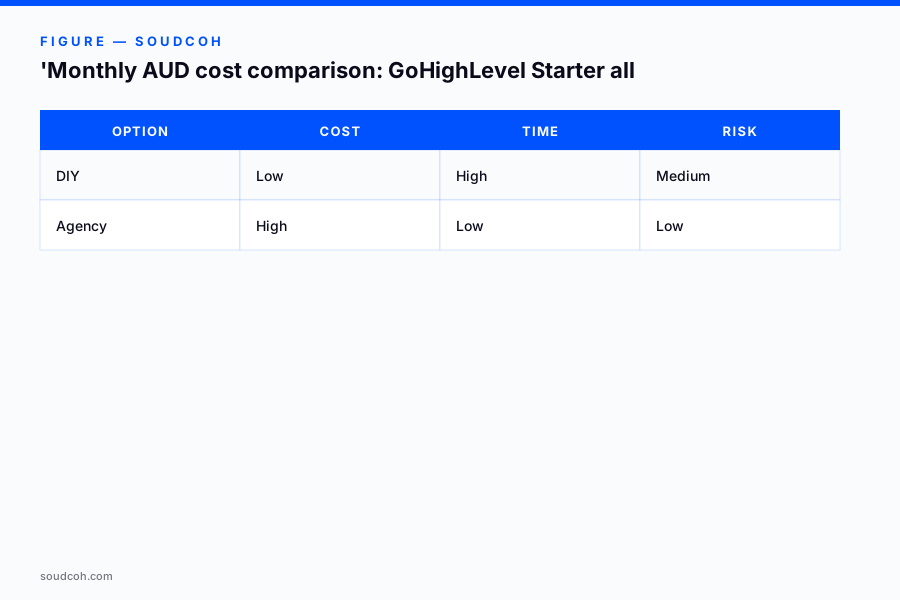
| Platform | What's included at base price | Approx. AUD/month (functional setup) |
|---|---|---|
| GoHighLevel Starter | CRM, SMS, email, pipeline, review requests, landing pages | ~$150 |
| HubSpot Starter (functional) | CRM + email (native), SMS and reviews via add-ons | $280–$420 |
The 500-contact threshold where the calculation flips
Below 500 active contacts, GoHighLevel wins on cost every time. Above 500 contacts — particularly when you're running Google Ads with conversion tracking needs, generating inbound content leads, or have hired a dedicated ops person — HubSpot's reporting depth and 1,500-plus native integrations start to justify the premium. The question isn't which CRM is better. It's which CRM is better for your contact volume right now.
"The real GoHighLevel vs HubSpot comparison isn't features — it's $150/mo all-in versus $400/mo and three logins."
A GoHighLevel pipeline for a trade job looks nothing like a SaaS sales funnel — and that's the point
Most CRM tutorials are written for software companies selling annual contracts to procurement managers. A plumbing business, a physio clinic, or a bookkeeping practice has a different job to do. The pipeline needs to reflect how that job actually moves — not how a Silicon Valley sales team closes deals.
The six-stage trade pipeline that runs itself
A GoHighLevel pipeline built specifically for a trades or service business runs like this:
- New Enquiry — lead captured via website form or phone call logged manually
- Quote Sent — pipeline card moved, triggers a confirmation SMS to the customer automatically
- Follow-Up SMS — automated, fires 24 hours after Quote Sent stage if no reply received
- Job Booked — customer confirms, calendar invite sent via GoHighLevel's booking tool
- Invoice Sent — moved manually or triggered via Xero webhook, sends a payment reminder SMS at 48 hours if unpaid
- Review Requested — fires automatically 24 hours after invoice is marked paid, sends Google review link via SMS
Six stages. Zero manual triggers after the initial setup. The owner moves a card; the automations do the rest.
Why the SMS reply landing in the same thread matters for on-site operators
GoHighLevel's SMS automation fires through its native Twilio layer from a local Australian mobile number. When the customer replies — "Yes, Tuesday works" — that reply lands back in the GoHighLevel unified inbox, attached to the contact record. The owner checks one app on their phone while in the van. No switching between a CRM and a separate SMS thread. No losing context.
For a trade business where the owner is on a roof or under a sink from 7am to 5pm, this matters more than any reporting dashboard.
How long setup actually takes
Configuring this pipeline from a blank GoHighLevel account — building the six stages, writing the SMS templates, connecting the trigger automations — takes under two hours for someone who has done it once before. The equivalent HubSpot Starter setup requires: connecting a Twilio account, building a sequence in HubSpot's workflow builder (which is powerful but not simple), configuring a separate review platform, and linking them with enough logic that they don't fire out of order. Most small operators start that build, hit the Twilio API setup screen, and stop.
Per Capterra's 2024 aggregated review data, GoHighLevel scores higher than HubSpot among trades verticals on 'ease of automation setup' — this is the reason why.
The real GoHighLevel vs HubSpot comparison isn't features — it's $150/mo all-in versus $400/mo and three logins.
HubSpot Starter does win — for exactly one type of Australian service business
This article isn't anti-HubSpot. HubSpot is genuinely excellent software. It's just excellent for a different business than the one most people reading this are running right now.
The business profile where HubSpot earns its cost
HubSpot Starter justifies its full cost stack — including SMS integrations and review tools — when your business meets all three of these criteria:
- You generate inbound leads from content, SEO, or paid ads with dedicated landing pages
- You are running Google Ads or Meta Ads and need conversion tracking tied to contact records
- You have one person whose primary job is CRM and ops management — not a founder splitting time between the tools and the admin
If you hit all three, HubSpot's ad attribution, reporting depth, and landing page A/B testing tools are worth the friction. If you hit one or two, you're paying for a platform you'll grow into — while your current leads go cold.
Professional services firms that outgrow GoHighLevel's reporting
Accountants, bookkeepers, and financial planners tend to need something GoHighLevel doesn't do well: deep contact history, document tracking on deals, and audit-ready records of who said what and when. These businesses often outgrow GoHighLevel's relatively simple reporting within 18 months of serious growth. For them, HubSpot's deal timeline, note history, and document tracking justify the cost — particularly once they're running a team of three or more.
The Xero and MYOB integration question
HubSpot's integration ecosystem includes native connections to Xero, MYOB, and Google Ads — three platforms that most sub-$5M Australian service businesses are already running. According to HubSpot's App Marketplace (marketplace.hubspot.com), there are over 1,500 native integrations available. GoHighLevel's native integration list is significantly shorter; it covers the marketing and communications stack well but leans on Zapier for accounting software connections, which adds both cost and a failure point.
If your business already runs Xero and needs CRM data to flow into it without a Zapier layer, HubSpot is a cleaner solution. For everything else under 500 contacts, GoHighLevel is the more survivable choice — especially for a CRM for trades or clinic operators doing ops solo.
The Spam Act 2003 trap that Australian GoHighLevel users keep falling into
Here's the compliance issue nobody in the GoHighLevel reseller community talks about loudly enough. Australia's Spam Act 2003 (Cth) requires express or inferred consent before sending any commercial electronic message — including CRM-triggered SMS. GoHighLevel's default automation templates were not designed with Australian compliance in mind, and many resellers deploy them without a compliant opt-in step at the lead capture form.
What the ACMA can actually fine you
The Australian Communications and Media Authority (ACMA) can issue infringement notices for Spam Act breaches. For serious or repeated contraventions, civil penalties can reach $222,000 AUD per day under the current penalty unit framework. The cost saving of GoHighLevel over HubSpot — roughly $200 AUD per month — disappears entirely after a single compliance notice, let alone repeated breaches.
This is not a theoretical risk. The ACMA's 2023 enforcement actions included infringement notices issued to businesses operating automated SMS sequences without documented consent records.
The fix — and how long it actually takes
The compliance fix is straightforward. Here is exactly what to do:
- Open your GoHighLevel lead capture form (Forms → Edit)
- Add a checkbox field with the label: I agree to receive SMS updates about my enquiry from [Your Business Name]
- Create a custom field in GoHighLevel called
sms_consentand map the checkbox to it - In your SMS automation trigger, add a filter condition:
sms_consent = true— the automation will not fire unless the contact has ticked the box - Save. Test with a real submission. Confirm the SMS fires only when the checkbox is ticked.
This takes under 20 minutes. It must be done before your first automated SMS goes live — not retrofitted after a complaint is received. If you are working with a GoHighLevel reseller or agency and they have not shown you this step during onboarding, ask for it in writing before you go live.
Note: "inferred consent" under the Spam Act 2003 (Cth) applies in limited circumstances — for example, where a business card is exchanged in a clear commercial context. For web-form leads, express consent via a checkbox is the safest and most defensible approach. This is not legal advice; consult a qualified Australian legal practitioner for your specific setup.
How to decide in under five minutes: a contact-volume and team-size decision tree
You don't need a 90-minute discovery call to work out which CRM fits your business. Answer three questions honestly.
The three questions
- How many active contacts do you have? Active means leads, current clients, and past clients you want to re-engage — not your whole mailing list.
- Who manages your CRM day-to-day? Is it you, split with actual work? A part-time admin? A dedicated ops hire?
- Are you running paid ads with landing pages right now? Not planning to — running them today with a budget and a tracking setup.
Under 500 contacts, part-time ops: GoHighLevel wins
If you have fewer than 500 contacts, one person managing ops part-time (including yourself), and you are not yet running paid ads with conversion-tracked landing pages — GoHighLevel is the right choice. The cost is lower, the automation is more survivable with less technical overhead, and you will actually use it at 9pm. This covers most trades businesses, most solo clinicians, and most sub-$1M professional services operators in Australia.
500-plus contacts, dedicated admin, active ads: HubSpot earns its place
If you have 500 or more active contacts, a dedicated admin or ops hire, active Google Ads campaigns with conversion tracking requirements, or a Xero or MYOB integration that needs to be native rather than Zapier-mediated — HubSpot Starter is worth the extra cost and setup friction. The reporting, the attribution, and the integration ecosystem justify the premium once your operation can support them.
The edge case: $1M–$3M trades with growth ambitions
A trades business at $1M–$3M revenue with 300–600 contacts and plans to hire a second tech or a virtual assistant sits in genuinely ambiguous territory. The recommendation here is: start with GoHighLevel, build clean pipeline habits, document your job stages, and run it for 12 months. Migrate to HubSpot only when your reporting needs — multi-channel attribution, team performance dashboards, Xero deal sync — outgrow what GoHighLevel's native dashboards can show. Migrating too early, before pipeline habits are formed, means you rebuild the same mess on a more expensive platform.
See our case studies for examples of how this transition has played out for Australian service businesses we've worked with.
A CRM your one-person ops team won't use at 9pm isn't a CRM — it's an expensive contact list.
Migration mid-quarter will cost you more than the wrong CRM choice did
The most expensive CRM decision isn't choosing the wrong platform. It's switching platforms at the wrong time. Mid-quarter migrations in service businesses don't just disrupt ops — they destroy pipeline momentum at the exact moment follow-up frequency matters most.
Why October–December is the worst window to switch
For most Australian trades and service businesses, October through December is peak quoting season. Renovation projects, end-of-year compliance work, physio and allied health catching up before Christmas — contact volume is highest, follow-up cadence is most critical, and your ops team has the least capacity for a platform rebuild. Switching CRMs in this window means rebuilding automations, re-importing contacts, and losing pipeline visibility during the period when a missed follow-up has the highest dollar cost.
What you lose in a GoHighLevel-to-HubSpot migration
A GoHighLevel-to-HubSpot migration is not a clean export-and-import. The contact records transfer. The SMS conversation history does not. HubSpot Starter has no native SMS inbox — every thread from GoHighLevel becomes a gap in the contact record. For a trade business where a customer disputes a quote or asks about warranty terms, that conversation history is your evidence. Losing it mid-migration is a genuine operational and legal risk, not just an inconvenience.
Specific data lost in a standard migration:
- All SMS conversation threads (GoHighLevel unified inbox has no HubSpot equivalent at Starter tier)
- Automation trigger history — you won't know which contacts have already received which messages
- Review request send history — risk of sending duplicate review requests to the same customers
The lowest-risk migration window: February to March
The optimal window for an Australian service business to migrate CRMs is February to March. Post-summer slowdown means lower contact volume and fewer active pipeline deals at risk. It's before the new financial year planning cycle (which typically starts April–May). And it gives you enough runway to rebuild automations and test them before EOFY quote volume hits in May and June, which is the second peak period for most trades and professional services businesses.
If you're considering a migration, mark your calendar for the first week of February as the earliest viable start date — not tomorrow.
What SoudCoh does differently when we set up CRM for Australian service businesses
Most CRM setup services configure the software. SoudCoh configures the software around the actual job flow — quote, book, invoice, review — and the actual team size, which for most of our clients is one person doing three jobs.
Spam Act compliance is built in at setup, not retrofitted after complaints
Every GoHighLevel pipeline SoudCoh builds includes a Spam Act 2003-compliant opt-in step at the lead capture form before any SMS automation goes live. The sms_consent custom field is mapped at onboarding, the automation gate is tested with a real submission, and the client gets a written record of the consent configuration. This is standard, not optional — because a $222,000/day ACMA fine erases every dollar of cost saving from choosing GoHighLevel over HubSpot.
We audit before we recommend a migration
For clients already on HubSpot, SoudCoh audits the actual monthly cost stack — CRM seat costs, SMS integration fees, review platform subscriptions, Zapier usage — before recommending any migration. If the combined spend hasn't crossed the GoHighLevel break-even threshold, we say so. Switching for the wrong reason wastes a quarter of pipeline momentum and typically costs more in rebuilt automations than a year of HubSpot fees. We've seen it enough times to know that the recommendation to switch should never come from a CRM preference — it should come from a cost calculation on a spreadsheet. You can explore our approach across our web design, SEO, and about pages to understand how we frame the whole digital stack, not just the CRM decision.
Every setup includes a 90-day automation that runs without daily input
SoudCoh delivers every CRM setup — GoHighLevel or HubSpot — with a 90-day follow-up automation sequence already built and tested. That means the day after handover, the system is sending quote follow-ups, booking confirmations, payment reminders, and review requests without the owner logging in to trigger anything. We build for the 9pm operator: the person who has been on the tools all day, has 20 minutes before bed, and needs the CRM to have already done the work.
If you want to see what that looks like for a business like yours, the clearest evidence is in our case studies — real pipelines, real automation sequences, real AUD cost stacks before and after.
What to do next: If you've read this far, you already know which platform is probably right for your business — but the real question is what your current cost stack actually adds up to and whether your automation is Spam Act-compliant before you scale it. Book a free 20-minute CRM audit with a SoudCoh strategist — we'll tell you exactly whether GoHighLevel or HubSpot fits your current contact volume, show you the real AUD cost stack, and map out a migration plan if you need one.
Questions and answers
Should we move systems before fixing the process?
Clarify the process first where possible. Otherwise a migration can transfer unclear statuses and ownership into a different interface without resolving them.
Who should attend a selection demonstration?
Include a daily user, the process owner and the person responsible for administration and records. They will notice different requirements and ongoing costs.