
    Proof
    Aussie Plumbing — ad spend scaled 1.8× with enquiries up 2.1×, so each enquiry cost lessI-ELEC — a 231-page electrician website for Inner SydneyWhat a plumbing lead costs on Google AdsWhat a lead costs on Google Ads, industry by industrySLS Solicitors — cost per recorded Google Ads conversion down 58.48%Wilco Plumbing — search campaigns and service pagesWilco Plumbing — service menus and guided enquiriesHow much should a trade business spend on marketing?State Choice Plumbing — a drains, hot water and gas websiteAussie Drains — a 600-page drain website for SydneyWhat an electrician lead costs on Google AdsAussie Electrical — a 650-page electrical website for SydneyThe most efficient ways for a trade business to get leadsEOL Melbourne — click-to-enquiry rate up from 28% to 33.4%What a cleaning lead costs on Google AdsAlliance Plumbing — ad spend scaled 1.8× with enquiries up 2.1×, so each enquiry cost lessImpress Blinds — cost per recorded Google Ads conversion down 62.63%FixCare Property - cost per enquiry down 28%Rubbish Removal WA — cost per enquiry down 53.18%Floral Cakery — cost per enquiry down 49.82%ILLUMINATE Laser Emporium — cost per enquiry down 48.54%Sydney Fence Painting — cost per enquiry down 33.68%Alliance Plumbing — cost per enquiry down 29.6%Gridless Build Solutions — cost per enquiry down 29.16%FacilityWorx — cost per enquiry down 23.62%Cornerstone Roofing — cost per enquiry down 20.47%Council finance — budgeting and workforce designCouncil planning — clearer approvals and reportingCultural audiences — media strategy and creative conceptsCommunity participation — surveys, maps and project pagesPublic-sector research — survey design and analysisPublic art — site studies and visual conceptsRegional identity — visitor guides and wayfinding conceptsCouncil systems — integration and migration planningA pressure washing business — service-led search campaignsA pressure washing business — a clear enquiry journeyA carpet cleaner — Google Ads built around cleaning servicesA roofing company — campaigns for repairs and restorationA CCTV installer — campaigns for security enquiriesA fence painter — search campaigns for specific surfacesA maintenance business — live in 8 weeks, 3 stacks gone5.0 across every Google review$120M+ in media under management250+ active engagements across five countries
    Small Business

    Do reviews help me show up in ChatGPT, Claude and Perplexity answers?

    Very likely, yes. No AI company publishes an exact formula, but Google says its Ask Maps feature draws on reviews from more than 500 million contributors, and AI tools read what other sites say about you. Reviews also matter after an AI names you: 97% of people read them. Aim for a steady flow of recent, detailed reviews.

    • By Vaishu, Head of SEO
    • 17 November 2026
    • 5 min read
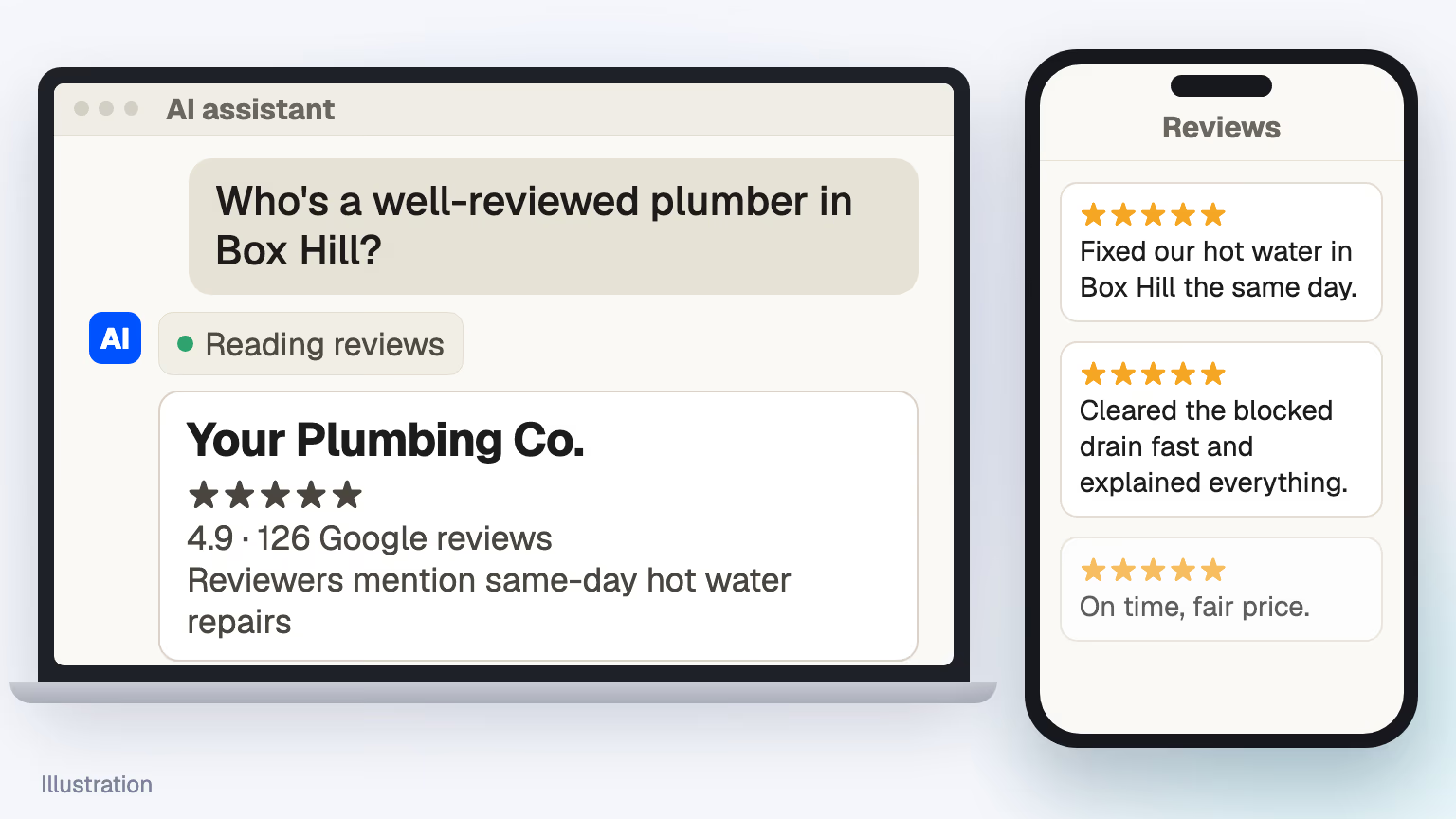
    Illustration of an AI assistant recommending a local plumber. On a laptop, someone asks who is a well-reviewed plumber in Box Hill; the assistant reads reviews and shows a 4.9-star business with 126 Google reviews, noting that reviewers mention same-day hot water repairs. On a phone, three five-star reviews describe the jobs in detail.

    Three review habits that help with AI

    Set these up once and keep them going.

    Tick a check as you review it.

    A steady flow of honest, detailed reviews beats a burst once a year.

    When someone asks ChatGPT or Claude for a good local business, do your reviews make a difference? Almost certainly, but not only in the way you'd think. Here's what the evidence says, how many reviews you need, and how to get more without breaking Google's rules.

    Do reviews help you show up in AI answers?

    Very likely, yes, though no AI company publishes an exact formula. What we do know points the same way:

    • Google's AI uses reviews directly. Google says its Ask Maps feature, now rolling out in Australia, draws on information about over 300 million places, including reviews from more than 500 million contributors.
    • AI tools read the web, and reviews are part of it. When ChatGPT, Claude or Perplexity look for a local business, they read what other sites say about it, not just your own website.
    • People check the reviews anyway. In BrightLocal's 2026 survey, 97% of consumers read reviews for local businesses, and 82% read AI-written review summaries.

    So reviews help in two ways: they're part of what AI tools read about you, and they're what a customer checks after an AI tool names you.

    What AI tools look for in your reviews

    Not just the star rating. AI tools read the words. A review that says "fixed our hot water system in Box Hill the same day" tells an AI what you do, where and how fast. A review that just says "great service" tells it very little.

    You can't ask customers for specific wording; Google's policy doesn't allow it. But you can ask at the right moment, straight after the job, when the details are fresh, so their review naturally describes the work.

    How many reviews do you need?

    Enough, and recent. In the same survey, 47% of consumers said they won't use a business with fewer than 20 reviews, and 74% look for reviews written in the last three months. A steady flow every week beats a burst once a year.

    We follow our own advice: SoudCoh has a 5.0 rating from 88 Google reviews (November 2026), built by asking every client, every time.

    AI tools read the words in your reviews, not just the stars.

    How to get more reviews the right way

    1. Ask every customer. Google's review policy doesn't allow asking only happy customers, offering incentives, discouraging negative reviews or asking for specific content.
    2. Make it one tap. Send your Google review link by text straight after the job.
    3. Reply to every review, good and bad. It shows future customers that you listen.
    4. Keep your Google Business Profile complete, with the right categories, services and areas; see Google Business Profile and local SEO.

    This is exactly what our review generation work sets up, so asking becomes routine rather than something you remember once a month.

    Reviews on other websites count too

    Google isn't the only place AI tools look. Industry directories, local news and supplier listings that mention you all add to the picture. Our guide to getting your business mentioned by ChatGPT and Claude covers where to start, and if a competitor keeps getting named instead of you, here's why ChatGPT recommends a competitor instead of you.

    Reviews work best alongside the rest of your marketing: clear service pages, a complete profile and ads for urgent jobs. That's why we plan reviews, search and ads in one plan, so each part supports your AI search visibility.

    How SoudCoh helps

    We set up a simple review routine, keep your Google Business Profile complete and check what AI tools say about you each month. If you're looking for the best marketing agency for your business, start with a free marketing audit and we'll show you how your reviews compare with the businesses AI tools are recommending.

    Common questions about reviews and AI search

    Do ChatGPT and Claude read Google reviews?

    Neither company says exactly which review sources it uses. OpenAI says ChatGPT can use trusted third-party providers for local information. Keep your reviews and business details strong on every platform your customers use.

    Can I pay for reviews or offer a discount for one?

    No. Google's policy doesn't allow incentives for reviews, and fake or paid reviews can get removed and damage trust. Ask every customer instead.

    Do I need reviews on Perplexity or ChatGPT itself?

    No, there's nowhere to leave reviews on them. They read what's already on the web, so reviews on Google and other well-known sites are what count.

    Questions and answers

    How many Google reviews does a local business need?

    BrightLocal's 2026 survey found 47% of consumers won't use a business with fewer than 20 reviews, and 74% look for reviews from the last three months.

    Can I ask customers to mention my services in their review?

    No. Google's policy doesn't allow requesting specific content. Ask straight after the job instead, so customers naturally describe the work while it's fresh.

    How do your reviews compare?

    Tell us who AI tools recommend in your area and we will show you how your reviews compare and what to do next. Start with a free marketing audit.

    Book a free marketing audit

    Sources and related projects

    1. BrightLocal, Local Consumer Review Survey 2026 (1,002 US adults): 97% read reviews for local businesses; 74% seek reviews from the last three months; 47% won't use a business with fewer than 20 reviews; 45% use AI tools for local recommendations; 82% read AI-generated review summaries: brightlocal.com/research/local-consumer-review-survey
    2. Google, "Ask Maps is coming to Europe" (16 November 2026): Ask Maps draws on information about over 300 million places, including reviews from more than 500 million contributors; Google Australia blog (7 August 2026): Ask Maps rolling out in Australia in English: blog.google
    3. Google Maps user contributed content policy: no incentives for reviews; businesses may not selectively solicit positive reviews, discourage negative reviews or request specific content: support.google.com/contributionpolicy/answer/7400114
    4. SoudCoh Google rating: 5.0 from 88 Google reviews (November 2026).
    Read next

    Filed under the same desk first. The full index is searchable and filters by reader.

    Explore the services and related work

    See how the ideas in this article connect with our services and client projects.

    • Review generation — A simple routine that asks every customer for an honest Google review.

    • Local SEO — Google Business Profile, local pages and reviews for map and AI search.

    Related client work.

    These are individual engagements where the market, system or measurement problem overlaps with the briefing. Each study names its window and the evidence available; none is a forecast for another account.