
Not-At-Fault Accident Claims Sydney: 26 Enquiries at $125.64 Each
Hybrid Autos · Not-at-fault accident management · Sydney, NSW
The short version · a 32-day period in 2026
Hybrid Autos handles not-at-fault accident claims for Sydney drivers — an urgent, expensively contested category where the first credible voice usually keeps the claim.
What follows is one measured window out of the account, reported without dates on purpose. Across a 32-day period in 2026, running one campaign, the account produced 26 enquiries at $125.64 each from 297 clicks and 9,434 impressions, 11 of them phone calls, with 8.75% of clicks converting and 29.42% impression share. The one complete month sitting inside that period ran 24 days and delivered 13 enquiries at $182.06 each. The problem solved was paying premium accident-claim click prices for searches that were never going to become a claim.
The result.
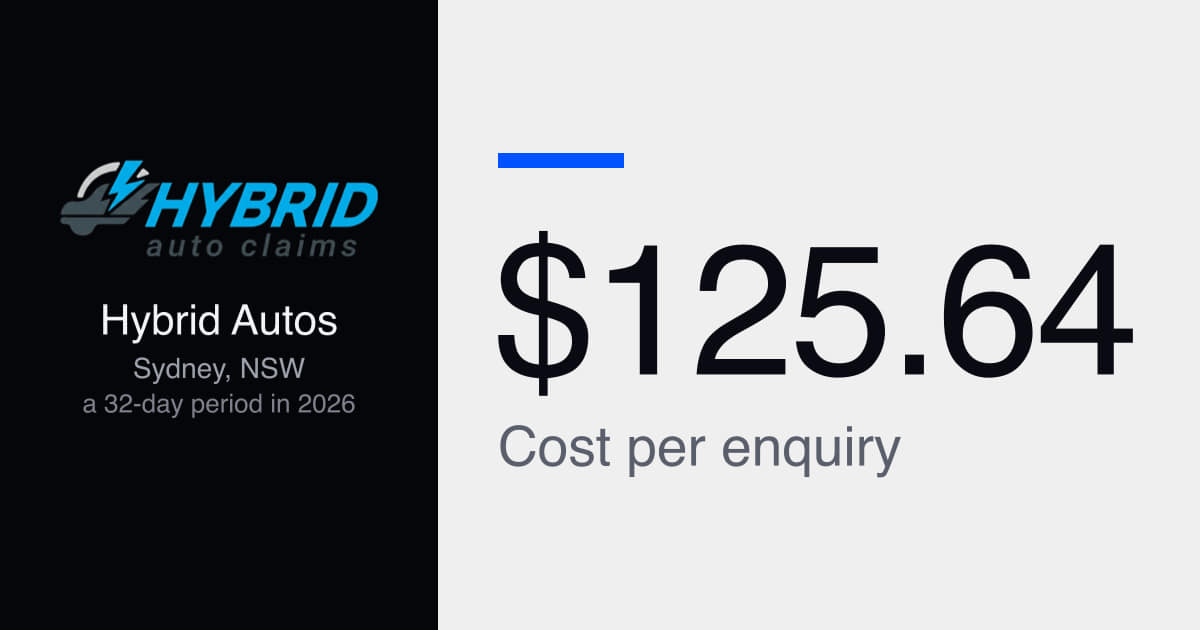
$125.64
Cost per enquiry
a 32-day period in 2026
26
Enquiries, 11 of them phone calls
a 32-day period in 2026
$182.06
Cost per enquiry, from 13 enquiries
a 24-day period in 2026
8.75%
Clicks that became an enquiry
a 32-day period in 2026
3.15%
Click-through rate from 9,434 impressions
a 32-day period in 2026
29.42%
Impression share
a 32-day period in 2026
- Industry
- Not-at-fault accident management
- Discipline
- Automotive & Transport
- Ad spend band
- $1K–$5K
- Measured over
- a 32-day period in 2026
Every figure above was read out of this client's live account and is reproduced exactly as the study publishes it. It is a record of what happened on one account, in one market, at one budget — not a forecast for yours.
What would this look like on your account?
Different market, different budget, different numbers. The first call is where we work out whether the same approach fits yours at all.
The case study
What moved for Hybrid Autos.
The short list
- 26 enquiries at $125.64 each across a 32-day period in 2026, from 297 clicks.
- 11 of the 26 arrived as phone calls — the format that matters most when the first credible voice usually keeps the claim.
- The one complete month inside that period ran at $182.06 per enquiry from 13 enquiries across 24 days. We print the dearer month too.
- Desktop converted disproportionately well in both stretches, which points to a second, calmer research moment after the roadside one.
- 29.42% impression share means most of the available Sydney demand in that window went to somebody else.
Each line above belongs to the period printed with it. None of them is an average across the account, and none of them is a forecast.
Nobody in this market is shopping around
Hybrid Autos looks after Sydney drivers on the not-at-fault side of a crash — the ones hit by somebody else, where the other driver's insurer is meant to cover the repairs, the replacement car and everything in between.
These people are not comparing providers. They are standing next to a damaged car on a Sydney road with no real idea what happens next, because most drivers do this once a decade at most.
Accident management is an odd category to advertise into, because the traditional lead flow has almost nothing to do with the driver choosing anyone. It arrives through tow-truck operators, smash repairers and referral arrangements that take years to build and can vanish when one person changes jobs. Advertising is the one channel where the driver rings because they found you, not because somebody handed them a card at the roadside.
Why the clicks are dear
Hire-car providers, claims managers, legal firms and repairers all sit in the same auction, and none of them are price-sensitive about a click, because everyone knows what a claim is worth at the other end.
Pay those prices for the wrong search and you spend the day on the phone to people who were at fault, uninsured, or simply reading up on their rights with no intention of ringing anybody.
Timing is the part outsiders underestimate. The first credible voice a driver speaks to usually keeps the claim — not the best priced, not the most decorated, the first one who sounds like they know what to do next. You are not competing for a considered decision made over a fortnight. You are competing for a twenty-minute window on the side of a road.
What we took on
One campaign, live for a 32-day period in 2026. The dates are withheld on purpose; this is one measured window out of the account and nothing about when it ran is part of the story. The brief was narrow: make sure the ad in front of somebody matched the situation they were actually in — not at fault, someone else's insurer, car off the road — rather than treating "accident" as one broad topic and hoping people sorted themselves out.
That reads as obvious. It is not what most accounts in this category do, because narrowing costs volume, and volume is what makes a report look busy.
Over those 32 days it was shown 9,434 times and clicked 297 times. Both numbers are small on purpose. How the narrowing is done stays with us, but the principle is no secret: anyone can bid harder, and almost nobody is willing to give up the volume that comes with answering searches they should not.
What came out of it
Taken whole, across all 32 days, the account produced 26 enquiries at $125.64 each, from 297 clicks and 9,434 impressions. Eleven of those 26 arrived as phone calls. 8.75% of clicks turned into an enquiry, at a 3.15% click-through rate, with the campaign holding 29.42% impression share and a top-of-page position 15.48% of the time.
Read as calendar months, only one month inside that period has a full month of trading behind it. It ran 24 days and produced 13 enquiries at $182.06 each, from 215 clicks and 7,170 impressions, with 6.05% of clicks converting and 7 of the 13 coming through as calls. The figure sits above the period average, and we are printing it as it stands rather than a good fortnight from inside it.
The other 13 enquiries came from the 9 days at the front of the period, off 82 clicks and 2,264 impressions. We will not print a cost per enquiry for that stretch. Nine days is not a month, the figure it produces flatters the account, and a part-month cost per enquiry is the oldest trick in this industry.
Half the period's enquiries came from roughly a quarter of its days — 13 of the 26, in the opening 9 days.
That volume is real. The cost figure we stand behind is the $125.64 across all 32 days.
- $125.64 per enquiry — across a 32-day period in 2026
- 26 enquiries, 11 of them phone calls — same period
- $182.06 per enquiry from 13 enquiries — the complete month inside it, 24 days
- 13 enquiries from 82 clicks in the opening 9 days
- 8.75% of clicks became an enquiry — across the period
- 3.15% click-through rate from 9,434 impressions — across the period
- 29.42% impression share, 15.48% top-of-page — across the period
Two moments, two devices
The device split says something about where these people are when they search. Across the opening 9 days, mobile served 1,974 impressions, took 68 clicks and produced 8 enquiries, while desktop served 278 impressions, took 13 clicks and produced 5. In the complete month that followed, mobile served 6,127 impressions, took 170 clicks and produced 7 enquiries; desktop served 993 impressions, took 41 clicks and produced 5; tablet added 50 impressions, 4 clicks and 1 enquiry.
Mobile does the volume, which is what you would expect from people standing beside a damaged car. Desktop punches well above its weight in both stretches, though — 13 clicks producing 5 enquiries in the opening stretch, and 41 clicks producing 5 in the month that followed.
That is the second conversation. The driver back home that evening, on a laptop, working out what their rights actually are.
What it changes for the business
Twenty-six enquiries in 32 days, eleven of them live phone calls, is a working pipeline in a corner of the market where lead flow usually depends on relationships nobody fully controls. A call in the hour after a crash is worth a good deal more than a form filled in three days later, because by day three the driver has almost always spoken to somebody else.
It also changes what the business is exposed to. When enquiries arrive through tow operators and repairers, the flow moves with somebody else's week. A channel producing 26 enquiries across a known number of days is something the business controls directly. It does not replace the relationships; it means a bad month in one need not be a bad month overall.
Then there is the number itself. Once you can see that an enquiry cost $125.64 over 32 days of trading, you are deciding how many you want next, instead of waiting to find out what the phone happens to do.
About that 29.42%
The campaign held 29.42% impression share across the period, which means roughly seven in ten relevant searches in that window happened without this business in them.
Read one way, that is a shortfall. Read properly, it is a decision: where the wrong click is expensive and the wrong enquiry costs an hour of somebody's time, choosing what to skip is most of the work. It does mean the answer to "can we have more" is not obviously no.
Questions from accident management and claims businesses
What does a not-at-fault accident claim lead cost in Sydney?
In this account, $125.64 across a 32-day period in 2026, and $182.06 in the one complete month inside it taken on its own. The spread between those two figures is the useful part. Anyone quoting one fixed price per accident claim lead in Sydney is describing an average from an account you cannot see.
Are phone calls really worth more than form enquiries here?
Generally yes, and it is a timing argument rather than a quality one. The driver who calls is deciding now; the driver who fills in a form has time to fill in three more. In this account 11 of the 26 enquiries across the period came through as calls, 7 of them in the complete month inside it.
Can advertising replace tow-truck and repairer referrals?
We would not claim that, and this account does not show it. What it shows is a second, measurable source running alongside them: 26 enquiries in 32 days at a cost the business can see. Referral relationships remain the backbone here; the difference is having something that does not depend on them.
Should impression share be higher than 29.42%?
Not automatically. Impression share measures how often you appeared, not how well you chose. Appearing for roughly three in ten relevant searches, in a category priced like this one, is a decision rather than a shortfall.
Know what an enquiry costs you
If you run an accident management, claims or hire-car business in Sydney and you cannot say what a single enquiry cost you last month, that is the gap worth closing first.
Send us the account. We will go through where the money actually went, line by line, and tell you which of it bought a phone call.
Tags
- Not-at-fault accident management
- Sydney, NSW
- $1K–$5K
That is one account. Yours is a different one.
We read your ads, your search presence and your tracking the same way this one was read, and tell you what we would change first.
What every number on this page actually means.
Marketing words get used loosely, and a loose word can make a small result look like a big one. Here is exactly what we mean by each of them.
- Conversion
- One real action by one real person: a phone call that lasted long enough to be a conversation, a submitted enquiry form, a booking, or a purchase. Not a page view and not a form that merely loaded.
- Cost per job · cost per lead
- The advertising money spent, divided by the number of those actions. It is the only figure that tells you whether the advertising is worth doing, which is why we publish it next to the count.
- Conversion rate
- The share of people who clicked the ad and then did the thing. A high click count with a low conversion rate usually means the ad and the page are promising different things.
- Ad spend
- Money that went to the advertising platform, not to us. Our management fee is separate and is never included in a cost-per-job figure, because mixing them would flatter the number.
- The measurement window
- The dates the figure covers, named every time. Where a study covers a launch, the clock starts the day campaigns went live — not the day the graph started looking good.
- A starting point
- Where a study knows what a figure was before the work began, that number is printed next to the one it became. Where the account had no history to compare against, the result is printed on its own rather than measured from a number nobody recorded.
- Qualified lead
- An enquiry that matched the service and the service area, so it was worth someone picking up the phone for. Where a study says qualified, somebody checked.
- An anonymised client
- Government, council and cultural-institution engagements are published as sector and jurisdiction only. The work and the measured outcome are described in full; the organisation is not named.
One more, because it matters most: nothing on this page is a guarantee. It is a record of what happened on one account, in one market, at one budget.
What this study cannot tell you is what the same figure looks like on your account — so what the impressions you are missing are worth, with your own click price and close rate. It takes about a minute and asks for nothing.
This page exists because of two of the six stages.
Compound is how our team works on any account — six stages every change passes through. Two of them are why there is anything honest to publish.
Meter
If it can't be measured, it doesn't get bought.
Before a dollar moves, every action worth money to the business is tracked as itself — calls, forms, bookings, purchases — with values attached. Without that stage there is no honest number to publish afterwards.
Ledger
Every change we make becomes a record you can open.
Every change lands in a dated record as it happens — what was added, what was stopped, what was rewritten and what it cost. Writing this page afterwards was reading a file, not reconstructing a memory.
What actually happens after the first call.
No mystery and no lock-in before you have seen anything. This is the sequence every account on this site went through.
- The call
Thirty to forty-five minutes, free
What you sell, who buys it, and what one customer is worth to you. No deck. You leave with a real number for your situation rather than a range.
- Week 0
The audit
We open your account — or your competitors' ground, if you do not have one yet — and write down every leak we can find. That list is yours whether or not you work with us.
- Week 1
The build
Everything the account needs before it can spend a dollar: what it will bid on, what it must never pay for, the ad copy, the assets, the landing pages and the tracking. A second person checks all of it before anything is live.
- Day one
You press go
Campaigns are created paused, every time, so you can read the whole build first. You activate when you are ready, not when we are.
- Days 1–14
The clean
The busiest fortnight your account will ever have. Search terms read daily, waste negated, early winners promoted, ad copy iterated against what is actually being served.
- From there
Rhythm
Weekly optimisation, reporting on a fixed cadence whether the news is good or bad, and a proper conversation each quarter about where the next block of budget should go.
Before you ask us anything
Here is what everybody asks first.
The questions this raises.
Whether the figures are real, how they were measured and over what length of window, what it costs, and whether any of it would hold for your business.
The first call is free and there is no deck.
Book a callWhat does a not-at-fault accident claim lead cost in Sydney?
In this account, $125.64 across a 32-day period in 2026, and $182.06 in the one complete month inside it taken on its own. The spread between those two figures is the useful part. Anyone quoting one fixed price per accident claim lead in Sydney is describing an average from an account you cannot see.
Are phone calls really worth more than form enquiries in this category?
In accident management, generally yes, and it is a timing argument rather than a quality one. The driver who calls is deciding now; the driver who fills in a form has time to fill in three more. In this account 11 of the 26 enquiries across the period came through as calls, 7 of them in the complete month inside it.
Can advertising replace tow-truck and repairer referrals?
We would not claim that, and this account does not show it. What it shows is a second, measurable source running alongside them: 26 enquiries in 32 days at a cost the business can see. Referral relationships are still the backbone of most accident management businesses. The difference is having something that does not depend on them.
Why is impression share only 29.42% — shouldn't it be higher?
Not automatically. Impression share measures how often you appeared, not how well you chose. In a category where the wrong click is expensive and the wrong enquiry costs an hour of somebody's time, appearing for roughly three in ten relevant searches is a decision rather than a shortfall.
Are the figures in this Hybrid Autos case study real?
Yes. Every number on this page was read out of the client's own advertising account and is printed here exactly as the study publishes it, beside the period it covers. The dashboard and ad images are screen-grabs of that account rather than recreations. If one of these figures matters to your decision, ask about it on the first call and we will walk you through where it came from.
How were these numbers measured, and over what window?
The headline figure covers a 32-day period in 2026, and every other figure on the page is printed beside the period it belongs to. We publish the LENGTH of a measurement window and the year, and withhold the exact dates — when a client advertised, and how their trading calendar looks, is their commercial information rather than ours. A conversion means one real action by one real person: a phone call that lasted long enough to be a conversation, a submitted enquiry form, a booking, or a purchase. Not a page view, and not a form that merely loaded.
How much was being spent to produce this?
The study publishes this account's advertising spend as a band — $1K–$5K — rather than an exact figure, because the precise number is the client's business. Our management fee is separate from that and is never folded into a cost-per-lead figure anywhere on this site; mixing the two would flatter every number on the page.
Would this work for my business?
We cannot promise you the same numbers, and nobody honestly can. What this page tells you is what was achievable in that market, at that budget, for that service. Your competition, your service area, your margins and what one customer is worth to you all move the answer. On the first call we build the picture from your figures rather than someone else's, and if the honest answer is that this channel is wrong for you right now, we will say so.
More accounts, same discipline.
Studies from the same kind of work, so you can see how the pattern holds across different businesses.
Automotive & Transport
Towing leads Melbourne at $19.22 each in a 12-day period
Towing leads in Melbourne: Any Car Towing paid $19.22 per enquiry in a 12-day period in 2026 and took 85 enquiries in a later 14-day period at $20.72, converting at 36.48%.
Read case study
Home Services
Brisbane Plumbing Leads at $176.78 Each in a 12-Day Period
Plumbing leads in Brisbane — ABZ Plumbing took 13 enquiries at $176.78 each in a 12-day period in 2026, and 19 in total across the wider account.
Read case study
Cleaning Services
Commercial Cleaning Perth: 11 Leads at $220.59 in a 19-Day Period
Commercial cleaning leads in Perth — PCCS Clean took 11 enquiries at $220.59 each in a 19-day period in 2026 while holding 48.75% impression share.
Read case study
More of the same work.
One account proves very little on its own. The closest neighbour to this one is Car detailing Sydney: 122 enquiries in a 31-day period; its window is a 31-day period in 2026. The rest of the trade is below, with what each one is known for and how long that figure covers.
The work that produced this.
Everything above was delivered by one of a handful of things we do. These are the ones this account leant on, written up in full rather than summarised.
- Advertising a vehicle service on FacebookWhere reach is cheap and the offer does the work. The usual first channel for automotive and transport accounts.
- Quote requests that turn into bookingsThe channel plan, the follow-up and the reporting, written up as one programme rather than three suppliers.
- Replying while the customer is still interestedIn automotive the second quote to arrive almost never wins. Response time is the whole game.
The briefing behind the work.
The case study records what happened. These two explain the channel, measurement or operating decision that made the result interpretable in the first place.
The profile and service-area rules for the mobile businesses represented throughout this library. That case is argued in Ranking a service-area business without publishing a storefront.
A review process that follows a real completed job and stays inside Google's rules. The other half of it is set out in Review requests that do not sound automated.
The work behind this one is written up in full under advertising a vehicle service on facebook, and the six stages every change on this account passed through sets out the sequence in order.
Want results like this?
Thirty minutes on your numbers rather than somebody else's, and a written list of what we would change first. Yours to keep either way.
No pitch deck. No upsell. A real conversation and a written list of leaks.