
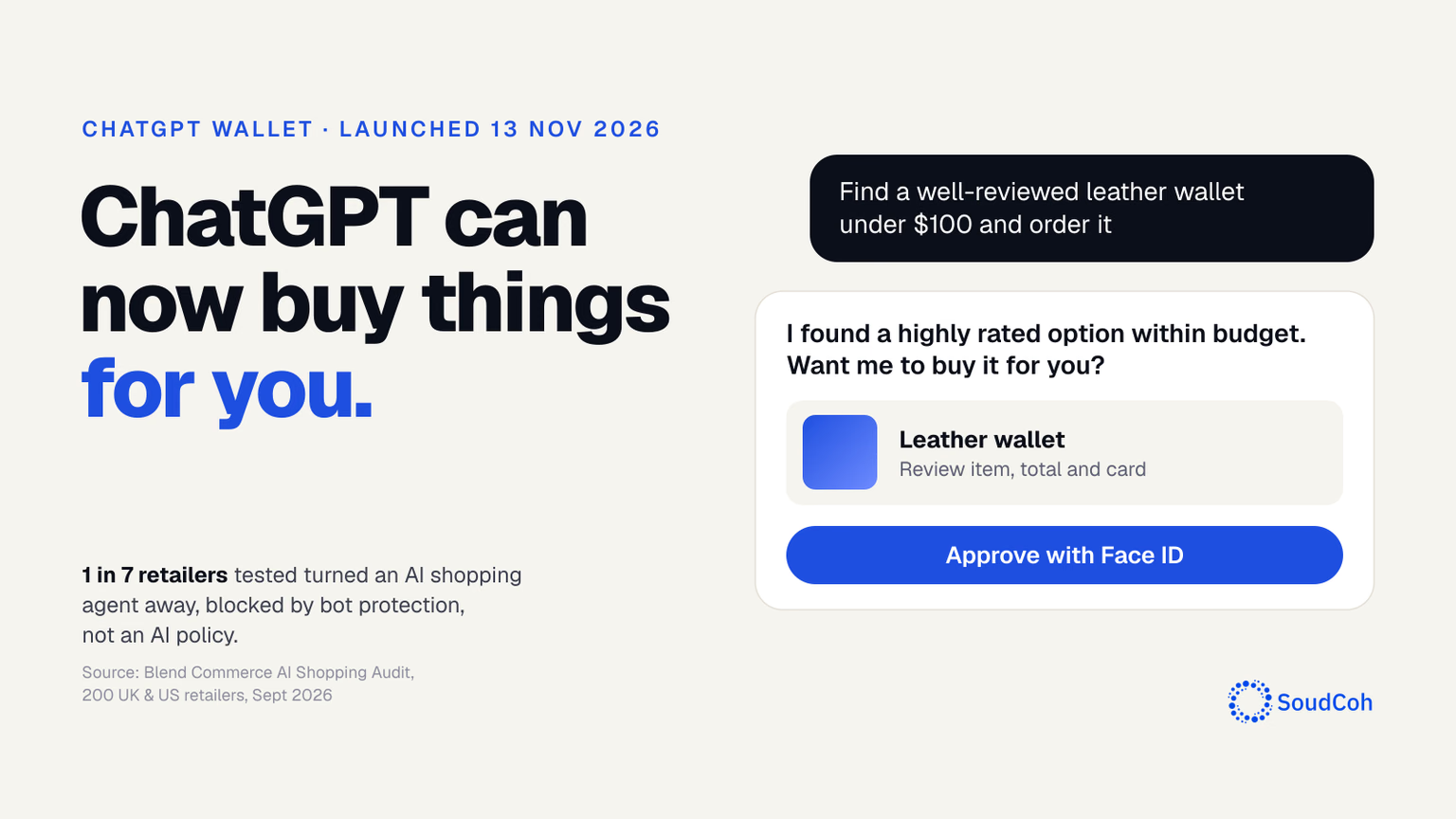
ChatGPT has taken its first real step from recommending products to buying them. On 13 November 2026, OpenAI launched ChatGPT Wallet, a feature that lets its AI agents help people decide what to buy and then complete the purchase for them.
How ChatGPT Wallet works
OpenAI's agents, called "dots", help a shopper compare options and choose a product. When it's time to buy, ChatGPT completes the checkout with a card the shopper has saved in their Wallet.
OpenAI has built in several safeguards:
- The shopper stays in control. They review the items, the total and the card before checkout.
- Every purchase is approved with a security check such as Face ID or a fingerprint.
- The real card number is never shared. ChatGPT pays with a payment token, so neither the agent nor the store sees the card details.
- Card benefits still apply. Shoppers keep their credit card rewards and protections, such as the right to dispute a transaction.
Where it's starting
OpenAI is launching ChatGPT Wallet with a limited rollout in the US, for ChatGPT Pro subscribers aged 18 and over with a US-issued Visa, Mastercard or American Express. OpenAI says the limited launch is to test and improve the feature before rolling it out more broadly.
It also plans to add more controls, such as spending limits and rules for purchase categories, so shoppers can pre-approve purchases their agent can then handle on its own.
Not every business is on board
This is the checkout side of "agentic commerce": AI that doesn't just suggest a product, but completes the sale. Businesses are responding in different ways:
- Amazon is the largest retailer to ban AI agents, steering shoppers to its own assistant, Alexa, instead.
- United Airlines announced on 11 November that it will block unauthorised third-party AI agents from booking flights. Agents can still show United flights and fares, but the customer has to complete the booking.
- DoorDash and Uber have so far reported low numbers of orders placed by AI agents.
To help retailers that do want to support agent shoppers, OpenAI has published a Commerce Partner Playbook with tools and guidance.
What matters is that you choose, rather than blocking them by accident.
Some businesses are blocking AI agents without knowing it
In September, Blend Commerce sent an AI shopping agent to 200 UK and US retailers. 29 of them, about one in seven, turned the agent away.
For 24 of those 29, Blend could read the robots.txt file, and every one of them allowed the search crawlers from ChatGPT, Perplexity and Claude. The refusals came from bot protection software, not from a policy against AI. Blend concluded that better product data and a review of bot-protection settings would close the largest gaps.
What businesses can do now
- Claim your business in ChatGPT. OpenAI's new Business Hub, in beta since 10 November, lets verified businesses update their details and see how often ChatGPT mentions them, how many people click through to their website, and the topics behind those mentions. OpenAI says ChatGPT is used by 1.2 billion people each week.
- Make your products and services easy to read. Clear names, prices, availability and descriptions help AI agents understand what you offer.
- Check your bot protection, not just robots.txt. Ask whoever manages your website security which AI agents are allowed through. Microsoft Clarity, which is free, now shows which AI agents visit a site and whether they can complete tasks like checkout.
- Make it a deliberate decision. Some businesses, like Amazon and United, choose not to let agents complete purchases. What matters is that you choose, rather than blocking them by accident.
Getting your business information and website ready now means you won't be catching up later.
Where this is heading
AI assistants are moving from "here are some options" to "want me to buy this one for you?" ChatGPT Wallet is starting small, and OpenAI plans to expand it. Getting your business information and website ready now means you won't be catching up later.
Common questions about ChatGPT Wallet
How does ChatGPT Wallet work?
OpenAI's agents, called "dots", help a shopper compare options and choose a product. When it's time to buy, ChatGPT completes the checkout with a card the shopper has saved in their Wallet.
Who can use ChatGPT Wallet?
OpenAI is launching ChatGPT Wallet with a limited rollout in the US, for ChatGPT Pro subscribers aged 18 and over with a US-issued Visa, Mastercard or American Express.
Does the store see the shopper's card number?
The real card number is never shared. ChatGPT pays with a payment token, so neither the agent nor the store sees the card details.
Why might AI shopping agents be blocked from my website?
In Blend Commerce's test of 200 UK and US retailers, the refusals came from bot protection software, not from a policy against AI. Ask whoever manages your website security which AI agents are allowed through.
Questions and answers
Is ChatGPT Wallet available outside the US?
OpenAI is launching ChatGPT Wallet with a limited rollout in the US. OpenAI says the limited launch is to test and improve the feature before rolling it out more broadly.
Can a business choose not to let AI agents buy from it?
Some businesses, like Amazon and United, choose not to let agents complete purchases. What matters is that you choose, rather than blocking them by accident.